

Plan F and Plan G are the same Medigap plan with one difference: Plan F pays your yearly Medicare Part B deductible, and Plan G does not. If you became eligible for Medicare on or after January 1, 2020, Plan F is not available to you, so Plan G is the most complete Medigap plan you can buy. If you were eligible before that date, you may still be able to choose between them, and the choice comes down to whether a higher monthly premium for Plan F is worth avoiding one small deductible each year.
This guide explains what each plan covers, who can still enroll in Plan F, how the costs compare, and how to decide. Our agents in Charlotte walk people through this exact decision every day.
TL;DR
- Plan F and Plan G cover the same benefits. The only gap is the Part B deductible, which Plan F pays and Plan G leaves to you ($283 in 2026).
- Plan F is closed to anyone who became eligible for Medicare on or after January 1, 2020. Those people can buy Plan G instead.
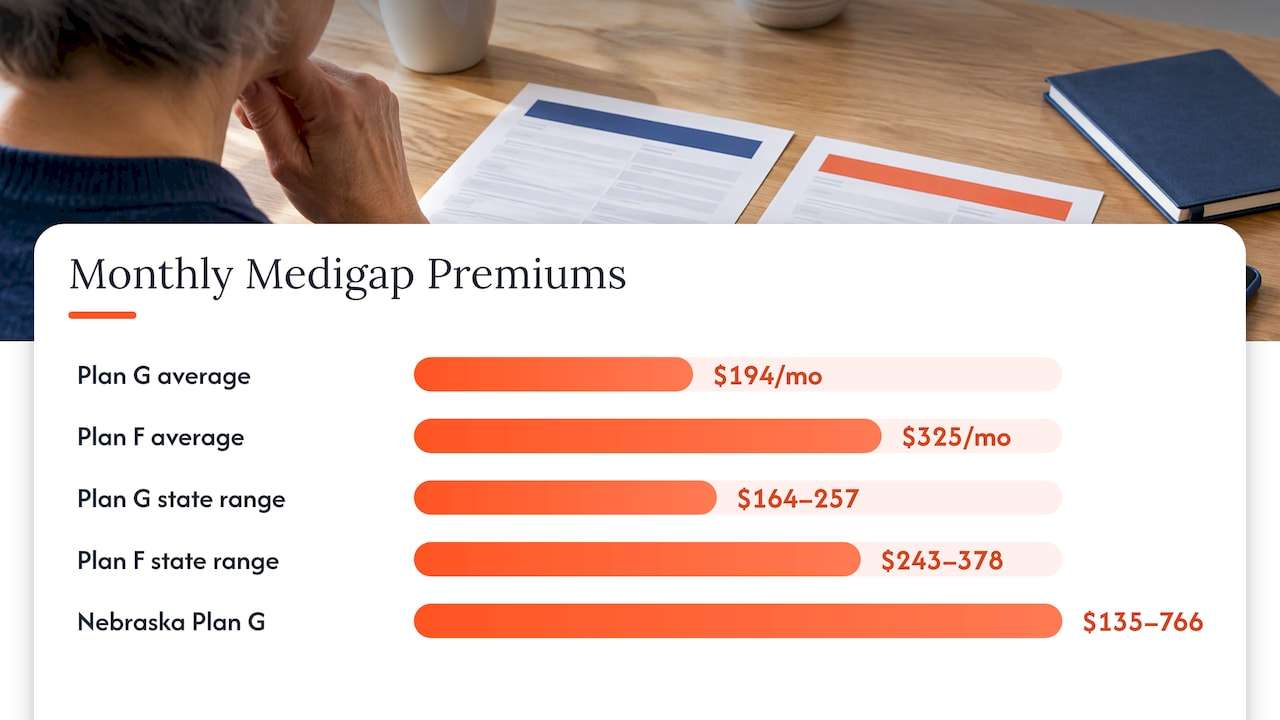
- In 2025, the average premium among current policyholders was $194 a month for Plan G and $325 for Plan F, according to KFF.
- Because Plan G’s premium is typically lower, the Part B deductible is usually the smaller cost, but your state, age and insurer set the real numbers.
- Your Medigap open enrollment window is six months and happens once. Missing it can mean health questions and possible denial.
Table of Contents
- What Plan F and Plan G both cover
- Can you still buy Plan F?
- What each plan costs
- A worked example: the Part B deductible versus the premium gap
- High-deductible versions
- When you can buy, and when insurers can say no
- How to choose between Plan F and Plan G
- Where we come in
- Our view: pick the plan for the next ten years, not this one
- FAQ
- Sources
What Plan F and Plan G both cover
Medigap (Medicare Supplement Insurance) is private insurance that pays part of the costs Original Medicare leaves behind, such as deductibles, coinsurance and copayments. Medigap plans are labeled with letters, and Medicare.gov’s benefit comparison shows that Plan F and Plan G pay for all of the following:
- The Part A deductible
- Part A coinsurance and hospital costs for up to an additional 365 days after Medicare benefits are used up
- Part B coinsurance or copayments
- The first three pints of blood
- Part A hospice care coinsurance
- Skilled nursing facility coinsurance
- Part B excess charges (what some providers bill above the Medicare-approved amount)
- 80% of emergency care costs during foreign travel
The one line where they differ is the Part B deductible. Plan F covers it. Plan G does not. Everything else is identical.
Two more points help you read the comparison correctly. First, Medicare.gov explains that every Medigap policy with the same letter offers the same basic benefits no matter which company sells it or where you live. A Plan G from one insurer pays exactly what a Plan G from another insurer pays, and price is the real difference. Second, Medigap generally does not cover long-term care, routine vision, dental or hearing aids. Those needs are handled with separate coverage, such as the dental, vision and hearing plans we help clients choose.
Can you still buy Plan F?
It depends on when you became eligible for Medicare. A 2015 law ended the sale of Medigap policies that cover the Part B deductible to people new to Medicare. According to Medicare.gov:
- If you were eligible for Medicare before January 1, 2020, but are not yet enrolled, you may be able to buy Plan C or Plan F.
- If you turned 65 or first had Medicare Part A on or after January 1, 2020, you cannot buy Plan C or F. You have the right to buy Plan D or Plan G instead.
- If you already have Plan C, Plan F or high-deductible Plan F, you can keep it.
The state of Iowa’s SHIIP program spells out the definition of “newly eligible”: anyone who reaches age 65 on or after that date, or who becomes eligible through disability or end-stage renal disease on or after it.
In practice, almost everyone turning 65 in 2026 and later is in the Plan G group. Plan F is now a plan held by long-time Medicare members and a small number of people who qualified before 2020 and delayed signing up.
That also answers a common worry. Plan F still exists and is not being canceled. Current holders keep their coverage, and as long as the premium is paid, it stays in force.
What each plan costs
The premium is the main cost for both plans. KFF’s 2025 analysis of premiums among current policyholders found:
| Plan | Average monthly premium (2025) | Range across states |
|---|---|---|
| Plan G | $194 | $164 (New Mexico) to $257 (New York) |
| Plan F | $325 | $243 (Vermont) to $378 (Nebraska) |
These are averages across people who already hold the plan, not quotes. Your own price depends on your state, age, the insurer and, in many states, your gender and tobacco use. The state of Nebraska’s 2026 fact sheet shows how wide the spread can be inside one state: a Plan G for a 65-year-old there runs from $135 to $766 a month in 2026. Nebraska also notes that most of its plans are attained-age rated, meaning premiums generally rise as you get older.
Why is Plan F so much higher? KFF points to two causes. Plan F covers the Part B deductible, which adds to what the insurer pays out. And the people in each plan are different: Plan G enrolls newer, younger beneficiaries, while Plan F holds an older group, because new enrollees can no longer buy it. KFF also reports that Plan G premiums rose 13% from 2024 to 2025, compared with a 7% rise across all Medigap plans, which is a reason to review your premium every year. Our page on Medigap rate increases explains how increases work and what you can do about them.
A worked example: the Part B deductible versus the premium gap
The Part B deductible is the amount you pay for Part B services each year before Original Medicare starts paying. Medicare.gov lists it at $283 for 2026. It resets every January, and CMS adjusts it annually.
Here is the arithmetic using KFF’s 2025 averages. The gap between $325 and $194 is $131 a month, or $1,572 a year. Plan G leaves you with a single Part B deductible of $283 in 2026. On those averages, Plan F costs you roughly $1,289 more per year than Plan G, even in a year when you use enough care to meet the deductible in full.
Treat that as an illustration, not a quote. Your actual premiums for the two plans, from the same insurer in your ZIP code, are what matter. The method is simple:
- Get the monthly premium for Plan F and Plan G from the same insurer, for your age and ZIP code.
- Multiply the difference by 12.
- Compare that yearly difference to the Part B deductible.
If the premium difference is larger than the deductible, Plan G costs less overall. For most people it is. Plan F wins only if its premium happens to sit within the deductible amount of Plan G’s, which is uncommon, or if you value knowing that you will never be billed a deductible, even at a higher yearly cost.
This math covers the cases where you actually use care. If you see doctors rarely, Plan G costs you even less, since you pay the deductible only when you have Part B services.
High-deductible versions
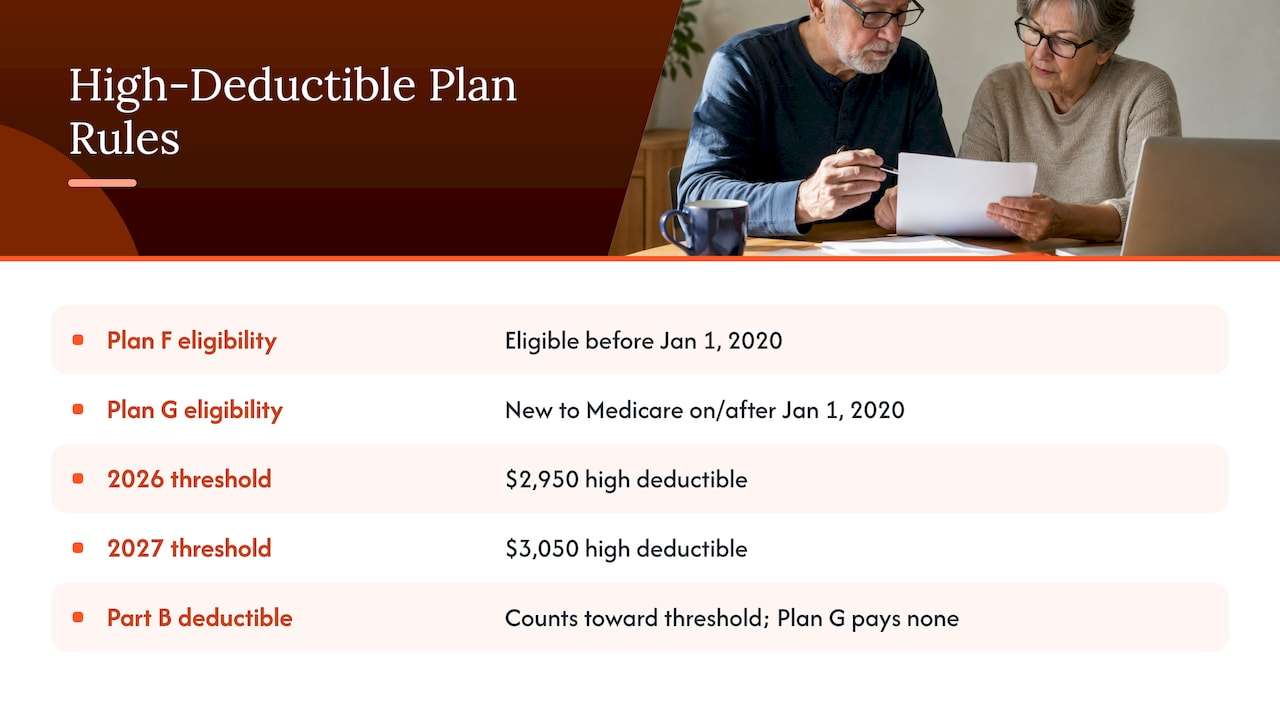
Some states also offer high-deductible Plan F and high-deductible Plan G. These carry much lower premiums, but you pay all Medicare-covered costs yourself until you reach a set amount. That amount is $2,950 in 2026, and CMS has announced $3,050 for 2027. CMS updates it each year using the consumer price index.
Eligibility follows the same dividing line. CMS says high-deductible Plan F is available only to people eligible for Medicare before January 1, 2020, and high-deductible Plan G is available to people new to Medicare on or after that date.
One detail trips people up. The Part B deductible you pay counts toward the high deductible, but high-deductible Plan G never pays any portion of the Part B deductible itself. Once the high deductible is met, the plan pays all remaining Medicare cost-sharing for the rest of the year. Nebraska’s fact sheet lists high-deductible Plan G at $38 to $75 a month in 2026. This option suits people who want the protection of a full Medigap plan against a large hospital bill and are comfortable setting aside money for the deductible.
When you can buy, and when insurers can say no
Which plan you buy matters less than when you apply. Your Medigap open enrollment period lasts six months. Medicare.gov explains that it starts once you sign up for Part B and are 65 or older, and it happens once. During it, insurers cannot deny you coverage because of your health. Our guide to the six-month open enrollment window shows how to time it.
After that window, the rules change in most cases. Washington State’s insurance commissioner training workbook notes that outside protected periods, insurers may use medical underwriting, and may apply a pre-existing condition waiting period of up to 90 days. Guaranteed-issue rights can still apply after certain coverage losses, for example when a Medicare Advantage plan is discontinued or you move out of its area, and these rights usually last up to 63 days. We cover the details in our pages on guaranteed issue rights and pre-existing conditions and Medigap. Rules for North Carolina applicants are in our guide to Medigap underwriting in North Carolina.
For a reader deciding between F and G, the takeaway is practical. If you are eligible for both, applying during open enrollment gives you the widest choice at the best chance of approval. If you wait and develop a health condition, switching later may not be possible.
How to choose between Plan F and Plan G
Start with your eligibility. If you became eligible on or after January 1, 2020, your decision is Plan G versus Plan N, or Plan G versus a Medicare Advantage plan. Our Plan G versus Plan N guide for Charlotte covers the first comparison, and Medicare Advantage versus Medigap covers the second.
If you are eligible for both F and G, work through these questions:
- What is the premium difference for your age and ZIP code? Multiply by 12 and compare it to the Part B deductible.
- How predictable do you want your costs to be? Plan F means no Medicare cost-sharing bills at all. Plan G means one known amount per year.
- Do you expect your premium to rise? Under attained-age rating, premiums climb as you age, so look at how each insurer has raised rates, not only at today’s price.
- Do you travel abroad? Both plans pay 80% of emergency care abroad, so this does not separate them.
- Do you want to keep your doctors without network rules? Both Medigap plans work with any provider who accepts Medicare, which is a core reason people choose Medigap over an HMO-style plan.
For anyone who already has Plan F, the decision is whether to keep it. Because you cannot buy it again once you leave, think carefully before changing. If your premium has risen sharply, ask for a quote on Plan G and compare the yearly numbers using the method above. Remember that a switch may involve health questions, depending on your state and timing.
A wider look at what you will pay across Medicare is in our guide to Medicare costs in 2026.
Where we come in
Comparing Plan F and Plan G across insurers is the part most people find tedious, because every insurer prices the same benefits differently. We are a Medicare agency in Charlotte, North Carolina, and we help clients compare Medicare Supplement plans, Medicare Advantage, Part D prescription drug coverage, and dental, vision and hearing plans. We offer personalized consultations and a free Medicare roadmap that lays out your options and eligibility, and our guidance comes at no extra cost to you.
If you are turning 65, approaching the end of employer coverage, or looking at a premium increase on your current plan, start with our Medicare Supplement plans in Charlotte page, or see our side-by-side plan comparison.

We also review plans with clients each year, which matters because Medigap premiums change and your needs do too.
Our view: pick the plan for the next ten years, not this one
Most people who ask us about Plan F and Plan G are really asking one question: will I regret not having the deductible covered? In our experience of how this decision is built, the honest answer for people eligible for both is that Plan G delivers the same protection with a lower premium, and you take on one known, capped expense each year.
What we care about more than the letter is the long game. A Medigap policy is something you carry for decades, and the insurer’s rate history, its approach to increases and the timing of your enrollment matter as much as the benefits chart. That is why our agents go through a full training program and why we sit down with clients before recommending anything. We want you to understand the plan you are buying, not just sign for it.
If you are new to Medicare, Plan G is the plan to measure everything else against. If you already hold Plan F, we will help you work out whether keeping it still makes sense, with the numbers from your own policy. And we come back every year for a plan review, so you are never left alone with a rate letter.
Zach
FAQ
Is Plan F still available?
Yes, but only to some people. If you were eligible for Medicare before January 1, 2020, you may be able to buy Plan F. If you became eligible on or after that date, you cannot, and Plan G is the closest option. Anyone who already has Plan F can keep it.
What is the difference between Plan F and Plan G?
The only difference is the Part B deductible. Plan F pays it, and Plan G does not. In 2026 that deductible is $283. Every other benefit, from Part A coinsurance to excess charges, is the same in both plans.
Is Plan G cheaper than Plan F?
Usually, yes. KFF’s 2025 figures show an average monthly premium of $194 for Plan G and $325 for Plan F among current policyholders. Your own quote will vary by state, age and insurer, so compare both from the same company before deciding.
Do I need medical underwriting to get Plan G?
Not if you apply during your six-month Medigap open enrollment period, which starts when you have Part B and are 65 or older. Outside that period, or a guaranteed-issue window, insurers in many cases can ask health questions and may decline coverage.
Sources
- Compare Medigap Plan Benefits, Medicare.gov
- Getting Started with Medicare Supplement Insurance, Medicare.gov (March 2026)
- Medicare Supplement Changes in 2020, Iowa SHIIP
- Key Facts About Medigap Enrollment and Premiums, KFF
- Medicare Supplement Fact Sheet 2026, Nebraska Department of Insurance
- F, G & J Deductible Announcements, CMS
- When can I buy a Medigap policy?, Medicare.gov
- SHIBA June 2026 Medigap workbook, Washington Office of the Insurance Commissioner
Recommended
Request a No Obligation Phone Call








Get Connected