

The difference comes down to what each program pays. The Qualified Medicare Beneficiary (QMB) program pays your Medicare premiums and also your deductibles, coinsurance and copayments. The Specified Low-Income Medicare Beneficiary (SLMB) program pays only your Part B premium. Both are state Medicaid programs, both are run through your state, and you can’t buy either one. What you can do is pick the right coverage around them, and that choice decides how much you pay out of pocket.
TL;DR
- QMB covers Part A premiums (if you owe one), Part B premiums, deductibles, coinsurance and copayments. SLMB covers the Part B premium only.
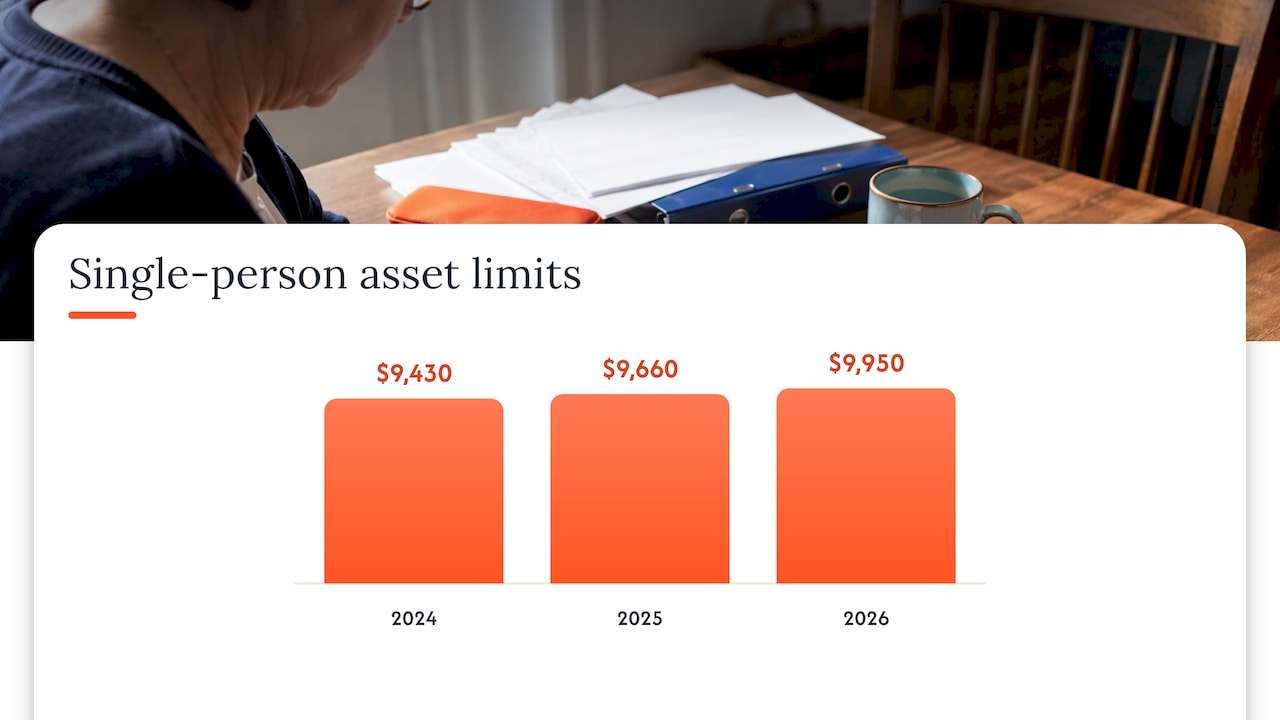
- In 2026 the federal monthly income limits are $1,350 (single) and $1,824 (couple) for QMB, and $1,616 (single) and $2,184 (couple) for SLMB. The asset limits are the same for both: $9,950 single, $14,910 couple.
- Both programs automatically qualify you for Extra Help with Part D drug costs.
- States can set higher limits than the federal minimum, so you may qualify even if your numbers are a little over.
- You apply through your state Medicaid office. A Medicare agent can help you choose the coverage that sits on top of the program.
Table of Contents
- QMB vs. SLMB at a glance
- What QMB pays for
- What SLMB pays for
- 2026 income and asset limits
- A worked example
- How QMB and SLMB compare with QI and QDWI
- What changed recently
- Extra Help comes with both programs
- How to apply
- What covers the gaps
- Hospital indemnity vs. critical illness insurance
- Perspective: the program is the floor, the plan is the choice
- Get a roadmap for the coverage around your program
- FAQ
- Sources
QMB vs. SLMB at a glance
| QMB | SLMB | |
|---|---|---|
| Part A premium | Paid, if you owe one | Not paid |
| Part B premium | Paid | Paid |
| Deductibles, coinsurance, copays | Paid | Not paid |
| 2026 monthly income limit (single / couple) | $1,350 / $1,824 | $1,616 / $2,184 |
| 2026 asset limit (single / couple) | $9,950 / $14,910 | $9,950 / $14,910 |
| Extra Help with Part D | Automatic | Automatic |
The benefits come from the Medicare.gov Medicare Savings Programs page. The limits come from the Social Security Administration’s 2026 program guidance, dated February 26, 2026. These figures apply to every state except Alaska and Hawaii, which have higher limits.
QMB is the broader benefit and has the lower income ceiling. SLMB reaches people with slightly higher income but gives them one benefit.
What QMB pays for
QMB is the most complete help in the Medicare Savings Programs. It pays for:
- Part A premiums, if you don’t have premium-free Part A
- Part B premiums
- Deductibles, coinsurance and copayments for services and items Medicare covers
That last item is the one that matters at the doctor’s office. A national consumer group’s 2026 coverage chart lists what QMB can absorb in 2026:
- the Part A hospital deductible of $1,736 per benefit period
- hospital copays of $434 a day for days 61 to 90 and $868 a day for days 91 to 150
- skilled nursing facility copays of $217 a day for days 21 to 100
- the Part B deductible of $283
- the Part B premium of $202.90 a month
- the 20% Part B coinsurance
QMB also comes with a billing protection. Federal law bars Medicare providers and suppliers, pharmacies included, from billing people in the QMB group for Medicare cost sharing. CMS says Medicare and Medicaid payments together count as payment in full, and providers who bill above that can be sanctioned. You may still see a small Medicaid copayment if your state charges one.
That protection applies to all kinds of care. A rehab stay is one example. If you want to see how the parts of Medicare split the cost of that care, Medicare rehab coverage by Part A, B and D walks through it. With QMB, the cost-sharing share of those bills is paid by Medicaid, not by you.
What SLMB pays for
SLMB pays the monthly Part B premium and nothing else. You need both Part A and Part B to qualify. At the 2026 standard premium of $202.90, that is about $2,435 a year that stops coming out of your Social Security check ($202.90 times 12 is $2,434.80).
SLMB does not pay deductibles, coinsurance or copays. A hospital stay or a run of specialist visits still produces bills you owe. KFF’s state data confirms that Medicaid pays the Part B premium for SLMB enrollees but does not cover other cost sharing.
That gap is where your other coverage choice comes in. More on that below.
2026 income and asset limits
QMB is for people whose income is at or below 100% of the federal poverty level. SLMB covers the band from 100% to 120%. The dollar figures are the ones in the table above. A few points make them easier to apply to your own situation.
The limits are monthly and updated every year. The poverty-level figures change each year, and the asset limits follow inflation. The asset limit was $9,430 for a single person in 2024, then $9,660 in 2025, and it is $9,950 in 2026. A CMS bulletin from December 2025 sets the 2026 resource standards at $9,950 and $14,910. Expect new numbers to take effect in early 2027, and check the current table before you decide you’re over a limit.
Not everything you own counts. Countable resources include money in checking or savings accounts, stocks and bonds. Your home, one car, a burial plot, up to $1,500 set aside for burial costs, furniture and other household and personal items don’t count.
Not all income counts either. KFF reports that every state except Alaska, Connecticut and Missouri allows at least a $20 disregard of unearned income. That means a person with $1,630 in Social Security may be counted at $1,610 and fall under the SLMB limit.
Your state may be more generous. Medicare.gov says you may still qualify even if your income or resources are higher than the listed limits, because some states count less or set higher limits. Some states have used this authority to effectively eliminate the asset test, according to the SSA guidance. Several states and the District of Columbia go beyond the federal minimum for income, so a quick check with your state is worth it before you rule yourself out. Program names also vary by state: Oregon, for example, calls SLMB “SMB,” according to the 2026 coverage chart.
If you want a quick read on where you stand before you contact the state, our Medicare eligibility calculator is a place to start.
A worked example
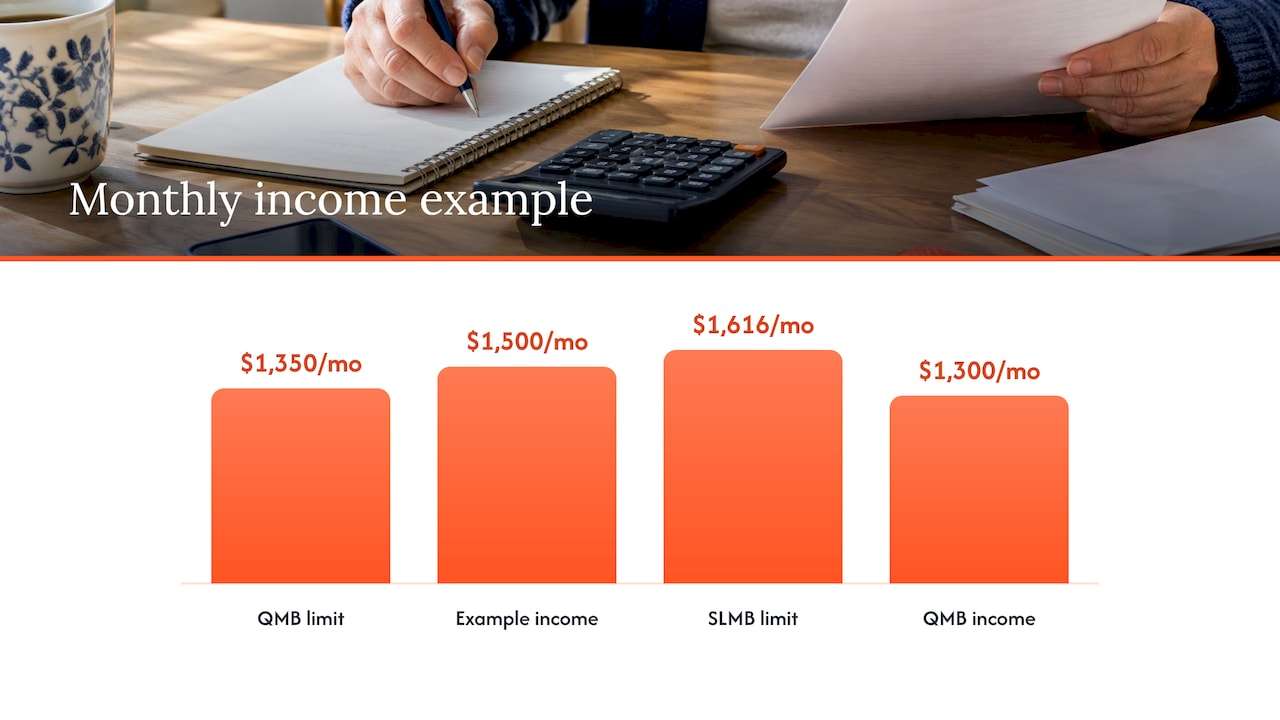
Say you’re single, 67, with $1,500 a month in Social Security and $6,000 in savings. Your car and home don’t count.
- Your income is over the $1,350 QMB limit, so you don’t qualify for QMB at the federal level (unless your state is more generous).
- It is under the $1,616 SLMB limit, and your savings are under $9,950, so you qualify for SLMB.
- SLMB pays your $202.90 Part B premium, so about $2,435 a year stays in your pocket.
- You also get Extra Help with Part D automatically.
Now change one number: your income is $1,300. You’d fall under the QMB limit. Your deductibles and copays are then covered too, and the same hospital stay that would have produced a $1,736 Part A deductible produces no bill to you.
A $50 difference in monthly income can separate a single benefit from a full one. That is why it is worth applying even if you think you’re close to a line. The state decides which level you land in.
How QMB and SLMB compare with QI and QDWI
There are four Medicare Savings Programs, and the other two are close relatives.
- QI (Qualifying Individual) pays only the Part B premium, like SLMB, for incomes from 121% to 135% of the poverty level. That is up to $1,816 single and $2,455 married in 2026. Funding is limited each year per state, according to CMS.
- QDWI (Qualified Disabled and Working Individuals) pays the Part A premium for people under 65 with a disability who lost premium-free Part A after returning to work. Its resource limit is $4,000 single and $6,000 married, and it is not adjusted annually.
If your income is just over the SLMB line, QI may be your program. You can apply for all of them at once, and the state places you.
What changed recently
Two federal changes are worth knowing. Since October 1, 2024, states have had to automatically enroll people into QMB when they are enrolled in SSI-based Medicaid and in premium-free Part A. The same rule was also meant to let applicants self-attest to certain income and asset categories without extra verification starting April 1, 2026. Ask your state office how it is handling documentation today.
The other change is the annual reset. The 2026 resource standards took effect January 1, 2026, and the next reset follows the same pattern.
Extra Help comes with both programs
If you qualify for QMB, SLMB or QI, you automatically qualify for Extra Help with Part D drug coverage. For QMB, Medicare.gov says you’ll pay no more than $12.65 in 2026 for each covered drug.
Extra Help only works if you are in a Part D plan, and the plan you pick still decides which drugs and pharmacies are covered. Our guides to Medicare Extra Help and Part D prescription drug plans explain how the pieces fit. If you go without drug coverage for too long, a late penalty can follow, and you can estimate it with the Part D penalty calculator.
How to apply
- Gather your documents. Have your Medicare card, proof of income (Social Security award letter, pension statements) and recent bank statements.
- Contact your state Medicaid office. The state makes the decision. Medicare.gov says you can apply by calling your State Medical Assistance (Medicaid) office or filling out an application. Call 1-800-MEDICARE for the office’s contact information.
- Ask to be considered for every program. Request QMB, SLMB and QI so the state places you at the highest level you qualify for.
- Watch your Social Security check. When the state starts paying your Part B premium, the deduction stops. If the state asks for more information, answer quickly so your start date isn’t delayed.
- Review your coverage. Once you know which program you’re in, look at what sits on top of it.
The state office is the authority for this step, and we can’t enroll you in the program. We can help you work out the rest of your coverage, as described below.
What covers the gaps
If you’re on SLMB or QI, you still owe deductibles and the 20% Part B coinsurance. Original Medicare also has no annual cap on what you pay. The coverage you choose decides how much of that risk lands on you.
There are two main routes. A Medicare Supplement (Medigap) plan pays much of what Original Medicare leaves. A Medicare Advantage plan replaces Original Medicare with a single plan that has its own cost structure. Our guide to Medicare Advantage vs. Medigap compares them, and our Original Medicare out-of-pocket estimate shows what the gaps can add up to. To see how your costs add up, try the Part A and Part B premium calculator.
If you are in QMB, the program already covers your cost sharing, so the plan you pick matters more for extras like drug coverage, dental, vision and hearing. Original Medicare doesn’t cover most routine dental, vision or hearing care, and our guide to Medicare dental, vision and hearing options lays out how to add it.
Hospital indemnity vs. critical illness insurance
Readers on a tight budget often ask about these two supplemental products. Both pay you cash instead of paying a provider, but they trigger differently.
- Hospital indemnity pays when you are admitted to the hospital. The payment is usually a set amount for the admission, a set amount per day of the stay, or both.
- Critical illness insurance pays a lump sum when you are diagnosed with a covered condition, such as a heart attack or stroke. It is tied to the diagnosis, not a hospital stay.
In both cases you can spend the money however you like: a deductible, rent, a caregiver or a flight to see family. Policies differ on waiting periods and pre-existing condition rules, so read those terms before you compare prices.
For people on Medicare, the hospital-stay trigger lines up with the big Original Medicare bill, the $1,736 Part A deductible. If you want to see how it works alongside your coverage, read our guide to hospital indemnity vs. Medicare or our hospital indemnity insurance page.
Perspective: the program is the floor, the plan is the choice
Most of the people who come to us with a question about QMB or SLMB are really asking two things. First, “Can the state pay for part of this?” Second, “What do I do about everything it doesn’t pay?” The first answer comes from the state. The second is where we spend our time.
Our agents go through a full training program, and that training is built around education first. Our job is to explain, in plain words, what each option does, so that you can decide for yourself. That advice comes at no extra cost to you.
What we see as the biggest mistake is treating the Medicare Savings Program as the end of the conversation. SLMB pays your Part B premium and that is a real help. It also leaves deductibles and coinsurance on your plate. QMB takes care of cost sharing, but it doesn’t choose a drug plan, add dental or vision, or tell you whether your doctors are in network.
We start with a free Medicare roadmap, built around your eligibility, your doctors and your prescriptions. We review your plan every year, because the programs, the limits and the plans all change. Your first question to any adviser should be “What happens to my costs if my situation changes?”
Zach
Get a roadmap for the coverage around your program
If you’re in Charlotte or elsewhere in North Carolina and want help sorting out Medicare Advantage, Medicare Supplement, Part D and dental, vision and hearing coverage next to a Medicare Savings Program, Safeguard Benefit Services can help. We start with a personalized consultation and a free Medicare roadmap that explains your eligibility and your options. We also help you avoid enrollment penalties and coverage delays, and we review your plan with you each year.

If you’re still working out when and how to sign up, our guide to free help with Medicare enrollment is a good first read.
FAQ
Can I have QMB or SLMB and a Medigap or Medicare Advantage plan?
Yes. The Medicare Savings Programs pay Medicare costs, and your Medigap or Medicare Advantage plan is separate coverage you choose. Which plan fits depends on your doctors, prescriptions and budget. Our Medicare Advantage vs. Medicare Supplement guide is a good place to compare them.
What does QMB not cover?
QMB pays your Medicare premiums and Medicare cost sharing, but it applies to services and items Medicare covers. It doesn’t pay for things Original Medicare leaves out, such as most routine dental, vision and hearing care. You may also get a bill for a small Medicaid copayment if your state charges one, according to Medicare.gov.
Is SLMB the same as full Medicaid?
No. Standard SLMB pays only the Part B premium. It is not full Medicaid, and it doesn’t cover cost sharing or other Medicaid services. Some states run their programs differently, so ask your state office what yours offers.
What is the QMB income limit for 2026?
The federal limit is $1,350 a month for an individual and $1,824 for a married couple in most states. Alaska is $1,683 and $2,275, and Hawaii is $1,550 and $2,095, according to the SSA guidance. Your state may count your income differently or set a higher limit.
If I’m over the limit, should I still apply?
Yes. Income disregards, excluded assets and state-specific limits can bring you under the line, and you may qualify for a different program level such as SLMB or QI. The state can tell you only after you apply.
Sources
- Medicare Savings Programs, Medicare.gov
- SSA POMS HI 00815.023, Medicare Savings Programs income and resource limits
- Get help with your Medicare costs, Medicare.gov
- Saving on health care costs, Medicare.gov
- Qualified Medicare Beneficiary Program Group, CMS
- MLN909330, Medicare and Medicaid Basics, CMS
- CMCS Informational Bulletin, January 2026 SSI and spousal impoverishment standards
- Texas HHS Q-1300, MSP Resource Limits
- KFF, Eligibility for Medicare Savings Programs for SLMBs
- 2026 Medicare Savings Programs Eligibility and Coverage chart, NCOA
Recommended
Request a No Obligation Phone Call








Get Connected