

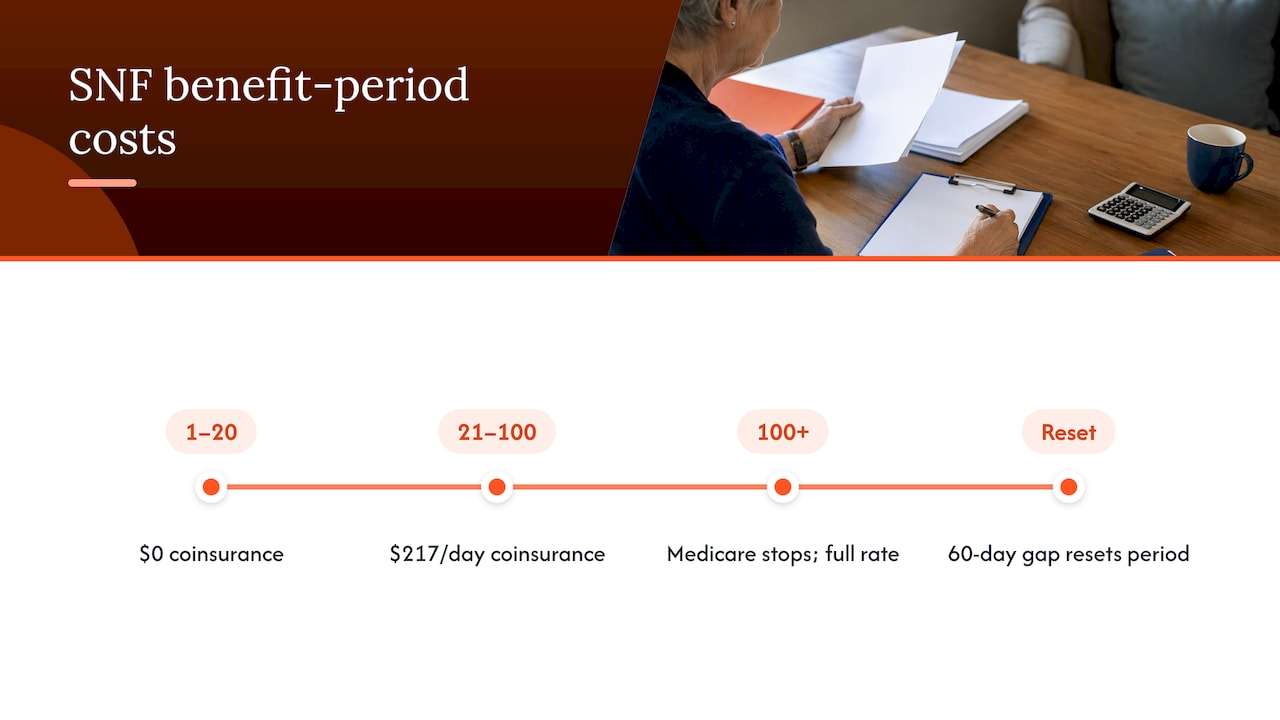
Medicare Part A does cover skilled nursing facility care, but only for a limited, short-term window and only when specific conditions are met. You generally need a qualifying 3-day inpatient hospital stay first, and coverage tops out at 100 days per benefit period, with $0 coinsurance for days 1 through 20 and $217 per day for days 21 through 100 in 2026.
TL;DR:
- Observation stays do not satisfy the qualifying hospital requirement; confirm formal inpatient status, because Medicare counts admission day but not discharge day.
- The facility must participate in Medicare and provide skilled care ordered by a physician; help with bathing, dressing, meals, or mobility alone is not covered.
- A benefit period resets only after 60 consecutive days without inpatient hospital or skilled nursing care; days 21 through 100 cost $217 daily in 2026.
- Medicare Advantage plans may waive the three day rule, but network restrictions and prior authorization still apply; confirm both with your plan before transfer.
- If a facility issues a noncoverage notice, request a Medicare claim and promptly file a fast appeal with your state Quality Improvement Organization.
Table of Contents
- What Medicare pays for during a covered SNF stay
- Eligibility checklist before you enter a skilled nursing facility
- How benefit periods and the 100-day limit affect your costs
- Medicare Advantage differences you need to check before you transfer
- What to do when a facility says Medicare will stop paying
- Paying for care once your Part A SNF benefit runs out
- Step-by-step: qualifying for SNF coverage with the right documentation
- How your hospital diagnosis affects skilled nursing eligibility
- A look at how coverage plays out in practice
- Enrollment timing and penalties that can affect SNF coverage
- Coordinating Medicare with other insurance you hold
- What we’ve seen help families avoid coverage surprises
- Get help confirming your Medicare skilled nursing coverage
- FAQ
- Sources
What Medicare pays for during a covered SNF stay
When you qualify for Medicare skilled nursing facility coverage, Part A pays for a defined set of services tied to your recovery, not everyday personal care. The goal is medically necessary, short-term treatment that helps you regain function after a hospitalization, delivered in a facility that meets Medicare’s certification standards.
A covered stay typically includes:
- A semi-private room and meals, including special diets your condition requires
- Skilled nursing care provided by licensed staff, not aides performing routine assistance
- Physical, occupational, and speech-language therapy ordered by your doctor
- Medical social services to help coordinate your care and discharge plan
- Medications, medical supplies, and equipment used during your stay
- Ambulance transportation when medically necessary
- Dietary counseling related to your treatment
The distinction that trips up most families is skilled care versus custodial care. Skilled care means treatment that requires a nurse or therapist, such as wound management, IV medication, or rehabilitation after a stroke. Custodial care means help with bathing, dressing, eating, or getting around, and Medicare does not cover it as a standalone long-term service. If your only need is daily living assistance, Part A will not pay for the stay, regardless of how long you remain in the facility.
One more requirement matters as much as the type of care: the facility itself must be Medicare-certified, and a physician must order the inpatient skilled services. A nursing home that isn’t certified, or care that isn’t physician-ordered, falls outside Part A coverage no matter how skilled the staff.
Eligibility checklist before you enter a skilled nursing facility
Qualifying for Medicare’s skilled nursing facility benefit depends on timing and documentation as much as medical need. Walk through these steps before admission so you aren’t caught off guard by a denied claim.
- Confirm a 3-consecutive-day inpatient hospital stay. Medicare counts your admission day but not your discharge day, and observation status doesn’t count toward this requirement, so ask the hospital directly whether you were formally admitted as an inpatient.
- Enter the SNF within the required window, typically around 30 days of hospital discharge. Waiting longer can break the connection between your hospital stay and your need for skilled care.
- Verify the facility is Medicare-certified. Ask the admissions office directly or confirm through your hospital discharge planner.
- Check whether your plan waives the 3-day rule. Some Accountable Care Organizations and many Medicare Advantage plans waive this requirement, so call your plan before assuming you don’t qualify.
- Confirm medical necessity. You need daily skilled nursing or therapy that can only be safely delivered in a facility setting, backed by physician orders, not just a preference for supervised recovery.
Missing any one of these conditions is the most common reason families later discover a stay wasn’t covered, so confirm each item before, not after, admission.
How benefit periods and the 100-day limit affect your costs
A Medicare benefit period starts the day you’re admitted as a hospital inpatient or begin SNF care, and it doesn’t end until you’ve gone 60 consecutive days without receiving inpatient hospital or skilled nursing care. This 60-day rule, not the calendar year, determines when your SNF days reset. If you’re readmitted before that 60-day gap closes, you’re still in the same benefit period, drawing down the same pool of days.
You get up to 100 days of SNF coverage per benefit period, and the cost split is fixed for 2026. Days 1 through 20 cost you $0 in coinsurance, Medicare pays in full. Days 21 through 100 carry a coinsurance of $217 per day, which adds up fast: a stretch of days in that range can add up quickly if you have no supplemental coverage. After day 100, Medicare stops paying entirely for that benefit period, and you’re responsible for the full daily rate.
If your SNF stay follows a hospitalization, you’ll also have already paid the Part A inpatient hospital deductible for that benefit period, a separate charge from the SNF coinsurance. Beyond the core daily rate, facilities often bill separately for items Medicare doesn’t cover at all, phone service, television, and personal laundry are common examples, so ask for an itemized list of non-covered charges at admission.
Medicare Advantage differences you need to check before you transfer
If you’re enrolled in a Medicare Advantage plan rather than Original Medicare, the baseline coverage rules still apply, your plan must cover at least as many SNF days as Original Medicare does. How you access that coverage, though, often looks very different.
- Most Medicare Advantage plans use provider networks, meaning your preferred SNF may not be covered at all if it’s out of network.
- Many plans require prior authorization before admission or continued stays, and a missed authorization can mean a denied claim even for medically necessary care.
- Some plans waive the 3-day hospital stay rule, which can work in your favor, but you have to confirm it rather than assume it.
- Cost-sharing structures can differ from Original Medicare’s $0/$217 split, so your Evidence of Coverage document is the source of truth for your specific plan.
Reviewing your plan’s provider directory before a crisis happens saves real money and stress later. For a deeper walkthrough of how to confirm your plan’s network status, see our steps for confirming Medicare Advantage networks.
Pro Tip: Call both your Medicare Advantage plan and the receiving facility before transfer, and ask for written confirmation of network status and any required authorization.
What to do when a facility says Medicare will stop paying
When a skilled nursing facility believes Medicare will no longer cover your stay, it may give you a Skilled Nursing Facility Advance Beneficiary Notice of Noncoverage (SNFABN). This notice isn’t a final decision, it’s a warning that lets you choose how to proceed.
- Request that the facility submit a claim to Medicare anyway. This triggers an official coverage decision rather than leaving you to assume the facility is right.
- Watch for a Notice of Medicare Non-Coverage (NOMNC), which tells you the specific date your covered care is set to end.
- File a fast appeal with your state’s Quality Improvement Organization (QIO) right away. You may be able to remain in the facility while an independent reviewer evaluates whether ending your skilled care is appropriate.
- Contact Medicare directly or your local State Health Insurance Assistance Program (SHIP) if you need help understanding the notice or filing the appeal.
Acting quickly matters. Ask the facility or QIO how to start a fast appeal and what deadline applies, and don’t delay seeking guidance.
Paying for care once your Part A SNF benefit runs out
Medicare’s skilled nursing benefit is built for short-term rehabilitation, not open-ended custodial care, so planning for what happens after day 100, or after your treatment goals are met, prevents a financial scramble.
- Medigap policies may cover some or all of the days 21-100 coinsurance, depending on the plan you hold, which can meaningfully reduce your exposure during an extended stay.
- Medicaid can pay for long-term custodial care once you meet your state’s income and asset limits, though many people face a spend-down process to qualify.
- Private funds remain the default payer once Medicare and any supplemental coverage are exhausted.
- Long-term care insurance, where a policy is already in place, can offset custodial costs Medicare was never designed to cover.
Because Original Medicare generally does not cover custodial care as the only care needed, the earlier a family starts evaluating Medicaid eligibility or Medigap options, the fewer surprises they may face. A licensed agent or a county caseworker can walk through your specific numbers and timeline. Our overview of the role Medicare plays in long-term care planning covers how these pieces fit together in more detail.
Step-by-step: qualifying for SNF coverage with the right documentation
Getting approved for Medicare’s SNF benefit comes down to sequencing and paperwork as much as medical need. Start the process while you’re still in the hospital, not after discharge.
First, confirm your inpatient status with hospital staff in writing, since observation status, even for multiple nights, doesn’t satisfy the 3-day rule. Second, ask your discharge planner for a referral to a Medicare-certified SNF and request documentation showing your admitting diagnosis and the skilled services you’ll need, physical therapy orders, wound care instructions, or medication management notes. Third, make sure your physician’s discharge summary explicitly states the need for daily skilled nursing or therapy, since vague language is a common reason claims get questioned.
Once you arrive at the SNF, the facility’s admissions team will verify your hospital stay dates and benefit period status directly with Medicare. Keep your own copy of hospital discharge paperwork and your Medicare card accessible, and ask the facility for a written estimate of your anticipated length of stay and expected coinsurance once you pass day 20. If you’re on a Medicare Advantage plan, bring your plan’s member ID and ask the facility to confirm authorization before you’re admitted, not after.
How your hospital diagnosis affects skilled nursing eligibility
What landed you in the hospital in the first place has a direct bearing on whether your follow-up care qualifies as skilled. A hip fracture requiring surgical repair, a stroke requiring rehabilitation, or a severe infection requiring IV antibiotics typically supports a clear skilled nursing need, daily therapy or nursing tasks that genuinely require professional oversight.
By contrast, a hospital stay for a condition that resolves with observation or minor treatment, without an ongoing need for skilled intervention, often does not support SNF coverage even if the patient is elderly or weak. Medicare’s coverage decision hinges on the treatment required after discharge, not the severity of the original diagnosis alone. A patient recovering from pneumonia who still needs IV antibiotics and monitoring has a stronger case for skilled coverage than one who has fully recovered but simply needs help getting around at home.
This is why physician documentation matters so much. The discharge diagnosis and the specific skilled services ordered, not just the hospital stay itself, determine whether the SNF stay meets Medicare’s definition of medically necessary skilled care.
A look at how coverage plays out in practice
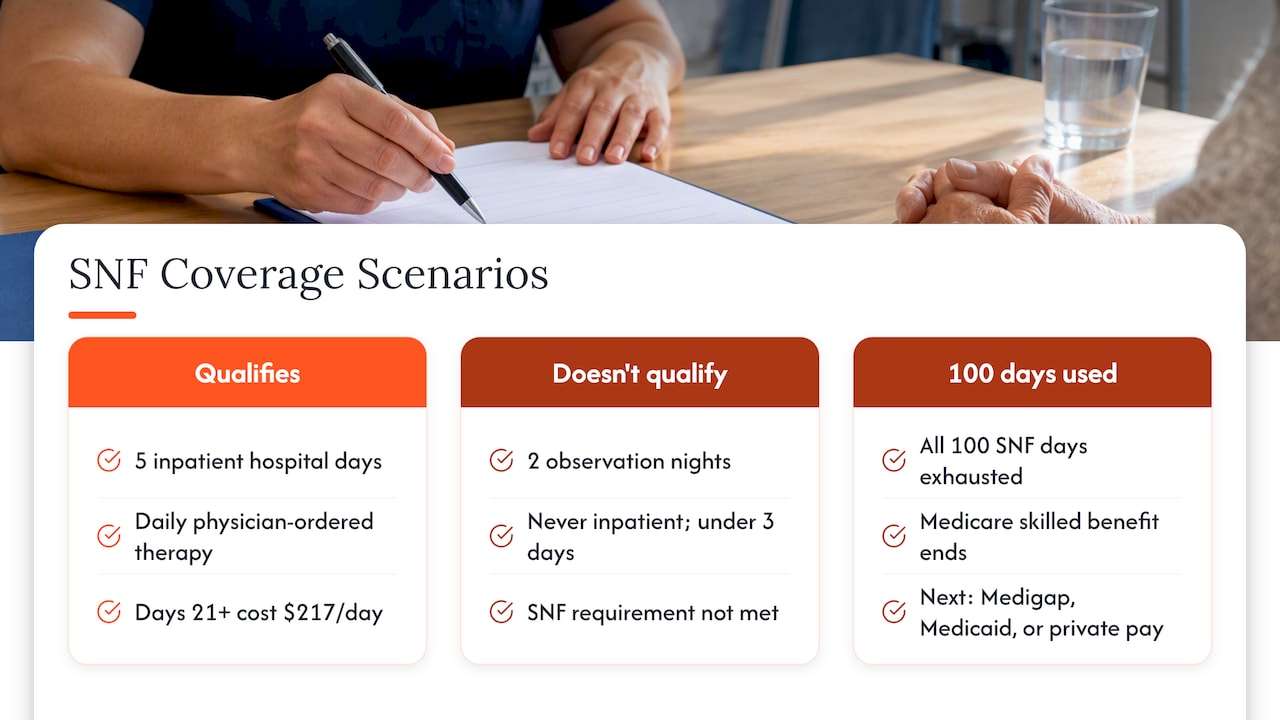
Consider a Medicare beneficiary admitted to the hospital for five days following a stroke, then transferred to a Medicare-certified SNF for physical and speech therapy. Because the hospital stay exceeded 3 inpatient days and the SNF care involves daily therapy ordered by a physician, days 1 through 20 are covered in full, and days 21 onward carry the $217 daily coinsurance if the stay continues.
Compare that with a beneficiary who spends two nights in the hospital under observation status for chest pain, then is referred to a nursing facility for general weakness. Because the hospital stay never reached inpatient status and lasted fewer than 3 days, the SNF stay would not meet Medicare’s qualifying requirement, regardless of how reasonable the request for supervised recovery might seem.
A third scenario involves a beneficiary who uses all 100 days of SNF coverage after a complex surgery, then requires ongoing custodial assistance at home. Medicare’s skilled benefit ends at day 100 for that benefit period, and the family then needs to evaluate Medigap, Medicaid, or private payment for continued support. These examples illustrate why confirming inpatient status and the specific type of care needed, early, shapes the entire coverage outcome.
Enrollment timing and penalties that can affect SNF coverage
Delaying Medicare enrollment past your initial eligibility window can create gaps that affect skilled nursing facility coverage indirectly but significantly. If you didn’t sign up for Part A or Part B when first eligible and don’t qualify for a special enrollment period, you may face a late enrollment penalty and a delay before coverage starts, leaving you without Part A protection if a hospitalization or SNF need arises during that gap.
Because SNF coverage depends entirely on having active Part A benefits and an available benefit period, anyone who delayed enrollment should confirm their current coverage start date before assuming a hospital stay will translate into SNF benefits. Beneficiaries who enrolled late and are still within a penalty period may also find premium costs higher, which affects the overall affordability of care even when SNF days themselves are covered.
If you’re approaching Medicare eligibility or unsure whether a gap in your enrollment history might affect your coverage, reviewing your enrollment record with a licensed agent before you need SNF care avoids discovering a problem during a medical crisis.
Coordinating Medicare with other insurance you hold
Many beneficiaries carry more than one source of coverage, employer retiree insurance, a Medigap policy, or Medicaid, and how these interact with Medicare determines your actual out-of-pocket cost for a SNF stay. Medicare generally pays first for beneficiaries without other primary coverage, with secondary insurance picking up some or all of the remaining coinsurance.
If you have a Medigap policy, it may cover the days 21-100 coinsurance depending on which plan letter you hold, reducing or eliminating that $217 daily charge. If you have Medicaid in addition to Medicare, Medicaid typically covers costs Medicare doesn’t, including custodial care after your Part A benefit ends, though eligibility depends on your state’s income and asset rules. Employer retiree plans vary widely in how they coordinate with Medicare, so confirming the coordination of benefits order with your specific plan administrator before a SNF admission prevents billing confusion. In every case, bringing documentation of all active coverage to the SNF admissions office ensures claims are filed correctly and in the right order from the start.
What we’ve seen help families avoid coverage surprises
The biggest misconception we encounter is the assumption that a hospital stay automatically guarantees skilled nursing coverage. It doesn’t, and the gap between what families expect and what Medicare actually pays for is where most financial stress originates. The 3-day inpatient rule, the distinction between observation and admission status, and the custodial versus skilled care line all trip up people who had no reason to know these details until they needed them.
Our view is that the real value of professional guidance isn’t explaining what Medicare covers after a denial arrives, it’s reviewing your situation before a hospitalization happens, so you already know your benefit period status, your plan’s network rules, and whether Medigap coverage would soften days 21 through 100. Call Medicare or your State Health Insurance Assistance Program for general coverage questions or a specific claim dispute. Call a licensed agent when you want help comparing Medigap or Medicare Advantage options against your actual health history and budget.
— Zach
Get help confirming your Medicare skilled nursing coverage
Understanding the rules on paper is one thing, knowing how they apply to your specific hospital stay, diagnosis, and plan is another. We work with Medicare beneficiaries to review plan documents, check facility network status, and compare Medigap options against the daily coinsurance you’d otherwise face on days 21 through 100.

A consultation with our team can help clarify your options before a medical crisis forces a rushed decision.
- Bring your current Medicare card, any Medicare Advantage or Medigap policy documents, and recent hospital discharge paperwork if you have an upcoming or recent stay.
- We’ll review your plan’s network rules and prior authorization requirements against the facility you’re considering.
- We’ll walk through whether a Medigap policy makes sense for your situation, including how it would offset SNF coinsurance.
Visit our Medicare Advantage and Medigap overview to see the plan types we help clients compare, or schedule a consultation directly with our team to get a personalized Medicare roadmap.
This article is general information, not a substitute for advice from a qualified doctor. Consult a qualified healthcare professional about your own circumstances before acting on anything here.
FAQ
What part of Medicare pays for a skilled nursing facility?
Medicare Part A pays for skilled nursing facility care, covering up to 100 days per benefit period once you meet the qualifying hospital stay and medical necessity requirements. Part B may separately cover certain outpatient therapy or doctor visits received during your stay.
What are the 6 things Medicare doesn’t cover?
Original Medicare generally does not cover long-term custodial care, routine dental care, most vision and hearing services, and care outside the United States, along with cosmetic surgery and concierge medicine fees. For skilled nursing specifically, custodial-only care with no skilled nursing or therapy component falls outside Part A coverage entirely.
What is the difference between a skilled nursing facility and a nursing home?
A skilled nursing facility provides short-term, medically necessary treatment like rehabilitation therapy or wound care that requires licensed professionals, while a nursing home often provides long-term custodial assistance with daily living activities. The same building can sometimes offer both, but Medicare only covers the skilled nursing portion under specific conditions, not ongoing custodial stays.
Is it cheaper to live in an assisted living or nursing home?
Assisted living and nursing home costs depend heavily on your location, level of care needed, and whether Medicaid eligibility applies, so there’s no single answer that fits every situation. What’s consistent is that Medicare does not pay for either as a long-term custodial living arrangement, so most families weigh private funds, Medicaid, or long-term care planning options well before a placement decision becomes urgent.
Does Medicare cover home care after a skilled nursing stay ends?
Medicare may cover limited home health services, such as skilled nursing visits or therapy, when ordered by a doctor and provided by a Medicare-certified home health agency, but it does not cover ongoing non-medical personal care. For families weighing in-home support alongside or instead of facility care, resources like CareBuilders at Home’s coverage overview explain how home care options and costs typically work outside of Medicare’s skilled nursing benefit.
Sources
Recommended
Request a No Obligation Phone Call








Get Connected