

If you’re eligible for Medicare, enroll. Medicare becomes your primary payer, and COBRA typically shifts to a secondary role, paying little or nothing after Medicare processes a claim. Delaying that enrollment because you have COBRA is the single most expensive mistake people make at 65.
Before you do anything else:
- Check your Initial Enrollment Period (IEP) or Special Enrollment Period (SEP) window right now.
- Call your former employer’s plan administrator and ask, in writing, whether your COBRA drug coverage counts as creditable.
- Contact your State Health Insurance Assistance Program (SHIP) for free, unbiased counseling on your specific timeline.
Missing your enrollment window doesn’t just cost you coverage. It can cost you money for the rest of your life through permanent Part B and Part D late penalties.
Key Takeaways
Enrolling in Medicare on schedule, not clinging to COBRA, is what actually prevents lifetime Part B and Part D penalties.
| Point | Details |
|---|---|
| Medicare pays first | Once eligible, Medicare is primary and COBRA typically covers only leftover costs. |
| COBRA has fixed limits | Coverage generally runs 18 months, extending to 36 months for specific dependent or Medicare-related events. |
| COBRA won’t pause your SEP | Your Special Enrollment Period starts when active employment ends, not when COBRA expires. |
| Confirm drug coverage status | Verify whether COBRA’s drug plan is creditable to avoid a permanent Part D penalty. |
| Get a roadmap before deciding | Safeguard Benefit Services maps your enrollment deadlines and compares Medicare Advantage and Medigap options for free. |
Official Resources for COBRA and Medicare Questions
- Medicare
- DOL/EBSA COBRA FAQs
- SHIP locator for free, local Medicare counseling
- Benefits Coordination & Recovery Center for claims coordination questions
This article is general information, not a substitute for advice from a qualified financial advisor. Consult a qualified financial professional about your own circumstances before acting on anything here.
Table of Contents
- COBRA vs Medicare: What Each One Actually Covers
- Who Pays First: Coordination Rules and Real Scenarios
- Enrollment Windows, Penalties, and Why COBRA Doesn’t Buy You Extra Time
- When Keeping COBRA Makes Sense (and When It Doesn’t)
- What This Guide Gets Right That Most Advice Misses
- Get a Medicare Roadmap Before Your Enrollment Window Closes
- Sources
COBRA vs Medicare: What Each One Actually Covers
COBRA and Medicare solve different problems, which is exactly why comparing them head to head trips people up. COBRA is a temporary continuation of the employer group plan you already had. Under federal law, it generally runs for a limited time after termination or reduction in hours, with longer durations possible for dependents or when the employee becomes entitled to Medicare.
Medicare is federal health insurance built for the long haul, split into distinct parts:
- Part A covers hospital stays, skilled nursing, and hospice.
- Part B covers outpatient care, doctor visits, and durable equipment.
- Part D covers prescription drugs through private insurers.
- Medigap or Medicare Advantage fills the gaps Original Medicare leaves, from coinsurance to dental and vision.
Cost is where the two diverge sharply. COBRA premiums usually run high, because you’re paying the full employer cost plus an administrative fee, with no employer subsidy anymore. Medicare Part B has a set monthly premium, and pairing it with a Medigap policy or Medicare Advantage plan often lands well below what COBRA charges for equivalent protection.
Who Pays First: Coordination Rules and Real Scenarios
The coordination rule is straightforward once you know it: Medicare pays first for anyone 65 or older who’s eligible, and COBRA pays second, covering only what’s left after Medicare processes the claim, if anything at all. That single fact reshapes how much value COBRA actually delivers once you’re Medicare-eligible.
Here’s how that plays out in practice:
- You’re already on Medicare, then you elect COBRA. This happens when someone loses a job after turning 65. COBRA becomes secondary immediately, and since it rarely covers what Medicare doesn’t, you’re often paying a steep premium for coverage that adds marginal value beyond dental, vision, or drug benefits your Medicare plan may already include.
- You’re on COBRA, then you become eligible for Medicare. COBRA coverage frequently ends for the enrolled employee once Medicare starts, even if you intended to keep both. Dependents on your COBRA plan, however, can often continue for up to 36 months.
- You work for a company with fewer than 20 employees. Different coordination rules apply here than at large employers, since small-group plans typically make Medicare primary even while you’re still actively working.
The exception that trips up the most people: End-Stage Renal Disease (ESRD). That diagnosis triggers a separate 30-month coordination period with its own rules, distinct from the standard age-65 framework.
Pro Tip: Never assume your situation matches a friend’s. Employer size, dependent status, and ESRD status all change who pays first, so verify your specific scenario with your plan administrator before you decline anything.
Enrollment Windows, Penalties, and Why COBRA Doesn’t Buy You Extra Time
Your Initial Enrollment Period runs seven months, spanning three months before your 65th birthday month, that month itself, and three months after. Miss it, and you’re stuck waiting for the General Enrollment Period, often with a gap in coverage.
If you’re still working past 65 with employer coverage, you get an eight-month Special Enrollment Period after that employment or coverage ends. Here’s the part that catches nearly everyone off guard: COBRA does not extend or restart this SEP. The clock starts when active employment ends, not when your COBRA coverage runs out. Electing COBRA and assuming you have more time is the most common driver of avoidable Part B penalties.
The penalty math is unforgiving:
- Part B adds 10% to your premium for each 12-month period you were eligible but didn’t enroll.
- That penalty applies for as long as you have Medicare, typically for life.
- Part D carries its own separate penalty, calculated monthly, also generally permanent.
Before your COBRA coverage ends, confirm in writing whether your drug plan counts as creditable coverage for Part D. If it doesn’t, you get 63 days after employer coverage ends to enroll in Part D penalty-free, another clock that COBRA won’t pause. Our Part B penalty calculator can show what delaying actually costs over a 10 or 20-year retirement.
When Keeping COBRA Makes Sense (and When It Doesn’t)
COBRA isn’t automatically the wrong move. It just has a narrow lane where it genuinely helps.
- A short bridge before your Medicare effective date, when there’s a real gap of a few weeks or months and switching plans mid-treatment would disrupt ongoing care.
- An employer still subsidizing part of the premium, which is rare post-employment but changes the math entirely.
- Younger dependents who aren’t Medicare-eligible yet, since they may need continued coverage even after you personally transition.
Favor enrolling in Medicare now when avoiding permanent Part B and Part D penalties outweighs any short-term convenience, when you want long-term cost predictability, or when you want full access to Medigap’s guaranteed-issue window, which is time-limited and doesn’t wait for you to finish out a COBRA term.
Before deciding, ask your COBRA administrator directly: Does my coverage end automatically once I enroll in Medicare? Is my drug coverage creditable? What happens to my dependents’ coverage if I switch now? Get those answers in writing, then call SHIP for a second opinion before you commit either way.
Pro Tip: If your only reason for keeping COBRA is “I already have it,” that’s not a reason. Run the actual math on premiums, penalties, and coverage gaps first.
Special Cases: ESRD, Mini-COBRA, and Family Coverage
A few exceptions change the standard playbook enough to matter:
- ESRD patients fall under a distinct 30-month coordination window that doesn’t follow the usual age-65 sequence.
- State mini-COBRA laws extend continuation rights to employees at smaller companies not covered by federal COBRA, though rules and durations vary by state.
- Retiree health plans sometimes coordinate with Medicare differently than active-employer COBRA does, so don’t assume the same logic applies.
- Dependents can often stay on COBRA for up to 36 months even after the covered employee enrolls in Medicare, which matters if you have a spouse or child who isn’t yet Medicare-eligible.
How Safeguard Benefit Services Helps You Avoid Costly Mistakes
Sorting out COBRA and Medicare timing alone is where most penalties happen, not because people are careless, but because the rules genuinely aren’t intuitive. Safeguard Benefit Services, based in Charlotte, North Carolina, works through this timeline with clients every week.
- A free consultation to map your specific IEP or SEP window against your COBRA end date.
- A personalized Medicare roadmap that flags creditable coverage issues before they become penalties.
- Direct guidance on Medicare Advantage, Medigap, and Part D options once you’re ready to enroll.
Pro Tip: Bring your COBRA election notice and any drug plan summary to your first consultation. It cuts the guesswork in half.
Enrolling in Medicare on time isn’t just about avoiding a fee. It’s about locking in guaranteed-issue rights on Medigap plans before health changes can price you out later.
What This Guide Gets Right That Most Advice Misses
Most COBRA-versus-Medicare content treats the decision as a coverage comparison: which plan has better benefits, which network is bigger. That’s the wrong frame. The real decision is a timing problem with permanent financial consequences, and the research backs that up clearly.
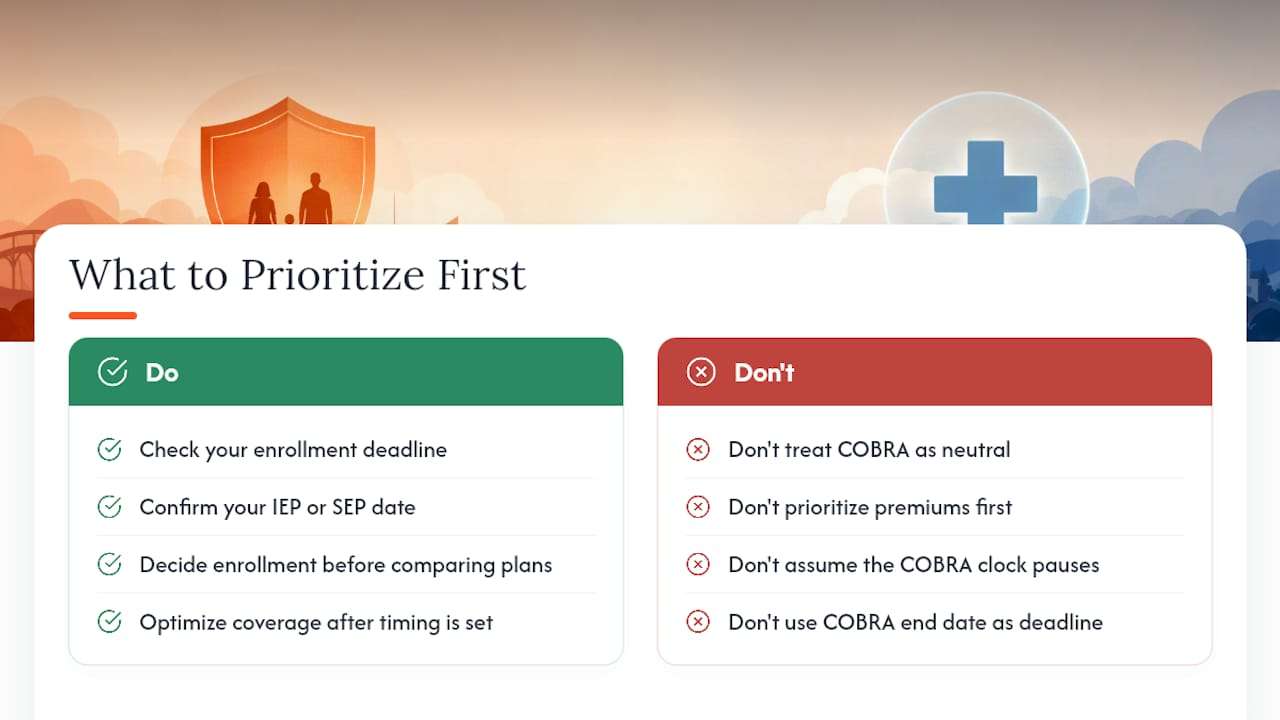
The conventional advice, “keep whatever you’re comfortable with,” fails people constantly because it treats COBRA as a neutral holding pattern. It isn’t. NCOA and other advocacy groups have flagged this repeatedly: COBRA’s SEP clock keeps running whether you’re paying attention to it or not, and that clock, not your COBRA end date, is what determines your penalty exposure.
What should you prioritize first? Not premiums. Not provider networks. Your enrollment date. Figure out your IEP or SEP deadline before you compare a single benefit chart, because a plan that’s 10% cheaper doesn’t matter if you’re staring down a Part B penalty that compounds for the next 20 years. Get the timing right, then optimize for coverage.
— Zach
Get a Medicare Roadmap Before Your Enrollment Window Closes
Figuring out whether to keep COBRA or switch to Medicare shouldn’t rest on a guess about penalties you can’t easily calculate yourself. Safeguard Benefit Services builds a personalized Medicare roadmap for Charlotte-area clients navigating exactly this transition, mapping your enrollment deadlines, checking your drug coverage for creditable status, and comparing Medicare Advantage against Medigap based on your actual health needs and budget.

Unlike a generic online calculator, you get a licensed local agent who walks through your specific COBRA end date, employer size, and dependent situation before you commit to anything. If you’re within your IEP or SEP window right now, schedule a free consultation to lock in your timeline and avoid a penalty that follows you for life.
Sources
- COBRA coverage | Medicare
- FAQs on COBRA Continuation Health Coverage for Workers | U.S. Department of Labor
- COBRA and Medicare: What to Know at 65 to Avoid Penalties and Coverage Gaps | NCOA
Recommended
- Can You Have Medicare And Private Insurance At The Same Time?
- Medicare Advantage Vs Medicare Supplement: Which Plan Fits You? — Safeguard Benefit Services
- Medicare Advantage Plan Vs. Medicare Supplement Plans: Choosing The Best Option For You In 2025
- Medicare Advantage 2025: The Future Of Medicare Changes And What They Mean For You








Get Connected