

Most people approaching Medicare think of it as a single system with a few plan types to pick from. But if you are managing a serious chronic illness, you qualify for both Medicare and Medicaid, or you live in a long-term care facility, there is a category of Medicare coverage most people never hear about until they need it. Medicare Special Needs Plans, known as SNPs, are a distinct type of Medicare Advantage plan built specifically for people in those situations. Understanding whether you qualify, and which type fits your circumstances, can mean the difference between generic coverage and a plan that actually coordinates your care.
Table of Contents
- What Are Medicare Special Needs Plans?
- The Three Types of Medicare SNPs
- Medicare SNP Eligibility: Who Actually Qualifies
- SNP vs. Standard Medicare Advantage: How They Compare
- Enrollment Rules for Medicare Special Needs Plans
- Medicare Advantage SNP in North Carolina: What to Know
- Common Mistakes to Avoid When Choosing a SNP
- Frequently Asked Questions
- References
What Are Medicare Special Needs Plans?
A Medicare Special Needs Plan (SNP) is a type of Medicare Advantage coordinated care plan designed specifically to provide targeted care for people with particular health or financial circumstances. Unlike standard Medicare Advantage plans that are open to anyone with Medicare Parts A and B, SNPs limit enrollment to individuals who meet defined eligibility criteria.
SNPs were established by the Medicare Modernization Act of 2003. Congress identified three categories of people who could benefit from more coordinated, specialized coverage: those living in institutions, those qualifying for both Medicare and Medicaid, and those with severe or disabling chronic conditions. Every SNP must include prescription drug coverage, which means enrolling in a SNP satisfies your Part D requirement automatically.
The practical difference from a standard Medicare Advantage plan is focus. A SNP builds its provider network, care management programs, and drug formulary around the specific needs of its target population. If you have congestive heart failure, for example, a C-SNP targeting heart failure patients is designed to give you specialists, care coordinators, and drug coverage that actually matches your treatment plan.

The Three Types of Medicare SNPs
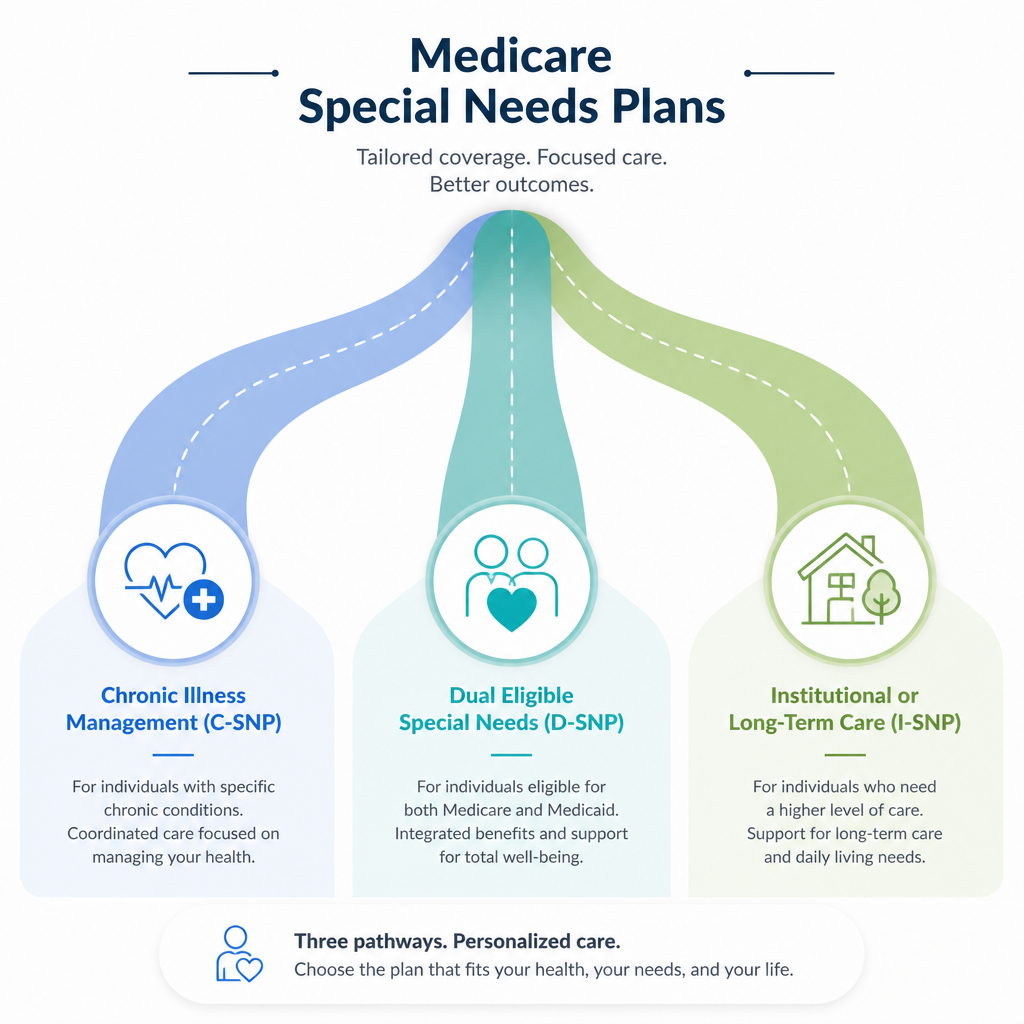
There are three categories of SNPs, each targeting a different population. Knowing which type applies to you is the first step toward evaluating whether this kind of coverage makes sense.
Chronic Condition Special Needs Plans (C-SNPs)
C-SNPs restrict enrollment to people with specific severe or disabling chronic conditions recognized by the Centers for Medicare and Medicaid Services (CMS). These plans are built around managing a defined condition or set of closely linked conditions. There are 15 CMS-approved chronic condition categories for C-SNPs, including diabetes, chronic heart failure, cardiovascular disorders, chronic kidney disease (including end-stage kidney disease), chronic lung disorders such as COPD, and a range of neurological conditions including multiple sclerosis, Parkinson’s disease, epilepsy, and stroke-related neurological deficits. Mental health conditions, including schizophrenia, bipolar disorder, and major depressive disorder, also qualify in some cases.
Enrolling in a C-SNP means receiving care within a provider network that specializes in your condition. Your care team knows the condition, your formulary is designed around the medications that treat it, and your plan’s care management programs are focused on avoiding hospitalizations and complications related to that specific illness.
Pro tip: If you have been diagnosed with one of the 15 qualifying chronic conditions and are comparing Medicare Advantage plans, ask specifically whether a C-SNP is available in your area before defaulting to a general Medicare Advantage plan. The targeted formulary alone can save you money.
Dual Eligible Special Needs Plans (D-SNPs)
D-SNPs serve people who qualify for both Medicare and Medicaid. These individuals are referred to as “dual eligible.” Roughly 13.6 million Americans have both Medicare and Medicaid coverage. A D-SNP combines Medicare and Medicaid benefits into a single coordinated plan and typically offers additional services not available under standard Medicare Advantage, such as transportation to medical appointments and routine vision exams. Most D-SNPs carry a $0 premium.
D-SNPs give dual-eligible enrollees access to trained care coordinators who help them understand and use all their benefits. This matters because the intersection of Medicare and Medicaid rules is genuinely confusing, and most people without guidance leave benefits on the table or end up with duplicative cost-sharing they did not need to pay.
Institutional Special Needs Plans (I-SNPs)
I-SNPs are designed for people who live in a skilled nursing facility or who need the level of care typically provided in such a facility. To qualify for an I-SNP, you generally need to have received skilled nursing care for at least 90 days consecutively. There is also an Institutional-Equivalent SNP (IE-SNP) for people living in a contracted assisted living facility who need the same level of care as nursing home residents.
I-SNPs are the least commonly encountered type among people new to Medicare. If you or a family member is transitioning into long-term care, evaluating whether an I-SNP is available in that facility’s area is worth doing before settling on a standard Medicare Advantage plan.
Medicare SNP Eligibility: Who Actually Qualifies
The core requirement for any SNP is that you must have Medicare Parts A and B and you must fit the specific eligibility criteria for that plan type. SNPs cannot enroll people who do not meet the defined criteria, so eligibility is not flexible.
C-SNP Eligibility
To enroll in a C-SNP, you need Medicare Parts A and B, a physician-verified diagnosis of a qualifying chronic condition, and you must live in the plan’s service area. A common mistake people make is assuming that having a chronic condition automatically qualifies them. The condition must be one of the 15 CMS-specified categories, and your doctor must confirm the diagnosis in writing. Some C-SNPs require that verification be submitted within 60 days of your first day of coverage.
Some C-SNPs are condition-specific, meaning they target only one condition such as diabetes. Others serve people with multiple co-morbid conditions that commonly occur together. Your diagnosis determines which plans are actually open to you.
D-SNP Eligibility
To enroll in a D-SNP, you must qualify for both Medicare and Medicaid. States determine Medicaid eligibility differently, so what qualifies you in North Carolina may differ from what qualifies you in another state. You should confirm your current Medicaid status with your state Medicaid office before assuming you qualify for a D-SNP. The dual eligibility category includes full-benefit dual eligibles as well as people who qualify for Medicare Savings Programs that pay Medicare premiums or cost-sharing.
I-SNP Eligibility
I-SNP eligibility requires either current residence in a skilled nursing facility or a documented need for institutional-level care. The 90-day continuous skilled nursing requirement is a firm threshold in most cases. If you are approaching this situation for yourself or a family member, confirming whether an I-SNP is available at the specific facility being considered is a practical first step.
Pro tip: Eligibility for a SNP does not mean every SNP in that category is available in your zip code. SNP availability varies significantly by county and region. In North Carolina, the range of available plans differs between urban and rural counties. Always confirm availability by entering your specific zip code when comparing plan options.
SNP vs. Standard Medicare Advantage: How They Compare
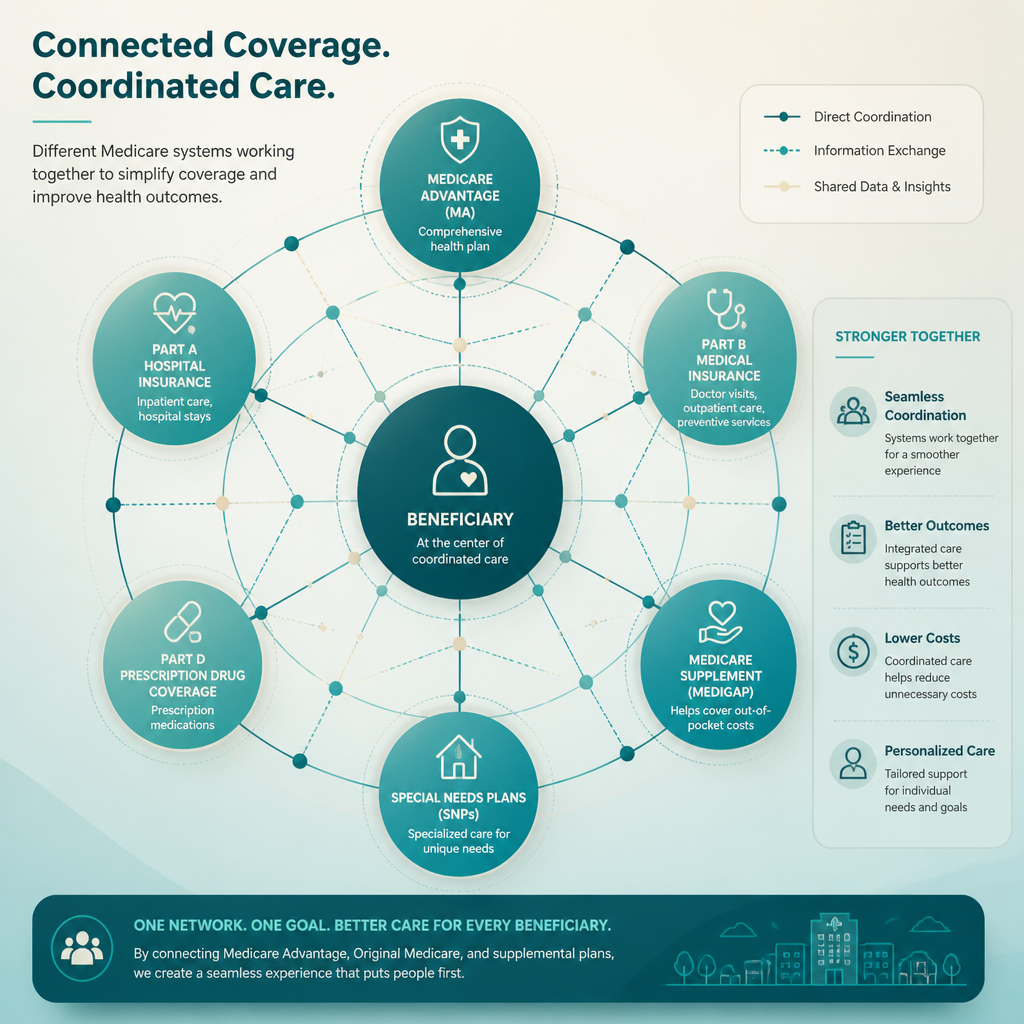
People often ask whether a SNP is really different from a standard Medicare Advantage plan in practice. The answer is yes, in ways that matter most to the populations they serve. Here is a direct comparison of the three main plan types.
| Feature | Standard Medicare Advantage | Medicare Special Needs Plan (SNP) |
|---|---|---|
| Who can enroll | Anyone with Medicare Parts A and B in the service area | Only individuals meeting specific eligibility criteria (chronic condition, dual eligible, or institutional) |
| Prescription drug coverage | Optional. Some plans include it, some do not | Required by law. All SNPs must include Part D drug coverage |
| Provider network focus | General network serving the broader Medicare population | Network of specialists and providers focused on the target condition or population |
| Care management | General care management programs, varies by plan | Specialized care coordination and individualized care plans tailored to the target condition |
| Additional benefits | Dental, vision, hearing may be included but vary widely | Additional benefits targeted to the SNP population (e.g., transportation for D-SNPs, specialized disease management for C-SNPs) |
| Premium | Varies. Often $0 but not guaranteed | Varies. D-SNPs often carry $0 premium for qualifying dual eligibles |
SNPs must offer the same base benefits available under other Medicare Advantage plans, but their real value is in the additional targeted services and coordinated care they provide for specific populations, not just in matching the minimum standard.
Enrollment Rules for Medicare Special Needs Plans
SNP enrollment follows the same core periods as Medicare Advantage, but there are important differences that work in favor of people who qualify for SNPs.
Standard Enrollment Windows
You can enroll in a SNP during your Initial Enrollment Period, which is the seven-month window around your 65th birthday or your initial Medicare eligibility date. You can also enroll during the Annual Election Period, which runs from October 15 to December 7 each year, with coverage beginning January 1. The Medicare Advantage Open Enrollment Period from January 1 through March 31 allows you to switch or drop a Medicare Advantage plan you are already enrolled in.
Special Enrollment Periods for SNP Qualifying Events
People who qualify for SNPs often have access to Special Enrollment Periods (SEPs) that allow enrollment outside the standard windows. For dual-eligible individuals, a SEP begins when they become entitled to any Medicaid-administered program and ends two months after they lose Medicaid entitlement. New enrollment in a D-SNP under this SEP takes effect the first day of the month following enrollment.
As of January 2025, certain full-benefit dual-eligible individuals can use a monthly Special Enrollment Period to join qualifying integrated D-SNPs, including Fully Integrated Dual Eligible Special Needs Plans (FIDE-SNPs), Highly Integrated Dual Eligible Special Needs Plans (HIDE-SNPs), and Applicable Integrated Plans (AIPs). This is a significant change from the prior quarterly structure and gives dual-eligible beneficiaries more flexibility to adjust coverage without waiting for an annual window.
A Common Mistake to Avoid
People who qualify for a C-SNP often assume they need to wait for the Annual Election Period. If you are newly diagnosed with a qualifying chronic condition, check whether that diagnosis creates a qualifying event for a Special Enrollment Period in your state. Do not assume you are locked out until October.
Medicare Advantage SNP in North Carolina: What to Know
North Carolina residents have access to Medicare Advantage SNPs, but availability varies by county. Urban areas such as Charlotte, Raleigh, and the Triad generally have more plan options than rural counties. This matters because having more plan options means more competition and more variation in additional benefits, network quality, and formulary coverage.
North Carolina has its own Medicaid program, and your eligibility for a D-SNP depends on your specific Medicaid category in the state. Medicaid eligibility categories in North Carolina include Full Benefit Dual Eligibles (FBDE), Qualified Medicare Beneficiaries (QMB), and related categories. Your specific category affects which D-SNP options you can access and what your cost-sharing will look like. Confirming your Medicaid category before comparing D-SNPs is not optional, it is the necessary first step.
For people in the Charlotte area and surrounding counties, working with a licensed broker who knows the local plan landscape is the fastest way to determine which SNPs are actually available at your address, which plans include your current doctors, and which drug formularies cover your prescriptions. A good broker runs this comparison for you at no cost and without pressure to pick a specific plan.
At Safeguard Benefit Services, based in Charlotte, the team works specifically with North Carolina Medicare beneficiaries to compare plans across 30 or more insurance companies. If you are curious whether you qualify for a SNP, or whether a SNP makes more sense than a standard Medicare Advantage plan given your health situation, a free consultation is the place to start. You can learn more and schedule time at safeguardbenefitservices.com.
Common Mistakes to Avoid When Choosing a SNP
Choosing a SNP without checking whether your doctors are in-network is one of the most expensive errors a new enrollee can make. SNPs, like standard Medicare Advantage plans, use defined provider networks. A plan that covers your cardiologist in one county may not cover the same doctor if you move across county lines. Verify network inclusion before you enroll, not after.
A second common mistake is enrolling in a C-SNP based on the plan name without confirming the specific condition it covers. Some C-SNPs target a single condition. If your qualifying condition is diabetes but the C-SNP in your area targets cardiovascular disease only, you will not qualify. Read the plan’s eligibility criteria directly, not just its marketing materials.
Third, people who qualify for both a D-SNP and a standard Medicare Advantage plan sometimes default to the standard plan because it is more familiar. In practice, D-SNPs for qualifying dual-eligible beneficiaries often offer more benefits, better care coordination, and lower out-of-pocket costs. Do not skip the comparison just because D-SNPs feel unfamiliar.
Finally, if you are helping an aging parent evaluate options, do not assume their situation fits the same SNP type year after year. Chronic condition status changes, Medicaid eligibility can change, and the plan available in their area can change annually. Reviewing the plan selection every fall is the right habit, not a one-time event.
Frequently Asked Questions
What is the difference between a SNP and a regular Medicare Advantage plan?
A SNP is a type of Medicare Advantage plan, but it is restricted to people who meet specific eligibility criteria. A standard Medicare Advantage plan is open to anyone with Medicare Parts A and B who lives in the service area. SNPs offer more targeted provider networks, specialized care management, and benefits designed for their specific population. All SNPs are required to include prescription drug coverage, which is optional in standard Medicare Advantage plans.
Can I enroll in a Medicare Special Needs Plan if I have multiple chronic conditions?
Yes, in some cases. Some C-SNPs are designed for people with multiple co-occurring chronic conditions that are clinically linked, such as diabetes combined with chronic kidney disease. CMS reviews these multi-condition plans to ensure they serve the combined population adequately. Having multiple qualifying conditions may actually expand your plan options in some areas. Check with a licensed broker to confirm what is available at your specific address.
Do Medicare Special Needs Plans cost more than regular Medicare Advantage plans?
Not necessarily. D-SNPs for qualifying dual-eligible individuals frequently carry a $0 premium. C-SNPs and I-SNPs vary by plan and location. The more important cost consideration is whether the plan’s formulary covers your specific medications at a reasonable tier and whether your cost-sharing structure fits your expected healthcare usage. Premium alone is not the right metric for comparing SNPs.
What happens if I enroll in a C-SNP and my condition improves or is reclassified?
If you no longer meet the eligibility criteria for a C-SNP, your plan is required to notify you and assist with transition to a different plan. You do not simply lose coverage without warning. However, this situation is relatively rare for the qualifying conditions CMS recognizes, which tend to be permanent or long-term conditions. If you have a concern about your qualifying diagnosis, talk with both your physician and your insurance broker before making any plan changes.
Are Medicare Special Needs Plans available everywhere in North Carolina?
No. SNP availability is determined by county. Some SNP types may be available in larger metropolitan areas like Charlotte but not in adjacent rural counties. Availability also changes year to year as insurance companies enter and exit markets. The only reliable way to confirm what is available in your specific zip code is to check directly during the plan comparison process, ideally with the help of a broker who knows the North Carolina market.
Can I switch from a SNP to a standard Medicare Advantage plan?
Yes. If you are enrolled in a SNP and want to switch to a standard Medicare Advantage plan, you can do so during the Annual Election Period from October 15 to December 7. You can also switch during the Medicare Advantage Open Enrollment Period from January 1 through March 31 if you are already enrolled in a Medicare Advantage plan. If your eligibility for the SNP changes (for example, you lose Medicaid), you may also qualify for a Special Enrollment Period to make a mid-year change.
Have you recently looked into whether a Medicare Special Needs Plan might fit your situation, or do you have questions about what type of SNP might apply to your health circumstances? Share your experience or questions in the comments.
References
- CMS official overview of Medicare Special Needs Plans and the three eligibility categories
- CMS detailed guidance on Chronic Condition Special Needs Plans and qualifying conditions
- National Council on Aging explanation of all three Medicare Advantage Special Needs Plan types
- National Council on Aging guide to Dual Eligible Special Needs Plans for people with Medicare and Medicaid
- Justice in Aging analysis of 2025 Special Enrollment Period changes affecting dual-eligible Medicare enrollees








Get Connected