

Choosing between an HMO and a PPO Medicare Advantage plan is one of the first real decisions you face when turning 65, and most people make it with almost no information. The plan type shapes everything: which doctors you can see, whether you need a referral just to visit a specialist, how much you pay out of pocket, and what happens if you end up needing care while traveling. For North Carolina residents, the stakes are real. HMO vs PPO Medicare Advantage is not a trivial distinction, and picking the wrong structure can cost you hundreds of dollars or leave you locked out of your preferred provider. This guide gives you the side-by-side comparison you actually need before open enrollment.
Table of Contents
- Quick Takeaways
- What Medicare Advantage Actually Is
- How HMO Plans Work
- How PPO Plans Work
- Side-by-Side Comparison: HMO vs. PPO Medicare Advantage
- What This Means for North Carolina Residents
- Costs That Catch People Off Guard
- Which Plan Type Is Right for You
- Frequently Asked Questions
- References
Quick Takeaways
| Key Insight | Explanation |
|---|---|
| HMOs generally cost less month to month | HMO premiums and copays tend to be lower, but you must stay in-network or pay the full cost yourself. |
| PPOs let you see out-of-network providers | You pay more for out-of-network care, but you are not completely locked out the way you are with most HMOs. |
| HMOs require a primary care physician (PCP) and referrals | You need your PCP to refer you before seeing a specialist. Skipping that step typically means no coverage. |
| PPOs let you self-refer to specialists | You can book a cardiologist or dermatologist directly, without waiting for a referral from a gatekeeper physician. |
| Out-of-pocket maximums differ significantly | In 2025, the average in-network out-of-pocket limit for HMOs was about $4,091, while local PPOs averaged roughly $9,519 when combined in and out-of-network exposure. |
| North Carolina has 175 Medicare Advantage plans available | Not every plan type is available in every county. Plan availability varies, so your zip code matters. |
| Switching plan types costs you a full year | Outside of Special Enrollment Periods, you are locked into your plan until the next Annual Enrollment Period (October 15 to December 7). |
What Medicare Advantage Actually Is
Medicare Advantage (Part C) plans are offered through private insurance companies and combine Medicare Part A and Part B benefits, often including Part D prescription drug coverage. They are not a supplement layered on top of Original Medicare. When you enroll in a Medicare Advantage plan, the private insurer takes over the delivery of your benefits.
Both HMO and PPO plans fall under the Medicare Advantage umbrella. Both must cover at least the same services as Original Medicare, meaning inpatient hospital stays, outpatient care, and most medically necessary services. Where they differ is in how they deliver that coverage and how much flexibility you get in choosing your providers.
Many plans also include extras that Original Medicare does not cover at all: dental, vision, hearing, and fitness benefits. Those extras are worth comparing, but they should not distract you from understanding the structural differences between the two plan types. Getting the structure wrong matters far more than a dental allowance.


How HMO Plans Work
HMO stands for Health Maintenance Organization. In an HMO, you choose a primary care physician (PCP) from the plan’s network, and that doctor becomes the central coordinator of your care. If you need to see a cardiologist, an orthopedist, or any other specialist, your PCP must first provide a referral. No referral means the visit is almost certainly not covered.
Network Boundaries Are Strict
The defining feature of an HMO is network rigidity. If you receive care from a provider who is not in the plan’s network, you typically pay the full cost yourself. The plan pays nothing. The only reliable exception is a genuine emergency, but even then you should confirm the details with your specific plan because cost-sharing rules vary.
This is not a minor inconvenience. A common mistake among new Medicare enrollees is assuming that “Medicare covers it everywhere.” That is true of Original Medicare, but once you are in an HMO, your coverage boundaries shrink to the plan’s contracted network.
What HMOs Trade for Lower Costs
The trade-off is straightforward: lower premiums and lower copays in exchange for less freedom. HMO plans frequently offer $0 monthly premiums, and the copays for routine visits are often modest. The plan’s annual in-network out-of-pocket maximum is typically lower than a PPO’s, which matters a great deal if you have ongoing health conditions.
Pro tip: Before enrolling in any HMO, look up every doctor you currently see on the plan’s provider directory. Do this directly on the insurer’s website, not through a general Medicare search tool. Provider directories can be outdated, so call the provider’s office to confirm participation before you finalize enrollment.
How PPO Plans Work
PPO stands for Preferred Provider Organization. Like an HMO, a PPO has a network of contracted providers where you pay lower costs. Unlike an HMO, a PPO also gives you coverage when you go outside that network, though at a higher cost. You are never completely cut off from care just because a provider is out-of-network.
No Referrals Required
PPO members can see specialists directly without going through a PCP gatekeeper. You decide you need a dermatologist, you call and make an appointment. This is a practical advantage for anyone managing multiple conditions who does not want every specialist visit to flow through a single referring physician.
The Real Cost of PPO Flexibility
PPO plans typically carry higher monthly premiums and higher out-of-pocket maximums than HMOs. The flexibility is real, but it is not free. When you use out-of-network providers, your cost-sharing increases substantially. The plan still pays a portion, but your share grows. In 2025, the average out-of-pocket spending limit for local PPO plans (combining in-network and out-of-network exposure) was roughly $9,519, compared to around $4,091 for HMO plans.
Pro tip: If you travel frequently within the United States or split time between two states, a PPO’s out-of-network coverage offers a meaningful safety net. An HMO will not cover non-emergency care in a city where your plan has no contracted providers.
The real question is not which plan type is “better.” The real question is which structure fits the way you actually use healthcare, given your current doctors, your health conditions, and how often you travel.
Side-by-Side Comparison: HMO vs. PPO Medicare Advantage
The table below summarizes the most important structural differences between Medicare Advantage HMO and PPO plans. These are general characteristics that hold across most plans. Always review the specific plan’s Evidence of Coverage document for the details that govern your actual benefits.
| Feature | Medicare Advantage HMO | Medicare Advantage PPO |
|---|---|---|
| Monthly premium | Often $0 or very low | Typically higher than HMO |
| Primary care physician required | Yes, required | No, optional |
| Specialist referrals | Required from PCP | Not required |
| Out-of-network coverage | Not covered (except emergencies) | Covered at higher cost-sharing |
| In-network out-of-pocket maximum (2025 avg.) | Approximately $4,091 | Approximately $9,519 (combined in/out-of-network) |
| Provider network flexibility | Low, must stay in-network | High, in- and out-of-network both covered |
| Best for | Cost-conscious enrollees with local providers in-network | Those who travel, see multiple specialists, or want provider choice |
What This Means for North Carolina Residents
North Carolina has a large and growing Medicare Advantage market. From 2010 to 2024, the number of North Carolinians enrolled in Medicare Advantage plans jumped from roughly 244,000 to almost 1.2 million, according to data from KFF. For 2025, the average beneficiary in North Carolina had a choice of 44 Medicare Advantage plans, and 175 plans were available statewide.
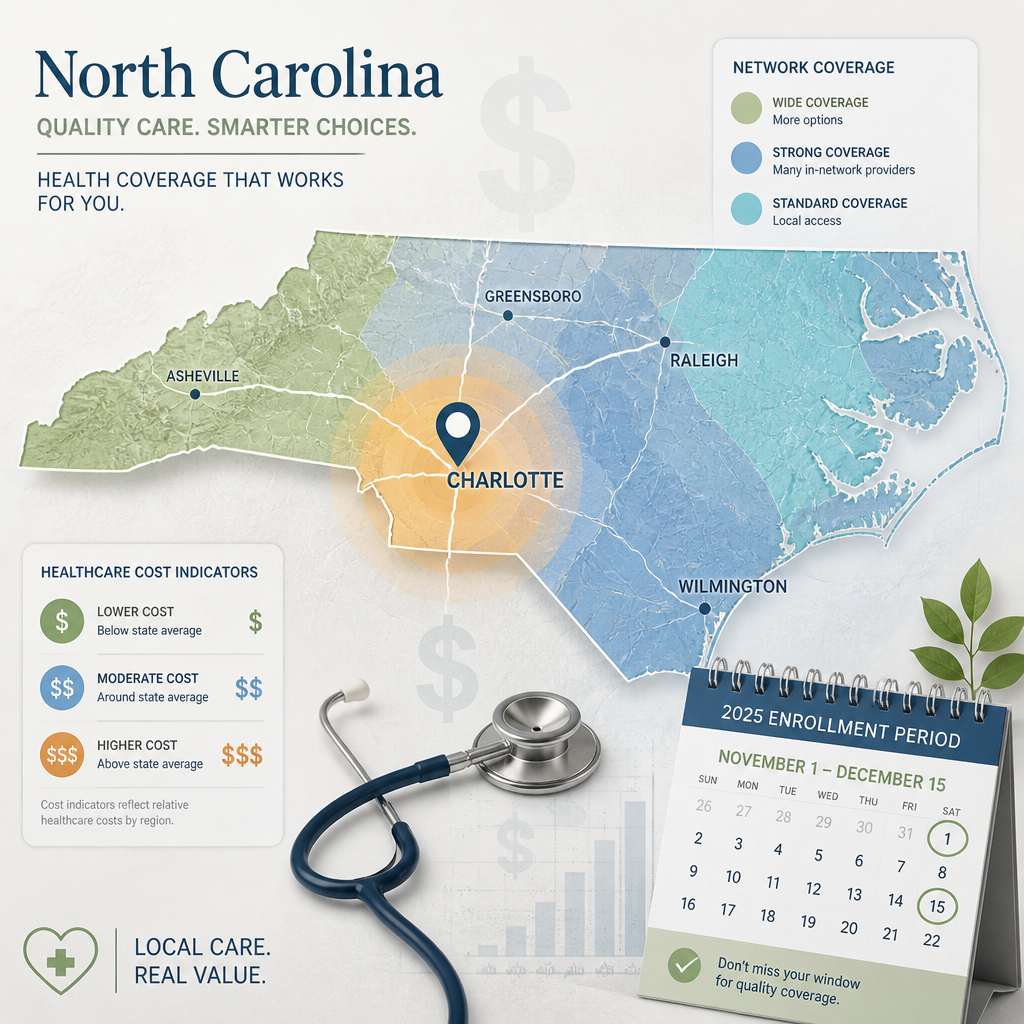
That variety is both a benefit and a source of real confusion. Not every plan type is available in every county. Residents in Charlotte and Mecklenburg County tend to have a broad selection of both HMO and PPO options because of the area’s large provider infrastructure. But residents in smaller or more rural NC counties may find that only one plan type, or even only one insurer, participates in their area.
Charlotte-Area Considerations
Mecklenburg County has one of the largest Medicare Advantage enrollment bases in the state, with tens of thousands of enrollees across multiple carriers. Major health systems in the Charlotte area participate in various plan networks, but participation is not universal. A hospital or physician group in-network for one insurer’s HMO may be completely out-of-network for another.
This is why generic plan comparisons found on national websites are almost useless for a Charlotte resident. The question is not “which plan type is generally better?” It is “which specific plans in my county include my doctors, my hospital, and my pharmacy, at a cost structure that works for my situation?” That question requires someone who knows the local market.
Rural NC vs. Urban NC
In rural North Carolina counties, HMO networks can be thin. If the only cardiologist within 60 miles is not contracted with your HMO, you either travel further or pay out of pocket. In those situations, a PPO’s out-of-network coverage is not a luxury, it is a practical necessity. Conversely, in a well-served urban county like Mecklenburg or Wake, an HMO’s network may be robust enough that most residents never hit its limitations.
Costs That Catch People Off Guard
Both plan types have a set of cost components that new enrollees consistently underestimate. Understanding them upfront prevents the unpleasant surprise of a large bill months after enrollment.
The Part B Premium Still Applies
Regardless of whether you choose an HMO or PPO Medicare Advantage plan, you continue paying your Medicare Part B premium. That cost does not disappear when you enroll in a Medicare Advantage plan. Some plans offer a Part B premium reduction as an added benefit, but that is a plan-specific feature, not a universal one.
HMO Out-of-Network Bills
The most common financial shock in Medicare HMO plans happens when a member unknowingly receives care from an out-of-network provider. This often happens at an in-network hospital when a consulting specialist, an anesthesiologist, or a radiologist is not part of the same plan network. The member assumed everything at the hospital was covered. It was not.
PPO Out-of-Pocket Maximum Confusion
PPO plans often publish two out-of-pocket maximum figures: one for in-network care and a higher one for combined in-network and out-of-network care. Enrollees sometimes only notice the in-network number. If they later use out-of-network providers regularly, the real ceiling is the combined maximum, which is substantially higher.
In practice, the smartest way to evaluate total annual cost is to estimate your likely healthcare usage: primary care visits, specialist visits, any ongoing prescriptions, and any planned procedures. Run those assumptions through both an HMO and PPO cost structure before making a final decision. A licensed agent at an agency like Safeguard Benefit Services can do this side-by-side cost modeling with you for free.
Which Plan Type Is Right for You
There is a clear pattern in who benefits most from each structure. An HMO typically works well for someone who has established relationships with local physicians who are already in the plan’s network, prefers lower and more predictable monthly costs, does not need to see specialists without coordination, and stays primarily in their local area for care. A PPO typically works better for someone who wants to keep seeing a specific specialist or specialist group that may not be in every network, splits time between North Carolina and another state, manages multiple complex conditions and sees several specialists, or values the freedom to make their own care decisions without a referral step.
If you are turning 65 and currently have employer coverage that includes your preferred doctors, check whether those doctors participate in the Medicare Advantage networks you are considering before you assume continuity of care. This is the single most common enrollment mistake that results in people having to change doctors they have trusted for years.
Working with an independent Medicare insurance agency that represents 30 or more carriers, rather than one tied to a single insurer, means you get a comparison across plans that actually compete in your county. Agents at Safeguard Benefit Services in Charlotte do this at no cost to you, and the consultation takes the guesswork out of matching your situation to the right plan structure. You can reach them directly at safeguardbenefitservices.com to schedule a free consultation.
Frequently Asked Questions
Can I switch from an HMO to a PPO Medicare Advantage plan after I enroll?
You can switch plan types during the Annual Enrollment Period, which runs from October 15 to December 7 each year, with coverage changes taking effect on January 1. Outside of that window, you would need to qualify for a Special Enrollment Period, such as moving to a new service area or losing current coverage. If you enroll in an HMO and realize mid-year that your doctors are out of network, you are generally stuck until the next enrollment window.
Do Medicare Advantage HMO plans cover emergency care outside their network?
Yes. All Medicare Advantage plans, including HMOs, are required to cover emergency care regardless of where it occurs within the United States. However, the cost-sharing for emergency visits may differ from routine in-network visits. Once you are stabilized, the HMO may require you to transfer to an in-network facility for continued care. Confirm the specifics with your plan’s Evidence of Coverage document.
Are there Medicare Advantage HMO plans with no referral requirement?
Yes. Some plans offer an HMO-POS (Point of Service) variation that allows a limited degree of out-of-network or self-referred access, usually at higher cost-sharing. These plans blend some PPO-style flexibility into an HMO structure. They are not available everywhere in North Carolina, but they are worth asking about if you want lower HMO premiums combined with some ability to self-refer.
How do I know if my doctor is in-network for a specific Medicare Advantage plan in North Carolina?
Every Medicare Advantage insurer maintains an online provider directory. Go directly to the insurer’s website and use their find-a-doctor tool with your specific plan name. Do not rely on Medicare.gov’s directory alone, as it can lag behind the insurer’s real-time data. After finding your doctor listed, call the doctor’s office directly and ask whether they are currently accepting patients under that specific plan. Provider directories can show providers who have recently left a network.
Is a $0 premium Medicare Advantage HMO really free?
No. A $0 premium means you pay no monthly premium to the private insurer for the plan itself, but you still pay your Medicare Part B premium, which in 2025 is at least $185 per month for most enrollees. You also pay copayments, coinsurance, and deductibles for services you use. A $0 premium plan can still result in significant annual costs depending on your healthcare usage. The premium is just one line item in the total cost picture.
Can people in Charlotte, NC, find both HMO and PPO Medicare Advantage plans?
Yes. Mecklenburg County, which includes Charlotte, typically has a wide selection of both HMO and PPO Medicare Advantage plans available during open enrollment. Multiple national and regional carriers offer plans in that area. The right choice depends on which specific plans cover your current providers and how their cost structures compare for your expected level of healthcare use.
Have you already gone through Medicare Advantage enrollment in North Carolina? Share what surprised you most about choosing between HMO and PPO, your experience might help someone else avoid the same confusion.
References
- Healthline: How Medicare HMO and PPO Plans Compare on Costs, Networks, and Referrals
- NC Health News: Medicare Advantage Enrollment Growth and Plan Choices in North Carolina
- SelectQuote: Medicare Advantage Plan Availability and Statistics for North Carolina
- GoodRx: Medicare Advantage Plan Types Explained, Including HMO and PPO Structures
- UnitedHealthcare: The Difference Between Medicare HMO and PPO Plans








Get Connected