

Confused about Dual Eligible Special Needs Plans in North Carolina and what’s changing for 2027? You’re not alone. This expert Q&A breaks down D-SNP coordination, integrated ID cards and assessments, Medicaid interaction, and what dual eligible beneficiaries should review before they enroll—using clear language and up-to-date federal and North Carolina guidance.

What is a D-SNP, and who is “dual eligible” in North Carolina?
A Dual Eligible Special Needs Plan (D-SNP) is a type of Medicare Advantage plan tailored for people who have both Medicare and Medicaid. D-SNPs cover all Medicare Part A and Part B services and include prescription drug coverage, and they may add extra benefits like care coordination. D-SNPs are a type of Special Needs Plan (SNP) and can be either HMO or PPO, which affects rules for referrals and out-of-network care. Medicare defines these plans and their coverage standards at the national level.
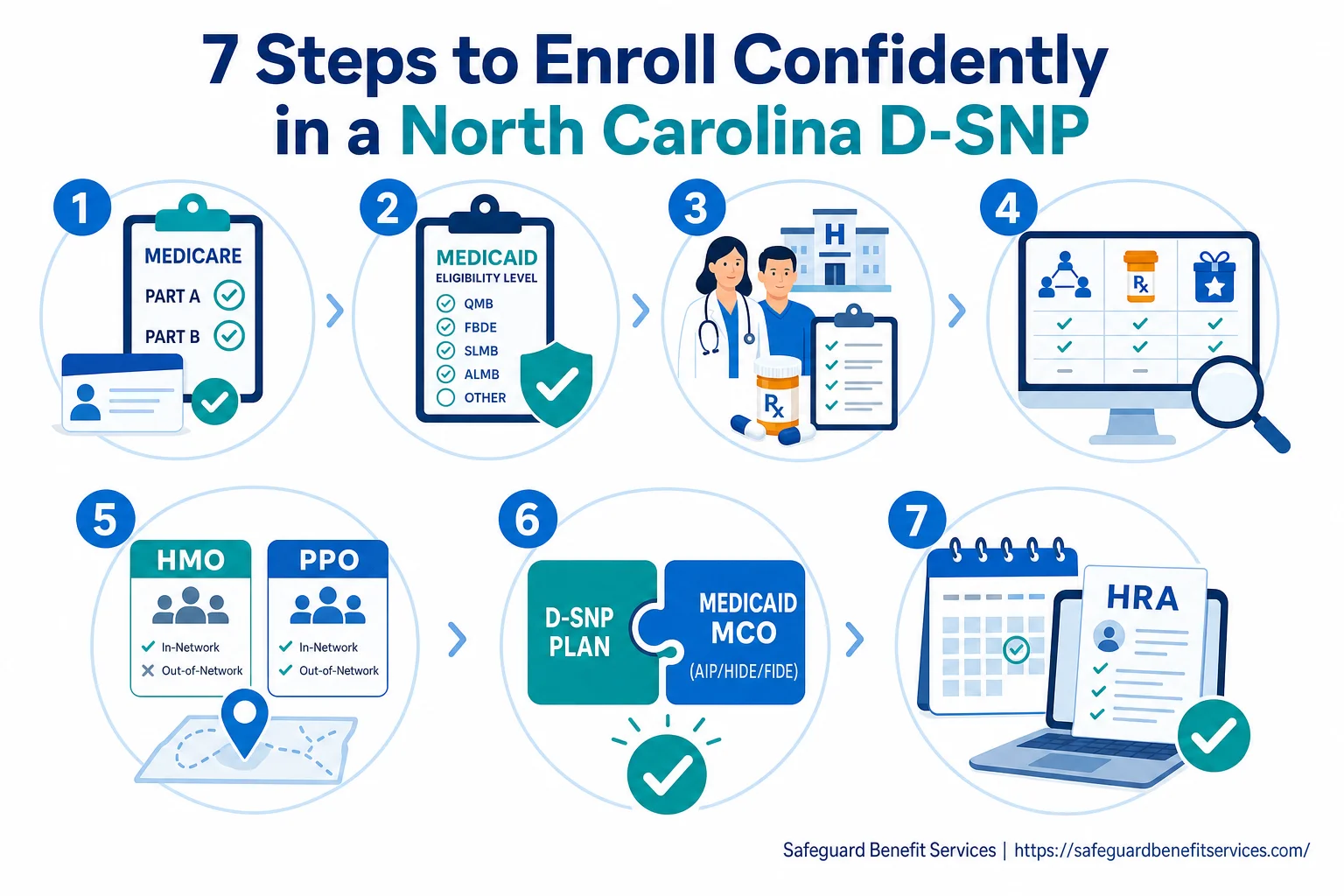
“Dual eligible” means you qualify for Medicare and also meet Medicaid eligibility rules in your state. Categories include full-benefit duals (who receive comprehensive Medicaid) and partial-benefit groups like QMB, SLMB, QI, or QDWI. Your category influences premiums and cost sharing that Medicaid may pay.
What 2027 D-SNP changes should North Carolinians know about?
The Centers for Medicare & Medicaid Services (CMS) finalized policies that begin applying in contract year 2027 to simplify choices and increase integration between Medicare and Medicaid. In service areas where a company offers both a Medicaid managed care plan and a D-SNP, new enrollment into certain D-SNPs will be limited to individuals who are also enrolled in that affiliated Medicaid plan (often called “exclusive alignment”). CMS will also limit how many D-SNP benefit packages the parent company can offer in the same area to reduce consumer confusion.
CMS also strengthened minimum integration standards for D-SNPs, building on earlier rules that unified certain appeals and grievance processes across Medicare and Medicaid for integrated plans beginning in 2021. The goal is fewer cards, simpler notices, and coordinated care for people in both programs.
Will there really be a single integrated member ID card and a unified assessment in 2027?
For “applicable integrated plans” (AIP D‑SNPs with exclusively aligned enrollment), CMS requires an integrated member ID card that works for both Medicare and Medicaid no later than contract year 2027. That means you can present one card at the doctor or pharmacy if you’re in one of these integrated D‑SNPs in a participating state.
In the same timeframe, these integrated D‑SNPs must conduct a single, integrated Health Risk Assessment (HRA) that satisfies both Medicare and Medicaid requirements, so you aren’t asked to repeat similar questions twice. SNPs also must ensure the HRA informs your individualized care plan and interdisciplinary care team support.
How do D-SNPs coordinate Medicare and Medicaid benefits in North Carolina?
Every D-SNP must have a State Medicaid Agency Contract (SMAC) describing how it coordinates with North Carolina Medicaid—including data sharing, transition notifications, and who does what. For example, D-SNPs that aren’t fully or highly integrated must notify the state (or its designee) of certain hospital or skilled nursing facility admissions for at least one high‑risk group to improve care transitions.
North Carolina also operates Medicaid Managed Care, including Behavioral Health and I/DD Tailored Plans that launched July 1, 2024. If you receive Tailored Plan services or are in a Standard Plan, coordination between your D-SNP and your Medicaid plan matters—particularly for behavioral health, long‑term services and supports, and transportation.
Nationally, research shows “coordination‑only” D-SNPs (those without full integration) can change how Medicaid dollars are spent; states seeking to delay or reduce nursing home transitions may need deeper integration. This finding comes from a North Carolina–focused cohort study published in 2025.
Does a D-SNP change what I pay for premiums and copays?
Many D-SNPs advertise $0 premiums, but your actual costs depend on your Medicaid category. If you are a Qualified Medicare Beneficiary (QMB), federal law prohibits providers from billing you for Medicare Parts A and B cost sharing; Medicaid and/or the plan handles those amounts per state policy. Keep your QMB or Medicaid card with you and show it at each visit.
If you qualify for a Medicare Savings Program (MSP), North Carolina may pay your Part B premium. And if you get Extra Help, your prescription drug copays can be very low; for example, Medicare’s 2026 guidance notes that many Extra Help copays won’t exceed $12.65 per covered drug.
D-SNPs include prescription drug coverage as part of the plan. Drug costs vary by formulary tier and pharmacy choice; check the Summary of Benefits and Evidence of Coverage to confirm your medications and any step therapy or prior authorization rules.
When can I enroll or switch plans—and what’s different in 2026 and 2027?
As of January 1, 2025, Medicare added an Integrated Care Special Enrollment Period (SEP) that allows full‑benefit dual eligible individuals to elect an integrated D‑SNP in any month to align with their Medicaid managed care plan. This is separate from the fall Annual Enrollment Period and is meant to help you match your Medicare and Medicaid plans more easily.
Medicare.gov also explains that if you have Medicaid or Extra Help, you can make coverage changes once each calendar month, which provides flexibility beyond the quarterly limits CMS used in earlier years (for example, the 2019 rule). If you’re unsure which SEP applies to your situation, work with a licensed agent to avoid denials.
Looking ahead to 2027, the new exclusive‑alignment rule will limit new enrollment in certain D-SNPs to people also enrolled in the affiliated Medicaid managed care organization in overlapping service areas. This is designed to reduce fragmentation and increase use of integrated materials and processes.
What should I review before I enroll in a dual eligible special needs plan?
Use this short checklist with a trusted advisor before you enroll in a D‑SNP in North Carolina:
- Your dual status: Confirm whether you’re full-benefit dual (FBDE) or in an MSP category like QMB/SLMB; this drives cost sharing and eligibility to enroll in a D‑SNP.
- Plan integration: Ask whether the D‑SNP is an applicable integrated plan (AIP), a highly integrated D‑SNP (HIDE‑SNP), a fully integrated D‑SNP (FIDE‑SNP), or a coordination‑only model—and whether it aligns with your Medicaid plan for 2026–2027.
- Provider and hospital network: Check that your primary care provider, specialists, and nearby hospitals take the plan. If it’s an HMO, out‑of‑network services are typically not covered (except emergencies); PPOs may allow out‑of‑network at higher cost.
- Prescription drug coverage: Verify your medications on the plan’s formulary, preferred pharmacies, and any utilization management rules.
- Care management: Confirm you’ll receive an HRA and a written individualized care plan, and ask who’s on your interdisciplinary care team (ICT).
- Integrated materials and ID card: For 2027 and beyond, find out if the plan uses an integrated ID card and unified notices so you can carry one card for both programs.
- Local NC Medicaid considerations: If you use behavioral health or long‑term supports, ask how the D‑SNP works with your Tailored Plan or Standard Plan in Mecklenburg or surrounding counties.
These points reflect federal requirements and North Carolina’s managed care environment, which together shape the experience you’ll have in a D‑SNP.
How will my D-SNP interact with my North Carolina Medicaid plan day to day?
In an integrated D‑SNP, Medicare remains primary for Medicare‑covered services, and Medicaid remains secondary for Medicaid‑covered services and, depending on eligibility, cost sharing. Your plans should share information so care managers can coordinate appointments, medications, and transitions of care—especially after hospitalizations. North Carolina Medicaid also requires reporting of other insurance coverage to keep records aligned.
For QMBs, remember: no balance billing for Parts A and B cost sharing is allowed by providers, including those in Medicare Advantage. If you’re billed in error, contact your plan, your provider, or North Carolina Medicaid for correction.
What assessments and care team support should I expect after I enroll?
All SNPs, including D‑SNPs, must perform a Health Risk Assessment (HRA) within required timeframes after enrollment and annually thereafter, use the results to build an individualized care plan, and support you through an interdisciplinary care team. CMS codifies these model‑of‑care requirements in regulation.
Starting no later than 2027, if you’re in an AIP D‑SNP, the plan must complete a single integrated HRA that satisfies both Medicare and Medicaid standards—reducing duplicate questionnaires and improving coordination.
HMO vs. PPO in a D-SNP: which network setup fits me?
Most D‑SNPs are HMOs, some are PPOs. HMOs typically require in‑network care and referrals; PPOs can allow out‑of‑network services, often at a higher cost share. Because many dual eligible members have multiple specialists, it’s wise to list your providers and confirm network participation in Mecklenburg, Gaston, Union, Cabarrus, and Iredell Counties before you enroll.
Is a D-SNP the same thing as a “single-nucleotide polymorphism” (SNP)?
No. In health insurance, “SNP” stands for Special Needs Plan, a type of Medicare Advantage plan. “Single‑nucleotide polymorphism” is a genetics term that’s unrelated to Medicare coverage. Always look for “Medicare SNP,” “D‑SNP,” “C‑SNP,” or “I‑SNP” to avoid confusion.
What’s different about D-SNPs in 2026 versus 2027?
In 2026, you’ll continue to see integrated materials rolling out in states that partner with CMS (including integrated coverage decision letters and, in some states, model ID cards for AIP D‑SNPs). In 2027, integrated cards and assessments are required for AIP D‑SNPs nationwide, and exclusive‑alignment enrollment limits begin where a Medicare parent organization also runs a Medicaid managed care plan in overlapping service areas.
What are my next steps if I want help comparing D-SNPs around Charlotte?
Comparing a dual special needs plan means weighing your Medicare Part A and Part B needs, your Medicaid services, prescription drug coverage, and whether you benefit from an integrated AIP/HIDE/FIDE model. Many North Carolina residents also weigh behavioral health supports available through Tailored Plans. A licensed, independent Medicare agent can help you review networks, formularies, and eligibility details and then enroll using the right SEP.

Why work with Safeguard Benefit Services for North Carolina D-SNP guidance?
As a Charlotte‑based, independent agency, Safeguard Benefit Services offers personalized plan comparisons, guidance on HMO vs. PPO networks, help assessing whether you qualify for a D‑SNP, and ongoing support with your plan’s HRA and care coordination. We are BBB‑accredited with an A+ rating and serve Medicare beneficiaries throughout Mecklenburg County and surrounding communities.
Ready to review your options with a local expert?
If you’re dual eligible (or helping a family member) and want to understand 2027 D‑SNP changes—like integrated ID cards, single assessments, and enrollment alignment—schedule a no‑pressure consult with Safeguard Benefit Services in Charlotte. We’ll review your Medicaid category, doctors, prescriptions, and preferred hospitals, then compare integrated D‑SNP options for your specific needs. Visit Safeguard Benefit Services or call 704‑412‑6989 to get started.
This article is for informational purposes only and does not constitute financial advice. Consult a qualified professional for your specific situation.
Sources
- medicare.gov — SNP
- medicaid.gov — Seniors Medicare And Medicaid Enrollees
- cms.gov — Dsnps
- law.cornell.edu — Text
- ecfr.io — Section 422.101
- ecfr.io — Section 422.107
- medicaid.ncdhhs.gov — Tailored Plans
- jamanetwork.com — Fullarticle
- cms.gov — Qmbbillingprohibitionremindermemo
- medicare.gov — Medicare Savings Programs
- medicare.gov — Costs
- medicare.gov — Special Enrollment Periods
- cms.gov — Cy2025madsnpsfaqs
- cms.gov — Dual Eligible
- law.cornell.edu — Text
- govinfo.gov — CFR 2023 Title42 Vol3 Part422
- medicare.gov — Medicaid
- cms.gov — 2025 Coverage Decision Letter Memo
- bbb.org — Safeguard Benefit Services 0473 813662







Get Connected