

Medigap guaranteed issue rights are federal protections that make an insurance company sell you a Medigap policy even when you are outside your Medigap Open Enrollment Period. They apply in specific situations, mostly when you lose certain health coverage. In those situations the insurer cannot turn you down, cannot exclude your pre-existing conditions and cannot charge you more because of your health. Miss the window, and the same insurer may ask health questions and say no.
This guide covers who qualifies, which plans you can pick, the deadline that matters most, what paperwork to gather and where your state may give you more than federal law does.
TL;DR
- Guaranteed issue rights (also called Medigap protections) let you buy certain Medigap policies without medical underwriting when a qualifying event happens, such as your Medicare Advantage plan leaving your area.
- In most cases you must apply no later than 63 days after your previous coverage ends. Some situations let you apply up to 60 days before it ends.
- Under federal rules you can generally choose Plan A, B, C, D, F or G, depending on eligibility. Plans C and F are not available if you became eligible for Medicare on or after January 1, 2020.
- Keep your termination notice or plan letter. Insurers may ask for it as proof.
- Some states give broader rights than federal law, so check with your State Insurance Department.
Table of Contents
- What guaranteed issue rights actually give you
- Situations that can trigger a guaranteed issue right
- Which Medigap plans you can buy
- The deadline: 63 days, and why to apply early
- What proof to have ready
- State rules can go further than federal rules
- What happens if you miss the window
- Our perspective
- Get help applying before your window closes
- FAQ
- Sources
What guaranteed issue rights actually give you
Medicare describes these rights as situations when an insurance company can’t deny you a Medigap policy outside your Medigap Open Enrollment Period. They are federal rights, so they apply in every state, although a state can add to them.
Three protections come with them. According to Medicare’s Choosing a Medigap Policy guide, the insurer must sell you the policy, must cover your pre-existing conditions, and cannot charge you more or refuse coverage because of past or present health problems.
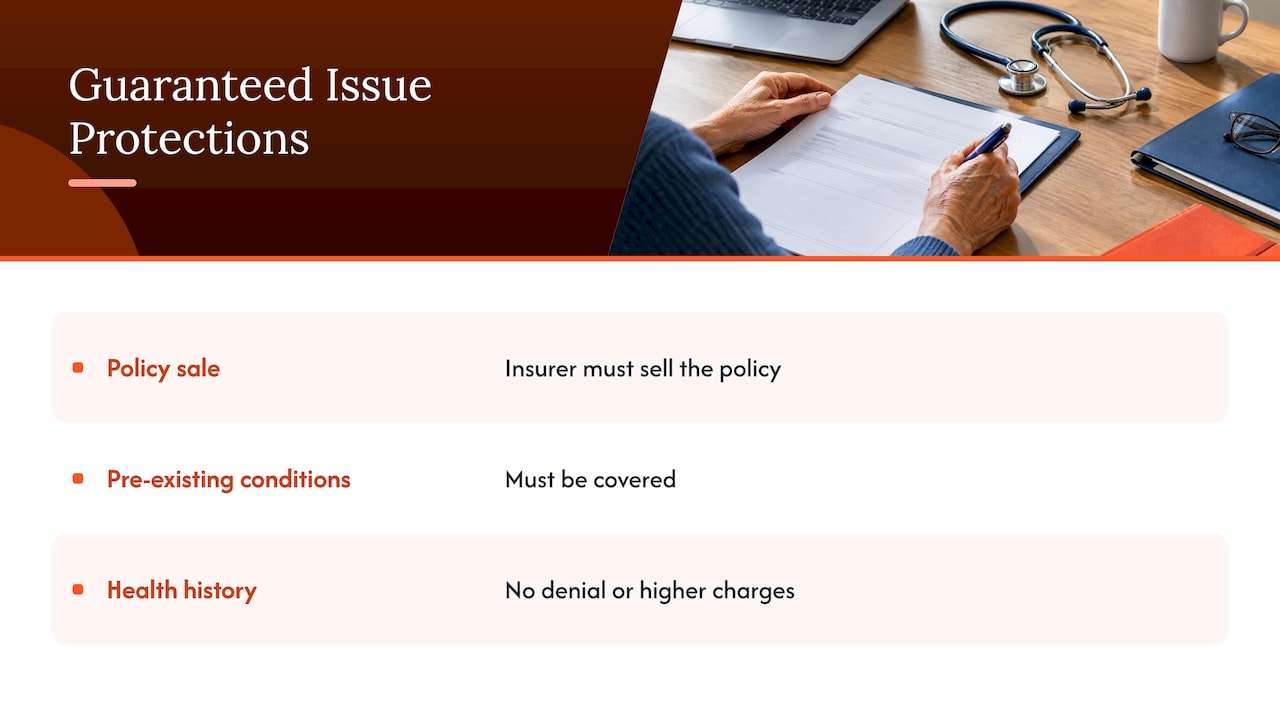
That last point is the whole value. Normally, once your six-month Medigap Open Enrollment Period has passed, a carrier in most states can ask about your health history and decline you. If you want the background on that first window, our guide to locking in Medigap during your six-month open enrollment explains how it works. Guaranteed issue rights are the safety net for everyone whose circumstances change later.
How this differs from open enrollment
The Medigap Open Enrollment Period starts once, when you are 65 or older and enrolled in Part B, and runs for six months. Guaranteed issue rights can start at many different points in your life, because they are triggered by an event, not by your birthday. You can in principle have both over a lifetime, and they do not cancel each other.
Situations that can trigger a guaranteed issue right
Medicare’s guide lists the situations in detail. In general they fall into a few families, summarized here.
| Situation | What happened | What it usually means for you |
|---|---|---|
| Medicare Advantage plan ends or leaves your area | Your plan stops serving your area or your coverage otherwise ends | You can move to Original Medicare and apply for a Medigap policy |
| Employer group plan ends | A group plan that paid after Medicare stops | You have a limited window to buy Medigap |
| Leaving a Medicare SELECT area | You move out of the service area of a Medicare SELECT policy | You can buy another Medigap policy |
| Trial right | You joined Medicare Advantage or left a Medigap policy when first eligible, and change your mind | In some cases you can return to Medigap within a year |
The exact conditions, such as which kind of coverage counts and what you must have done before, are spelled out in the official Medicare guide. Read the section that matches your event, because small details change which plans you can buy.
When your Medicare Advantage plan leaves
This is the most common case we see for people in the Charlotte area. Carriers adjust their service areas and networks from year to year. If your plan stops covering where you live, you generally get a guaranteed issue right to buy Medigap. Because the plan’s end date is known in advance, you can often apply early. Our page on switching from Medicare Advantage to Medigap within 63 days walks through the timing in more detail.
When employer coverage ends
Many people keep working past 65 and have a group plan that pays after Medicare. When that plan ends, because you retire or the employer drops it, a guaranteed issue right can open. The clock starts at the date the coverage ends, not the date you hear the news, so keep the termination letter and note the date on it.
The 12-month trial right
Trial rights are for people who tried something new and want to go back. According to Medicare’s guide, certain people who leave a Medicare Advantage plan within a year can return to a Medigap policy. If this sounds like you, read about the 12-month Medicare Advantage trial right, including when you can apply early.
When more than one situation applies
Sometimes two situations overlap, for example a plan leaving your area just as you move. The guide says that in general you can choose the one that gives you the best result. Do not assume the first one you notice is the best one. Compare the plan choices and deadlines under each.
Which Medigap plans you can buy
Under federal rules you are generally entitled to buy Medigap Plan A, B, C, D, F or G, depending on your eligibility, according to Medicare. Two details matter:
- Plans C and F are not sold to people who became newly eligible for Medicare on or after January 1, 2020. If that is you, Plan G is the closest option among the plans listed.
- Which plans you can pick can depend on the specific guaranteed issue situation you are in. The guide lays this out event by event.
Plan letters describe standardized benefits, so a Plan G from one company covers the same things as a Plan G from another. What differs is the premium, how the company raises it over time and how it treats you as a customer. That is why it is worth comparing carriers even when your right to buy is guaranteed. If you are weighing Medigap against staying in a managed plan, our comparison of Medicare Advantage and Medigap plans lays out the trade-offs.
The deadline: 63 days, and why to apply early
For most guaranteed issue situations you must apply no more than 63 days after your previous coverage ends. Medicare’s guide adds that in some cases you can apply as early as 60 days before your Medicare Advantage coverage ends. An Indiana state publication also describes the 63 calendar day window as the general rule for most qualifying events.
Two timing points trip people up:
- Medigap cannot start before your current coverage ends. Medicare’s guide is clear that a policy does not begin until the current plan has officially terminated. So you time the application so the new policy starts the day after the old one stops.
- Guaranteed issue rights do not extend your old policy. The Indiana guide recommends applying early so you avoid a gap in health coverage. The 63 days is a deadline to apply, not a grace period for coverage.
The South Carolina Department of Insurance’s shopper’s guide takes the same practical view and suggests planning ahead and applying while your current plan is still active to prevent gaps in medical coverage during a transition.
A simple timeline
Suppose your Medicare Advantage plan sends a notice that it will end at the close of the year. A sensible sequence looks like this:
- Save the notice the day it arrives.
- Confirm which guaranteed issue situation fits and which plans you can buy.
- Get quotes for the plan letter you want from several carriers.
- Submit the application early enough that the Medigap start date matches the day after your old coverage ends.
- Keep copies of everything you submit.
The point is that you are not racing the clock when you start early. You are choosing from a calm position.
What proof to have ready
Insurers may ask you to show that you qualify. Medicare’s guide says you may need copies of documents such as termination notices, letters from your plan or claim denials that list your name and the date your coverage ended. Send them with your application.
A short checklist:
- The notice or letter that states your coverage is ending or has ended, with the date
- Your name exactly as it appears on your Medicare card
- Any earlier policy information, if you are using a trial right
- Proof of the move, if a change of address is the trigger
If a document is missing, ask the old plan or employer for a replacement right away. Do not wait until day 60.
State rules can go further than federal rules
Federal law sets the floor. States can add to it. KFF’s overview of Medigap guaranteed issue requirements notes that some states provide broader protections, such as annual or continuous guaranteed issue periods or rights for people under 65. It also notes that Massachusetts, Minnesota and Wisconsin run their own standardized Medigap systems that differ from the federal structure.
That means two people with the same event can have different options depending on where they live. Medicare advises that you check with your State Insurance Department to see whether you can buy a Medigap policy outside the Open Enrollment Period and whether you have additional rights under state law. If you live in or are moving to North Carolina, ask us or the state department which rights apply to you before you assume the federal 63-day rule is the whole story.
What happens if you miss the window
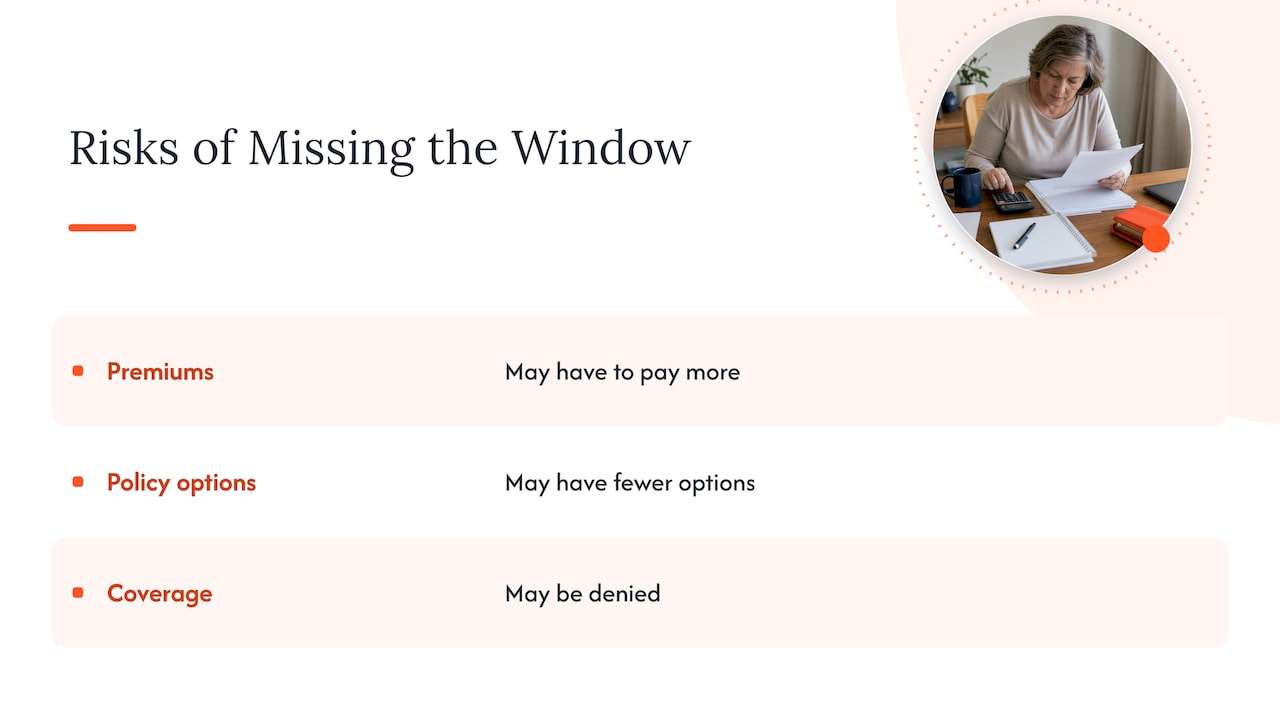
The cost of missing it is real but not always final. Medicare explains that outside your Open Enrollment Period you may have to pay more, have fewer policy options, or be denied if you do not meet the insurer’s medical underwriting requirements. KFF also reports that federal law lets insurers use medical underwriting to deny policies or charge higher premiums outside guaranteed issue periods.
If you are in that position, it helps to know what insurers can and cannot do. Our pages on Medigap underwriting rules and on pre-existing conditions and Medigap explain when health questions are allowed and how to prepare. Your state may also offer another opening, and a special enrollment period on the Medicare side might help; see how to change your Medicare plan mid-year.
Our perspective
Most of the worry we hear about guaranteed issue rights is really worry about timing. People get a letter that their plan is ending, set it aside, and find the days have gone by. The rights are strong, but they only work if you use them in time.
Our approach is to start from the date on your notice and work forward. We check which situation fits you, which plan letters you can buy and which carriers are worth quoting. We train our agents to explain the choices plainly and to give guidance that is personalized to you, at no extra cost to you.
We also like to look back after you enroll. An annual plan review catches changes in your needs, and a local agent in Charlotte can answer when something in the mail does not look right. A guaranteed issue right is a good start. A plan you understand and keep reviewing is the better finish.
Zach
Get help applying before your window closes
If your coverage is ending, or you think you may qualify for a guaranteed issue right, we can help you confirm your situation, compare Medigap carriers and line up the start date so there is no gap. We also work with Medicare Advantage, Part D and supplemental plans, so you can see every option side by side. Learn more about Medicare Supplement plans in Charlotte, NC, or start from our main page and ask for your free Medicare roadmap.

Bring your termination notice and your Medicare card to the conversation. That is usually all we need to begin.
FAQ
What are the qualifying reasons for a Medigap guaranteed issue right?
The common ones involve losing coverage: a Medicare Advantage plan leaving your area, an employer group plan that pays after Medicare ending, or moving out of a Medicare SELECT service area. Trial rights can also let some people return to Medigap after leaving a Medicare Advantage plan within a year. The full list is in Medicare’s Medigap guide.
How long do I have to use a guaranteed issue right?
In most cases you must apply no more than 63 days after your previous coverage ends. Some situations let you apply as much as 60 days before a Medicare Advantage plan ends. Applying early is wise, because Medigap cannot begin until your old coverage has ended.
Can an insurer charge me more or exclude my health conditions?
Not when you apply under a guaranteed issue right. Federal rules say the company must sell you the policy, cover your pre-existing conditions and not charge more because of your health. Outside those rights, and outside your Open Enrollment Period, medical underwriting can apply.
Does every state follow the same guaranteed issue rules?
The federal rights apply everywhere, but states can offer more. Some provide yearly or continuous guaranteed issue periods or cover people under 65, and a few states run their own standardized systems. Check with your State Insurance Department to see what applies where you live.
Sources
- Get ready to buy: guaranteed issue rights | Medicare
- Choosing a Medigap Policy: A Guide to Health Insurance for People with Medicare
- Choosing a Medigap Policy | Medicare
- Medigap RIGHTS | Indiana SHIP
- Medicare Supplement Insurance shopper’s guide | South Carolina Department of Insurance
- Medigap Guaranteed Issue Requirements: An Overview of Federal and State Rules | KFF
Recommended
Request a No Obligation Phone Call








Get Connected