

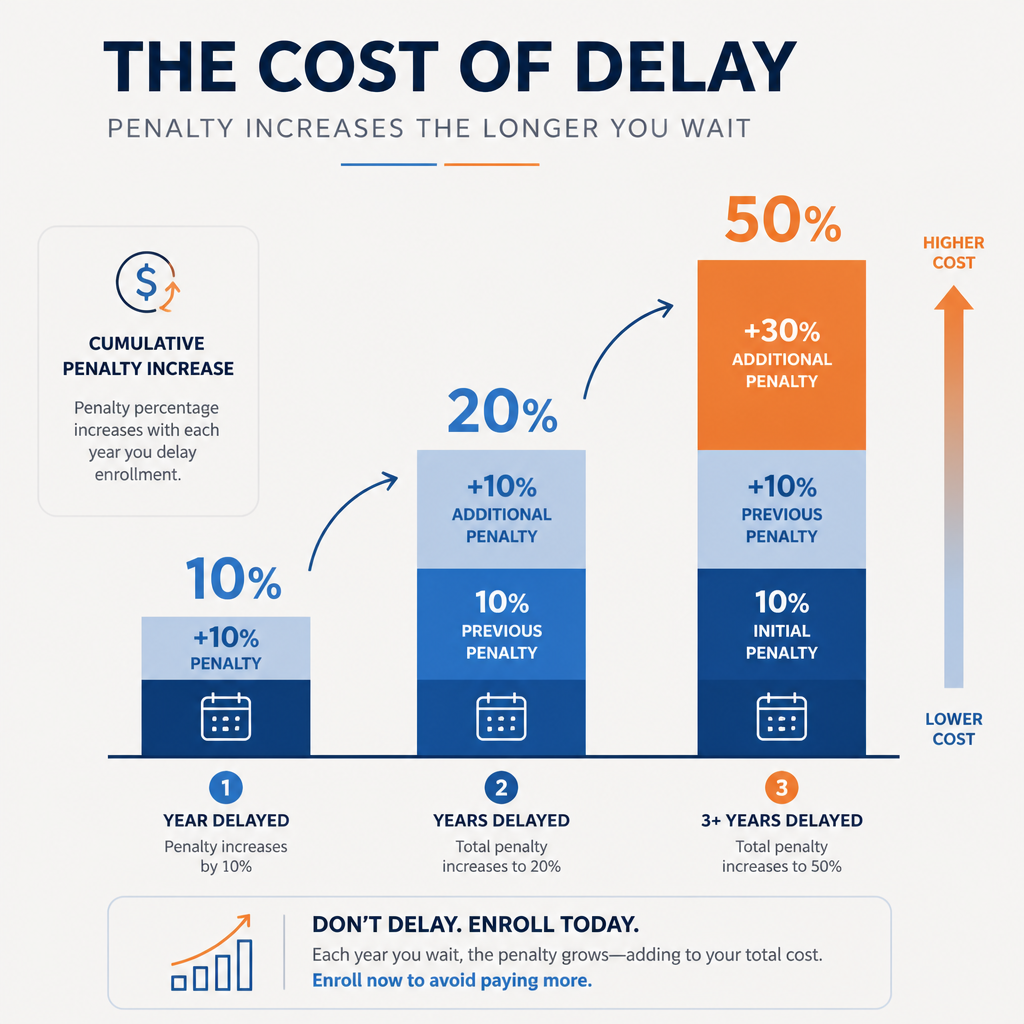
Missing a Medicare enrollment window is one of the most expensive mistakes a person approaching 65 can make, and the Medicare Part B penalty is the one that stings the longest. Unlike a one-time fee you pay and forget, this penalty is permanent. It adds 10% to your monthly Part B premium for every full 12-month period you were eligible but did not sign up. Miss two years, pay 20% more. Miss five years, pay 50% more. For the rest of your life. If you are turning 65 soon and live in the Charlotte area, understanding exactly how this penalty works, and how to sidestep it entirely, is one of the most valuable things you can do before your birthday arrives.
Table of Contents
- What Is the Medicare Part B Penalty?
- Quick Takeaways
- Your Enrollment Windows Explained
- When You Can Legally Delay Part B Without Penalty
- Common Mistakes That Trigger the Penalty
- How to Appeal or Eliminate the Penalty
- Enrollment Strategy Comparison
- Frequently Asked Questions
- References
What Is the Medicare Part B Penalty?
The Medicare Part B late enrollment penalty is a permanent surcharge added to your monthly Part B premium when you do not sign up for Part B during your designated enrollment window and do not qualify for an exception. The federal government, not private insurance companies, enforces this penalty.
The math is straightforward but unforgiving. For each full 12-month period you were eligible for Part B but did not enroll, your monthly premium goes up by 10%. That penalty is then calculated on top of the standard base premium every year, even as the base premium rises. In 2026, the standard Part B premium is $202.90 per month, up from $185.00 in 2025. A 20% penalty on the 2026 base rate means you pay an extra $40.58 every single month, and that number will grow as premiums increase in future years.
The penalty stays with you for as long as you are enrolled in Part B. There is no point at which it expires or gets forgiven, with a narrow set of exceptions covered later in this article.
Quick Takeaways
| Key Insight | Explanation |
|---|---|
| The penalty is permanent and cumulative | You pay 10% extra for every full year you missed. Miss 3 years, the penalty is 30%, added to your monthly premium for life. |
| Your Initial Enrollment Period is 7 months long | It starts 3 months before your 65th birthday month and ends 3 months after. Missing this window without a valid exception triggers the penalty. |
| Active employer coverage is the key exception | If you or your spouse has coverage through active current employment, you can delay Part B without penalty, then use an 8-month Special Enrollment Period after coverage ends. |
| COBRA and marketplace plans do NOT protect you | Coverage through COBRA or the ACA marketplace does not qualify as creditable coverage that lets you delay Part B without penalty. |
| The General Enrollment Period is a fallback, not a fix | If you miss your IEP without a valid exception, you can enroll January 1 through March 31 each year, but the penalty will still apply. |
| Medicare Savings Programs can waive the penalty | If you qualify for a state Medicare Savings Program, the state pays your Part B premiums and existing late enrollment penalties are eliminated. |
| A licensed Medicare agent costs you nothing | Working with an independent agency like Safeguard Benefit Services in Charlotte is free. Getting the enrollment timing wrong costs you for life. |
The single most common reason people in North Carolina call Safeguard Benefit Services is that they enrolled late, or nearly did, because no one explained the penalty rules to them before their 65th birthday. The information exists, but it is scattered across government websites and rarely delivered in plain language. That is what this guide is for.

Your Enrollment Windows Explained
There are three enrollment windows that matter for Part B. Knowing which one applies to your situation is the difference between paying the standard premium and paying a surcharge forever.
The Initial Enrollment Period (IEP)
The IEP is a 7-month window that begins 3 months before the month you turn 65, includes your birthday month, and ends 3 months after. This is your primary opportunity to enroll without any penalty. Signing up in the first three months of your IEP means your coverage starts on the first day of your birthday month. If you sign up during or after your birthday month, your coverage start date shifts forward by one to three months, which matters if you need coverage quickly.
If you retire before age 65, your IEP occurs around your 65th birthday, and signing up during that window is the standard path to penalty-free enrollment.
The Special Enrollment Period (SEP)
The SEP is available to people who delayed Part B because they or their spouse had health insurance through active current employment. This period lasts up to 8 months after that employer coverage ends or after employment ends, whichever comes first. You do not have to wait for your employer coverage to end before enrolling. You can sign up for Part B at any point while still covered by the employer plan, and your Part B coverage will begin the first of the month following enrollment.
Pro tip: Do not wait until the last minute of your 8-month SEP window. If you misjudge the timeline and the SEP closes before you enroll, you will be stuck waiting for the General Enrollment Period and will owe a penalty. Set a calendar reminder 6 months after your coverage ends and act then, not in month 8.
The General Enrollment Period (GEP)
The GEP runs from January 1 through March 31 every year. It is the safety net for people who missed their IEP and do not qualify for a SEP. As of 2023, coverage through the GEP now starts on the first of the month following enrollment, which is an improvement over the old rules that delayed coverage until July 1. However, signing up through the GEP rather than your IEP or SEP means the late enrollment penalty almost certainly applies to you, and it will be calculated based on how long you went without enrolling.
When You Can Legally Delay Part B Without Penalty
Delaying Part B enrollment is sometimes the right financial move. Part B has a monthly premium, and if you have solid coverage elsewhere, paying two premiums at once may be unnecessary. The question is whether your other coverage actually qualifies as a valid reason to delay.
Coverage Through Your Own or Your Spouse’s Active Employer
If you or your spouse is still working and you have health coverage through that active employer, you can delay Part B without penalty. The key word is active employment. The coverage must come from a current job, not a former job. Once that employment ends and the employer coverage is gone, your 8-month SEP begins, and you must enroll within that window to avoid the penalty.
Coverage That Does NOT Protect You
This is where people make expensive mistakes. COBRA coverage does not qualify as the type of creditable employer coverage that lets you delay Part B without a penalty. The same applies to individual marketplace plans purchased through the ACA. If you retired at 63, took COBRA for 18 months, and then assumed you had a SEP when you turned 65, you would be wrong. Your IEP runs on your birthday schedule regardless of what other coverage you have unless it comes from active current employment.
The penalty does not care about your intentions or your other coverage. It only cares whether your delay was legally permitted. Most people who pay the penalty did not know they were in the wrong category of coverage until it was too late.
If you are a federal employee with FEHB coverage, you do qualify for a SEP based on that coverage, which begins at retirement and lasts 8 months. The same general rules apply: enroll within that window and no penalty attaches.
Pro tip: If you turned down Part B because you thought your retiree health coverage would protect you, call a licensed Medicare specialist before your situation changes. Retiree coverage from a former employer is not the same as active employer coverage for penalty purposes. Getting a second opinion now costs nothing. Realizing the mistake after the SEP closes costs you every month for the rest of your life.

Common Mistakes That Trigger the Penalty
After working with Medicare clients across the Charlotte region, certain patterns show up repeatedly. These are not obscure edge cases. They are the most common ways otherwise informed people end up paying a penalty they never expected.
Assuming Marketplace or COBRA Coverage Counts
This is the most frequent and most costly mistake. People who lost job-based coverage before turning 65 often continued with COBRA or purchased an ACA marketplace plan. When they turn 65, they assume that existing health coverage gives them the flexibility to delay Part B. It does not. The IEP clock runs on your birthday, not on when your current coverage runs out.
Missing the Enrollment Window After Retirement
People who retire with employer coverage often assume they have unlimited time to sign up for Part B. In reality, the 8-month SEP starts the day their employer coverage ends (or the month employment ends, whichever comes first), and it does not pause or restart. Someone who retires in March and does not think about Medicare until November of the following year may have already missed the window entirely.
Counting Small Employer Coverage as Protection
If your employer has fewer than 20 employees, Medicare is typically the primary payer, not your employer plan. In that situation, you generally need to enroll in Part B at 65 regardless of employer coverage. Failing to do so can result in both a penalty and gaps in coverage, because your employer plan may not cover costs that Medicare would have paid as primary.
Enrolling Only in Part A and Forgetting Part B
Many people enroll in premium-free Part A automatically (through Social Security enrollment) but skip Part B because they do not want to pay the premium. If they later decide they need Part B and do not have a qualifying SEP, the penalty accrues from when they were first eligible, not from when they tried to enroll.
How to Appeal or Eliminate the Penalty
If you are already facing a Part B late enrollment penalty, you are not necessarily stuck with it forever. There are limited but real paths to reducing or removing it.
Appealing Based on Employer Coverage
If you had job-based insurance during the relevant enrollment period and can document it, you may have grounds to appeal the penalty. The Social Security Administration reviews these cases. Documentation matters enormously: written confirmation from your former employer stating the start and end dates of your group health plan coverage is typically what you need. This is worth pursuing if you genuinely had qualifying employer coverage and were wrongly assessed a penalty.
Medicare Savings Programs (MSPs)
If you have limited income and resources, you may qualify for a state Medicare Savings Program. Enrolling in an MSP means the state pays your Part B premiums on your behalf, and any existing Part B late enrollment penalties are eliminated. MSPs also allow you to enroll in Part B outside of the usual enrollment periods. In North Carolina, eligibility is handled through Medicaid, and a licensed Medicare specialist can walk you through whether you qualify and how to apply.
Living Abroad Exception
People who lived outside the United States and its territories and were not entitled to premium-free Part A cannot enroll in Part B from abroad. When they return and establish U.S. residency, they receive a special enrollment period that begins in the month they return and lasts up to two months. If they enroll during that window, no late penalty applies for the time spent living abroad.
Enrollment Strategy Comparison
| Enrollment Path | When It Applies | Penalty Risk |
|---|---|---|
| Initial Enrollment Period (IEP) | 7-month window centered on your 65th birthday month | No penalty if you enroll on time |
| Special Enrollment Period (SEP) | Active employer coverage at 65; 8-month window after coverage or employment ends | No penalty if you enroll within the SEP window |
| General Enrollment Period (GEP) | January 1 through March 31, for those who missed IEP and do not qualify for a SEP | Penalty applies; calculated based on months missed |
In practice, the IEP and the SEP are the only two paths that reliably prevent the penalty. The GEP is a fallback, not a strategy. If you are approaching 65 and are unsure which path applies to your situation, that uncertainty is exactly why speaking with a licensed Medicare advisor before your birthday matters more than most people realize.
At Safeguard Benefit Services, the team provides free consultations specifically designed to walk through situations like these. Working with 30+ carriers and 8+ years of experience helping North Carolina residents navigate Medicare, the advisors there will tell you exactly where you stand, which enrollment period applies to you, and what steps to take before your window closes. That guidance costs you nothing. Paying a permanent penalty costs you every month for the rest of your life.
Frequently Asked Questions
How is the Medicare Part B late enrollment penalty calculated?
The penalty is 10% of the standard Part B base premium for each full 12-month period you were eligible for Part B but did not enroll. The penalty is calculated using the standard base premium, not your income-adjusted premium, and it is added on top of whatever premium you owe. In 2026, the standard base premium is $202.90 per month. A 30% penalty adds approximately $60.87 to your monthly bill, every month, for as long as you have Part B.
Does COBRA coverage protect me from the Part B late enrollment penalty?
No. COBRA is not considered active employer-sponsored coverage for purposes of delaying Part B enrollment without penalty. If you are relying on COBRA after a job loss or retirement and you are turning 65, your Initial Enrollment Period clock is running based on your birthday, not based on your COBRA end date. Enroll in Part B during your IEP even if you are still on COBRA, or you risk accruing a penalty.
What if I missed my Initial Enrollment Period? Can I still avoid the penalty?
It depends on why you missed it. If you had qualifying employer coverage through active current employment (your own or your spouse’s), you can use the Special Enrollment Period and avoid the penalty entirely. If you missed your IEP without a valid reason, you will generally owe a penalty. You can still enroll during the General Enrollment Period each year, but the penalty will be added to your premium. The only way to have that penalty removed after the fact is through a successful appeal (if you had qualifying coverage that was not documented) or by qualifying for a Medicare Savings Program.
How long does the Medicare Part B penalty last?
The penalty lasts for as long as you are enrolled in Part B. It does not expire after a set number of years, and it does not shrink over time. The only exceptions are a successful appeal, enrollment in a Medicare Savings Program, or special circumstances recognized by Social Security. For most people who incur the penalty, it is a permanent increase to their monthly premium.
I am still working at 65. Do I have to enroll in Medicare Part B?
Not necessarily, but it depends on the size of your employer. If your employer has 20 or more employees, your employer coverage is typically primary and Medicare is secondary, which means you can legitimately delay Part B and use the SEP when you retire. If your employer has fewer than 20 employees, Medicare is generally primary, and you should enroll in Part B at 65 to avoid both the penalty and unexpected coverage gaps. When in doubt, ask your employer’s HR department whether Medicare or your group plan pays first, and then confirm with a licensed Medicare advisor.
Can I avoid the Medicare Part B penalty if I qualify for a Medicare Savings Program?
Yes. If you qualify for a state Medicare Savings Program, the state pays your Part B premiums and any existing late enrollment penalties are waived. In North Carolina, the MSP application is handled through the Medicaid program. Income and asset limits apply, and eligibility varies depending on which tier of the MSP you qualify for. This is one of the few situations where a penalty already in place can be fully eliminated, so it is worth checking your eligibility even after a penalty has been assessed.
What is the difference between the General Enrollment Period and the Special Enrollment Period?
The Special Enrollment Period is penalty-free and available only to people who delayed Part B because of active employer-based coverage. The General Enrollment Period runs from January 1 to March 31 each year and is available to anyone who missed their IEP, but it comes with the late enrollment penalty already attached. As of 2023, GEP enrollments have coverage starting on the first of the following month, which is faster than the old July 1 start date. But faster coverage still means a permanent penalty if you did not qualify for a SEP.
Have you or someone you know been surprised by a Medicare enrollment deadline? Share what happened in the comments so others in the Charlotte area can learn from real experiences.
References
- Official Medicare.gov guidance on how to avoid late enrollment penalties for Part A and Part B
- AARP explanation of how the Part B late enrollment penalty is calculated and when it applies
- Centers for Medicare and Medicaid Services rules on Part A and Part B enrollment periods and late penalties
- Overview of the 2023 changes to General Enrollment Period coverage start dates
- 2026 standard Medicare Part B premium amount and year-over-year increase








Get Connected