
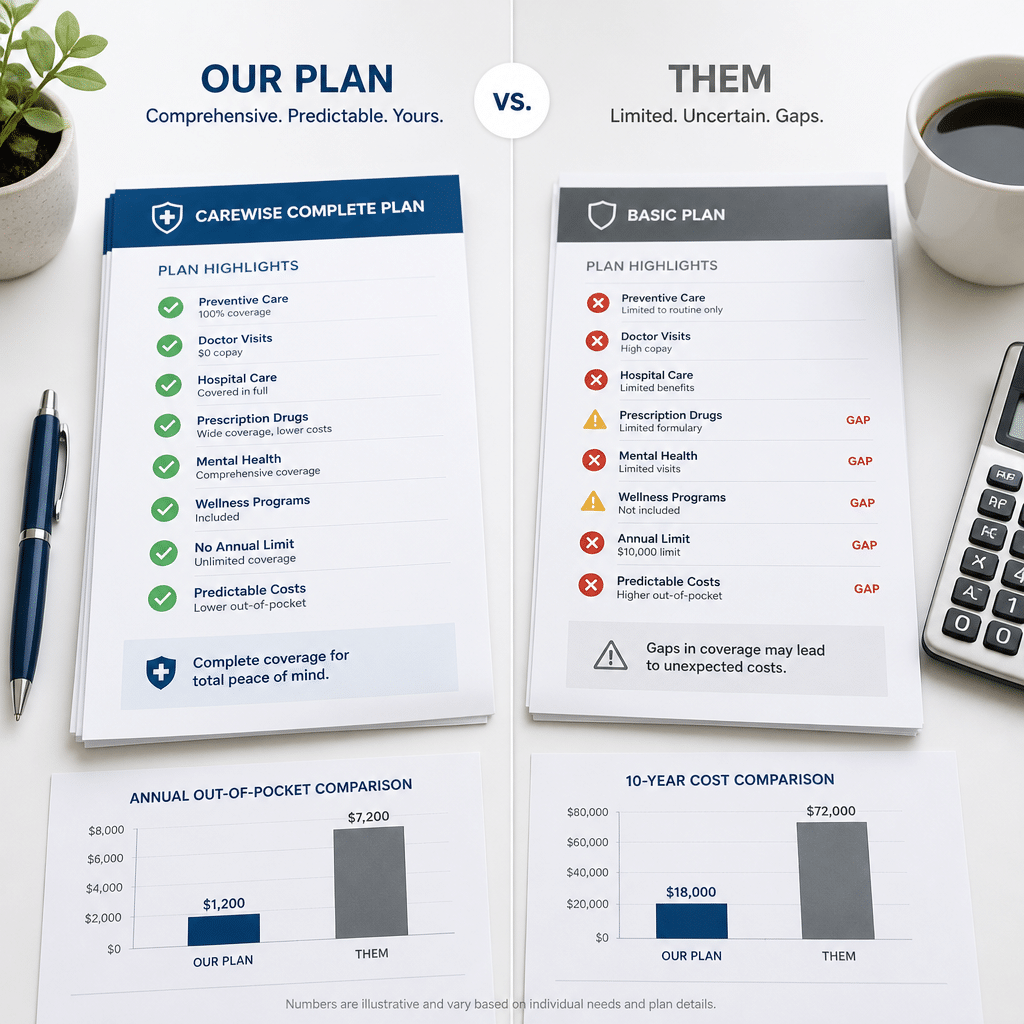
Most people turning 65 in Charlotte assume that picking between Medicare Supplement Plan G and Plan N is just a matter of choosing a cheaper premium or a more complete plan. That assumption costs some people hundreds of dollars a year, and it leaves others exposed to bills they never saw coming. The two plans share a lot of DNA, but the differences are precisely the ones that matter most when you actually need care. This guide cuts through the noise, explains exactly what each plan covers and what it does not, and gives you a direct recommendation based on your situation as a North Carolina resident.
Table of Contents
- Quick Takeaways
- What Plan G and Plan N Actually Cover
- The Real Cost Difference: Premiums vs. Out-of-Pocket
- The Excess Charge Question for North Carolina Residents
- Plan G vs. Plan N: Side-by-Side Comparison
- Who Should Choose Plan G
- Who Should Choose Plan N
- Enrollment Timing and the NC Birthday Rule Gap
- How Safeguard Benefit Services Helps Charlotte Residents Choose
- Frequently Asked Questions
- References
Quick Takeaways
| Key Insight | Explanation |
|---|---|
| Plan G covers nearly everything except the Part B deductible | In 2025, the Medicare Part B deductible is $257. After you pay that once per year, Plan G picks up the rest of your Medicare-approved costs. |
| Plan N has lower premiums but real cost-sharing | Plan N requires copays of up to $20 for some doctor visits and up to $50 for ER visits that don’t lead to admission. These add up if you see doctors frequently. |
| Plan N does not cover Part B excess charges | If your doctor does not accept Medicare assignment, they can charge up to 15% above the Medicare-approved rate. Plan G covers those charges; Plan N does not. |
| North Carolina has no Medigap birthday rule | Unlike some states, NC does not give you an annual window to switch plans without medical underwriting. Your best window to enroll penalty-free is your six-month Medigap Open Enrollment Period. |
| Plan G is the most popular Medigap plan in North Carolina | Plan G is now the top-selling Medicare Supplement plan in NC, followed by Plan N and Plan D, based on enrollment data. |
| Premiums vary significantly by ZIP code, age, and carrier | In Charlotte, Plan G premiums range broadly by carrier, age, and tobacco use. Comparing quotes from multiple insurers is essential to avoid overpaying. |
| Neither plan includes prescription drug coverage | You need a separate Medicare Part D plan regardless of whether you choose Plan G or Plan N. Medigap sold after 2006 does not include drug benefits. |
What Plan G and Plan N Actually Cover
Both Plan G and Plan N are standardized by the federal government. Every insurance company selling Plan G in North Carolina must offer the exact same core benefits. The price varies by carrier; the coverage does not. That is actually good news, because it means you are comparing apples to apples on benefits and can focus your attention on price, company stability, and service.
Plan G covers the Medicare Part A hospital deductible (which is $1,676 per benefit period in 2025), all Part A coinsurance and hospital costs for up to 365 days beyond what Medicare covers, Part B coinsurance (the 20% of Medicare-approved costs that Original Medicare does not pay), the first three pints of blood, hospice care coinsurance, skilled nursing facility coinsurance, and Part B excess charges. The only cost you pay out of pocket with Plan G is the annual Part B deductible, which is $257 in 2025.
Plan N covers all of those same categories with two important differences. First, Plan N does not cover Part B excess charges. Second, while Plan N does pay Part B coinsurance, it requires a copay of up to $20 for certain office visits and up to $50 for emergency room visits that do not result in a hospital admission. If you are admitted from the ER, that $50 copay is waived.
Pro tip: Confirm that any specialist you currently see in Charlotte accepts Medicare assignment before choosing Plan N. If they do, the excess charge risk disappears entirely for those visits.

The Real Cost Difference: Premiums vs. Out-of-Pocket
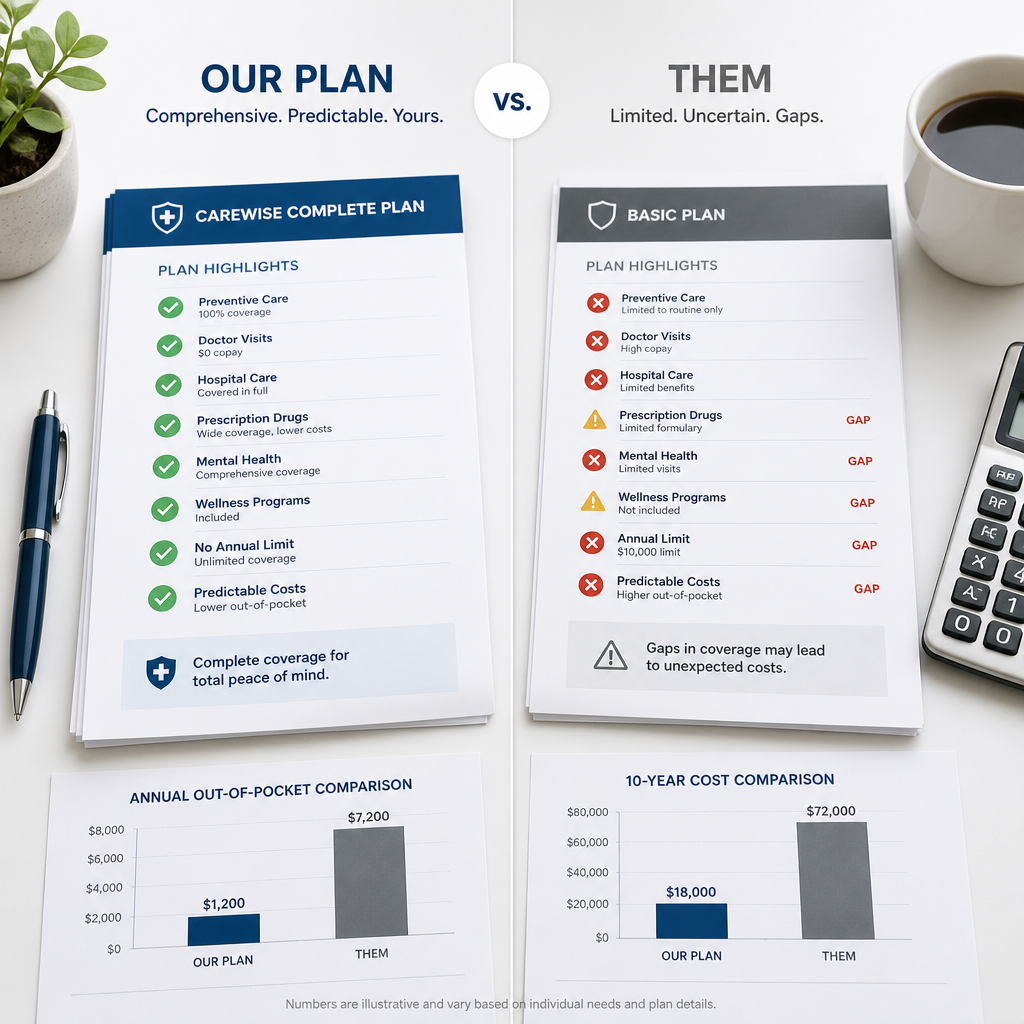
The premium gap between Plan G and Plan N is real, but it is smaller than many people expect. A third-party rate aggregator estimates that for a 65-year-old non-smoking woman in North Carolina, Plan G premiums run around $96 per month and Plan N premiums run around $72 per month from the same carrier. That is roughly a $24 per month difference, or about $288 per year in savings with Plan N.
Here is where the math gets specific. Plan N saves you roughly $288 annually on premiums. But with Plan N, you also pay the $257 Part B deductible and any copays. If you see the doctor ten times in a year, those $20 copays alone add $200 to your annual costs. Add the $257 deductible and your Plan N savings have almost entirely evaporated. If you are in good health and visit the doctor three or four times per year, Plan N’s arithmetic is compelling. If you manage a chronic condition and see multiple providers regularly, Plan G often comes out ahead in total spending.
The plan with the lower premium is not always the plan with the lower total cost. Run the full math before you decide.
Premiums also vary significantly by carrier, pricing method, age, gender, and ZIP code. In Charlotte, Plan G premiums range widely across carriers because each company uses its own pricing approach and rate history. This is why comparing quotes from 30 or more companies, not just one or two, makes a meaningful difference in what you actually pay each month.
Pro tip: Ask each carrier what pricing method they use: community-rated, issue-age-rated, or attained-age-rated. Attained-age-rated plans start cheaper but increase premiums as you get older. Issue-age-rated plans lock in your rate based on the age you are when you enroll, which can be significantly cheaper over ten or twenty years.
The Excess Charge Question for North Carolina Residents
This is the coverage difference that generates the most confusion, and it deserves a direct answer. When a doctor does not accept Medicare assignment, they are permitted to charge up to 15% above the Medicare-approved amount for a service. That extra 15% is called a Part B excess charge. Plan G covers it. Plan N does not.
North Carolina does not have a state law banning excess charges the way some other states do. So if your doctor is a non-participating provider, you are exposed to those charges on Plan N. However, the realistic risk is lower than many people fear. Nationwide, roughly 95% of providers accept Medicare assignment, meaning the vast majority of doctors and specialists you are likely to see in the Charlotte metro area will not bill excess charges at all.
That said, specialists at certain academic or private practices do sometimes operate as non-participating providers. If you see a specialist regularly, it is worth a five-minute phone call to their billing office to confirm they accept Medicare assignment before you commit to Plan N. If they do not, that is a concrete reason to choose Plan G instead.

Plan G vs. Plan N: Side-by-Side Comparison
| Coverage Feature | Medicare Supplement Plan G | Medicare Supplement Plan N |
|---|---|---|
| Medicare Part A deductible ($1,676 in 2025) | Covered | Covered |
| Medicare Part A coinsurance and hospital costs (up to 365 days beyond Medicare) | Covered | Covered |
| Medicare Part B deductible ($257 in 2025) | NOT covered (you pay this once per year) | NOT covered (you pay this once per year) |
| Medicare Part B coinsurance (20%) | Covered in full | Covered, except up to $20 copay per office visit |
| Emergency room visits | Covered in full | Up to $50 copay (waived if admitted) |
| Part B excess charges (up to 15% above Medicare-approved rate) | Covered | NOT covered |
| Skilled nursing facility coinsurance | Covered | Covered |
| Hospice care coinsurance | Covered | Covered |
| First three pints of blood | Covered | Covered |
| Foreign travel emergency (80% after deductible) | Covered | Covered |
| Prescription drug coverage | Not included (need separate Part D) | Not included (need separate Part D) |
| Typical monthly premium range, Charlotte area (varies by carrier and age) | Generally higher | Generally lower |
Who Should Choose Plan G
Plan G is the right call for people who want cost predictability above everything else. After paying the $257 Part B deductible once at the start of the year, you are done with out-of-pocket Medicare costs for all covered services. There are no copays at the doctor’s office, no surprise bills after an ER visit, and no exposure to excess charges.
Situations Where Plan G Makes Clear Sense
If you manage a chronic condition and see multiple specialists, cardiologists, rheumatologists, or any provider where appointment frequency is high, Plan G’s copay-free structure will often cost less in total than Plan N by year-end. The math favors G once you cross about five to six doctor visits per year in many cases.
Plan G also makes strong sense if any of your current doctors or preferred specialists in the Charlotte area are non-participating providers who bill excess charges. Rather than changing doctors or risking unexpected bills, Plan G closes that gap completely.
Finally, Plan G is worth the slightly higher premium if predictability itself has value to you. Many people approaching retirement find that knowing their maximum exposure for the year is exactly $257 is worth paying a bit more each month. Budgeting becomes straightforward.
Who Should Choose Plan N
Plan N is a genuinely strong option for the right person. It is not a lesser plan. It is a different trade-off.
Situations Where Plan N Makes Financial Sense
If you are in good health, rarely see the doctor beyond an annual wellness visit and one or two follow-ups per year, and your current providers all accept Medicare assignment, Plan N can save you real money annually without meaningful additional risk. The premium savings compared to Plan G can easily reach $200 to $300 per year depending on the carrier and your specific ZIP code in Charlotte.
Plan N is also a reasonable choice for people who are willing to be a little proactive. Verifying Medicare assignment before booking an appointment takes one phone call. Choosing providers who accept assignment eliminates the excess charge exposure entirely. For organized, engaged patients, Plan N rewards that behavior with lower monthly costs.
A common mistake with Plan N is choosing it purely based on the premium without accounting for the Part B deductible, the potential copays, and the excess charge exposure. Run the numbers for your actual doctor visit pattern, not a hypothetical one.
Enrollment Timing and the NC Birthday Rule Gap
When you enroll in Medicare Supplement coverage matters enormously, and North Carolina has a specific gap that catches many residents off guard.
Your Medigap Open Enrollment Period is a six-month window that begins the month you turn 65 and are enrolled in Medicare Part B. During this window, insurance companies cannot deny your application, require medical underwriting, or charge you more based on pre-existing health conditions. This is your strongest protection, and it is the best time to lock in Plan G or Plan N coverage regardless of your health history.
After that six-month window closes, the rules change. In most states, including North Carolina, you can apply for a Medigap plan at any time of year, but the carrier can review your health history and may deny coverage or charge higher premiums based on pre-existing conditions. This is called medical underwriting.
Some states have a “birthday rule” that gives residents an annual window, usually around their birthday each year, to switch Medigap plans without underwriting. North Carolina does not have this rule. If you miss your initial Open Enrollment Period or want to switch from Plan N to Plan G later because your health has changed, you may be subject to full medical underwriting and could be denied or charged more. This makes the decision at age 65 more consequential than in states with birthday rule protections.
There are specific life events, such as losing employer coverage or losing a Medicare Advantage plan, that can trigger guaranteed issue rights outside the initial enrollment period. A licensed agent can help you identify whether one of those situations applies to you.
How Safeguard Benefit Services Helps Charlotte Residents Choose
Safeguard Benefit Services is a Charlotte-based Medicare insurance agency that has been helping North Carolina residents navigate exactly this kind of decision for over eight years. The difference between working with an independent agency like Safeguard and going directly to a single insurer is access to comparison. Safeguard works with 30 or more insurance companies, which means they can show you what Plan G and Plan N actually cost from multiple carriers for your specific age, ZIP code, and health situation, not just the one or two options a single company offers.
The consultation is free, and there is no obligation to enroll. Licensed agents at Safeguard walk through your current doctors, anticipated healthcare use, and budget to give you a direct recommendation rather than a list of options with no guidance on which fits your life. That is a meaningful distinction from tools that generate quote lists and leave you to sort it out on your own.
If you found this article through social media and are turning 65 in the next few months, the most important step you can take right now is scheduling a consultation before your Medigap Open Enrollment Period opens or closes. That six-month window does not wait, and the decisions made during it follow you for years. Visit safeguardbenefitservices.com to book a free consultation with a licensed agent who knows the Charlotte market.
Frequently Asked Questions
Can I switch from Plan N to Plan G after I enroll?
Yes, you can apply to switch at any time, but in North Carolina there is no birthday rule or annual window to do so without health screening. If you apply to switch after your Medigap Open Enrollment Period has closed, the insurance company can require medical underwriting and may deny your application or charge higher premiums based on your health history. This is a strong reason to think carefully about the right plan when you first enroll at 65, rather than assuming you can easily upgrade later.
Does Plan N cover emergency room visits?
Plan N covers emergency room visits, but with a copay of up to $50. That $50 copay is waived entirely if your ER visit results in a hospital admission. Plan G covers ER visits in full with no copay, after your $257 annual Part B deductible is met.
What are Part B excess charges and should I be worried about them in Charlotte?
Part B excess charges are the extra amount, up to 15% above the Medicare-approved rate, that a doctor can bill if they do not accept Medicare assignment. Plan G covers those charges; Plan N does not. In practice, the majority of providers nationwide accept Medicare assignment and cannot bill excess charges. In Charlotte and the broader North Carolina area, you can verify whether your doctor accepts assignment by calling their billing office directly before your appointment. If all your providers accept assignment, the excess charge coverage in Plan G provides little practical benefit to you.
Do either Plan G or Plan N include prescription drug coverage?
Neither plan includes prescription drug coverage. Medicare Supplement plans sold after 2006 are prohibited from including drug benefits. You will need to enroll in a separate Medicare Part D prescription drug plan alongside either Plan G or Plan N. A licensed agent can help you select a Part D plan that matches your specific medications and preferred pharmacy.
Is there a network of doctors I have to use with Plan G or Plan N?
No. Both Plan G and Plan N work with Original Medicare, which means you can see any doctor or specialist in the United States who accepts Medicare. There are no networks, no referrals required, and no prior authorization hurdles. This is one of the primary advantages Medicare Supplement plans have over Medicare Advantage plans, which typically operate within provider networks.
How do I find the cheapest Plan G or Plan N rate in Charlotte?
The only way to find the most competitive rate is to compare quotes from multiple carriers, not just one or two. Because Plan G and Plan N benefits are standardized by the federal government, the coverage is identical across all carriers. The difference is purely in the premium, the company’s rate history, and its financial stability. Working with an independent agency that quotes from 30 or more carriers, like Safeguard Benefit Services, is the most efficient way to identify the lowest rate for your specific age, gender, ZIP code, and tobacco status in Charlotte.
What happens if I turn 65 and don’t enroll in a Medicare Supplement plan right away?
If you do not enroll in a Medigap plan during your six-month Open Enrollment Period, you may face medical underwriting if you try to enroll later in North Carolina. Insurers can review your health history and deny coverage or charge higher rates. There are some specific situations, called guaranteed issue events, that allow you to enroll without underwriting outside the initial period, such as losing employer-sponsored coverage. Missing the enrollment window without a qualifying event is one of the most common and costly mistakes new Medicare beneficiaries make, so it pays to plan ahead.
Have you already compared Plan G and Plan N quotes in Charlotte, or are you still working through which plan fits your situation? Share your questions or experience in the comments below.
References
- Official CMS fact sheet on 2025 Medicare Part A and Part B premiums, deductibles, and coinsurance amounts
- Detailed breakdown of Medigap Plan G vs. Plan N coverage differences, copays, and cost-sharing
- Medicare Supplement plan enrollment data and premium ranges specific to Charlotte, North Carolina
- Explanation of Plan N copays and Part B excess charge exclusions for seniors in the Carolinas
- North Carolina Plan N rates, guaranteed issue rules, and comparison with Plan G for new enrollees








Get Connected