

If you move within the United States, your Original Medicare (Part A and Part B) goes with you. What can change is everything built around a local service area: Medicare Advantage plans and Part D drug plans. Tell Social Security and your plan about the new address, check whether your plan still covers your new ZIP code, and use the special enrollment window that opens when you move. It is short, so don’t let it lapse.
This guide walks through each type of coverage, who needs to hear about your move, the deadlines that matter and a simple timeline you can follow.
TL;DR
- Original Medicare works in every state. You keep it as long as your new doctors and hospitals accept Medicare.
- Medicare Advantage and Part D plans are tied to service areas. A move out of your plan’s area gives you a special enrollment period that lasts for two full months after you move.
- Update your address with Social Security, then notify your Medicare Advantage, Part D and Medigap insurers.
- If you leave Medicare Advantage for Original Medicare, you may have up to 63 days of guaranteed-issue rights to buy most Medigap plans.
- Free, unbiased help is available from your state’s SHIP counselors and 1-800-MEDICARE.
Table of Contents
- What stays the same when you move
- What can change: plans with service areas
- Who to notify, and in what order
- How long you have to switch plans
- Moving with a Medigap policy
- Prescription coverage after a move
- If you get Extra Help or help from your state
- Dental, vision and hearing after a move
- A simple timeline for your move
- Where to get unbiased help
- Our perspective: plan the move around your coverage, not the reverse
- Get a plan check before you move
- FAQ
- Sources
What stays the same when you move
Original Medicare is a federal program, so it does not care which state you live in. According to AARP’s explanation of moving states with Medicare, you won’t lose Original Medicare coverage if you move within the U.S., as long as your new provider accepts Medicare. In practice, most doctors and hospitals do, but it is worth confirming that your new primary care doctor is taking new Medicare patients before you rely on the appointment.
Your Part A and Part B premiums and your Medicare card stay the same too. The one thing to handle is your mailing address, covered below.
What can change: plans with service areas
The pieces of Medicare that come from private insurers are different. Medicare Advantage (Part C) and Part D prescription drug plans are offered by service area, usually by county or region. A plan that works well in Charlotte may not exist in Phoenix, and a plan in your old county may not cover your new one.
| Your coverage | Does it follow you across state lines? | What to do |
|---|---|---|
| Original Medicare (Parts A and B) | Yes, within the U.S. | Update your address with Social Security |
| Medicare Advantage (Part C) | Only if your plan serves your new address | Notify the plan; pick a new plan if you’ve left its area |
| Part D drug plan | Only if your plan serves your new address | Notify the plan; check pharmacies and formulary in your new area |
| Medigap (Supplement) | Usually yes | Tell your insurer the new address; premiums may be based on location |
Even a move within the same state can matter. A Medicare Advantage plan’s provider network is local, so your doctors and your hospital may be out of reach even when the plan technically still covers your county. If you want to understand the difference between the two main paths before you decide, see our comparison of Medicare Advantage vs. Medicare Supplement.
Who to notify, and in what order
AARP’s guidance on moving is simple: update your mailing address with the Social Security Administration, and tell your Medicare Advantage or Part D plan about the move so you can check whether you remain in its service area (AARP). Here is how that breaks down.
- Social Security. This updates the address Medicare uses for your card, notices and billing. Do it as soon as you know your new address.
- Your Medicare Advantage or Part D plan. Call the number on your member card. Ask directly: “Does my plan serve my new address, and if not, when will I be disenrolled?”
- Your Medigap insurer. You usually don’t need to switch Medigap when you move, but you should give the insurer your new address (AARP).
- Any standalone benefit plans. Dental, vision, hearing, hospital indemnity or cancer policies have their own networks and rules. Ask each one whether it applies where you’re going.
- Your new providers. Confirm they accept Medicare and, if you have a Medicare Advantage plan, that they are in its network.
Some people notify their plan only after the move. Calling before the move is better, because it lets you shop for a new plan with a clear idea of when your old coverage ends.
How long you have to switch plans
Moving out of your plan’s service area gives you a special enrollment period (SEP). Medicare says the chance to switch begins when you move and continues for two full months afterward. If you don’t join a new Medicare Advantage plan during that window, you will be placed in Original Medicare when you’re dropped from your old plan (Medicare.gov special enrollment periods).
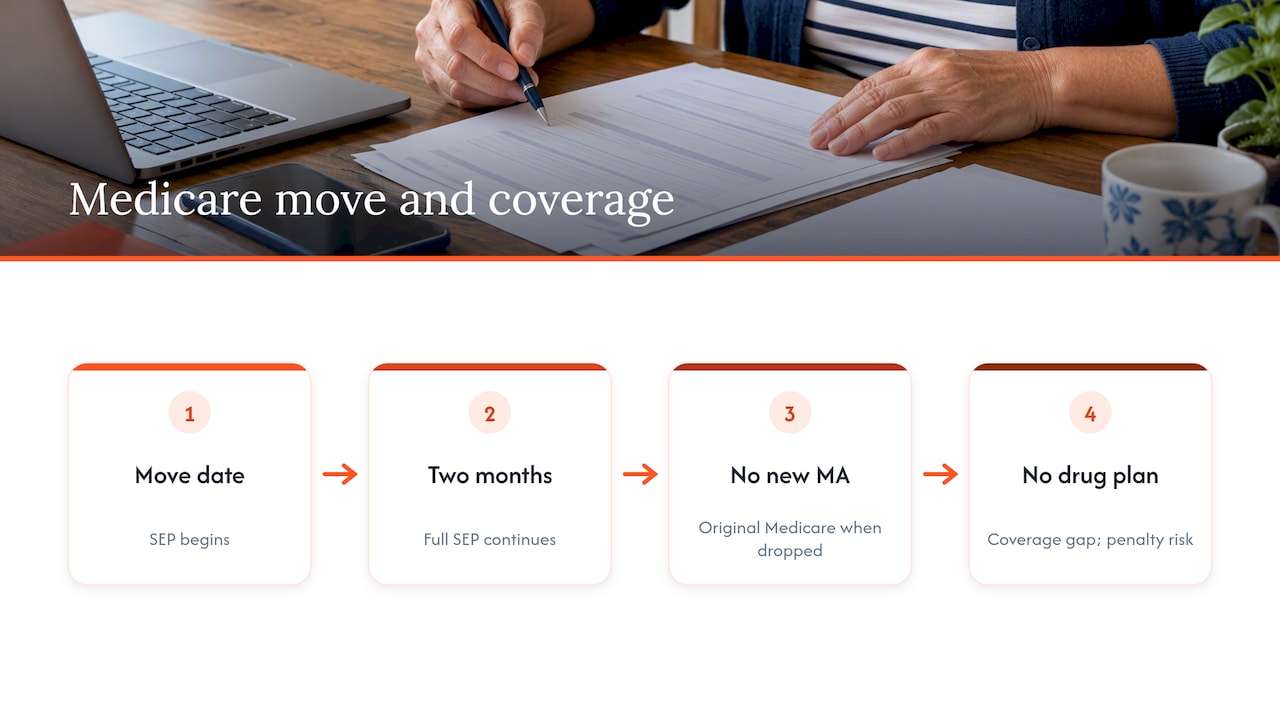
That default matters. Being moved to Original Medicare without a drug plan means you could end up without prescription coverage, and going without creditable drug coverage can lead to a late enrollment penalty later. Our guide to avoiding a Part D gap when you cancel Medicare Advantage explains how the pieces fit.
Other windows you may have
The SEP is not your only chance to make changes:
- Open Enrollment (October 15 to December 7 every year). You can join, drop or switch Medicare Advantage plans, switch between Original Medicare and Medicare Advantage, or join, drop or switch Part D plans, with coverage starting January 1 (Medicare.gov, Joining a plan). If you move in the fall, this period can give you extra time to compare. Our page on Open Enrollment steps covers the process.
- Medicare Advantage Open Enrollment (January 1 to March 31). If you’re in a Medicare Advantage plan, you can switch to a different one or return to Original Medicare (Medicare.gov).
For a wider look at life events that unlock mid-year changes, see our special enrollment period guide.
Do not assume a later window will rescue you. Each one has limits on what you can change, and Medicare’s calendar will not wait for your moving truck.
Moving with a Medigap policy
Medigap is the most portable of the private options. A Medicare Supplement policy sits on top of Original Medicare, which works nationwide, so you usually keep your policy when you relocate. Tell the insurer your new address, because premiums can depend on where you live and your insurer may need to update its records (AARP). To see how rates can shift over time, read our explainer on Medigap rate increases.
If you’re leaving Medicare Advantage
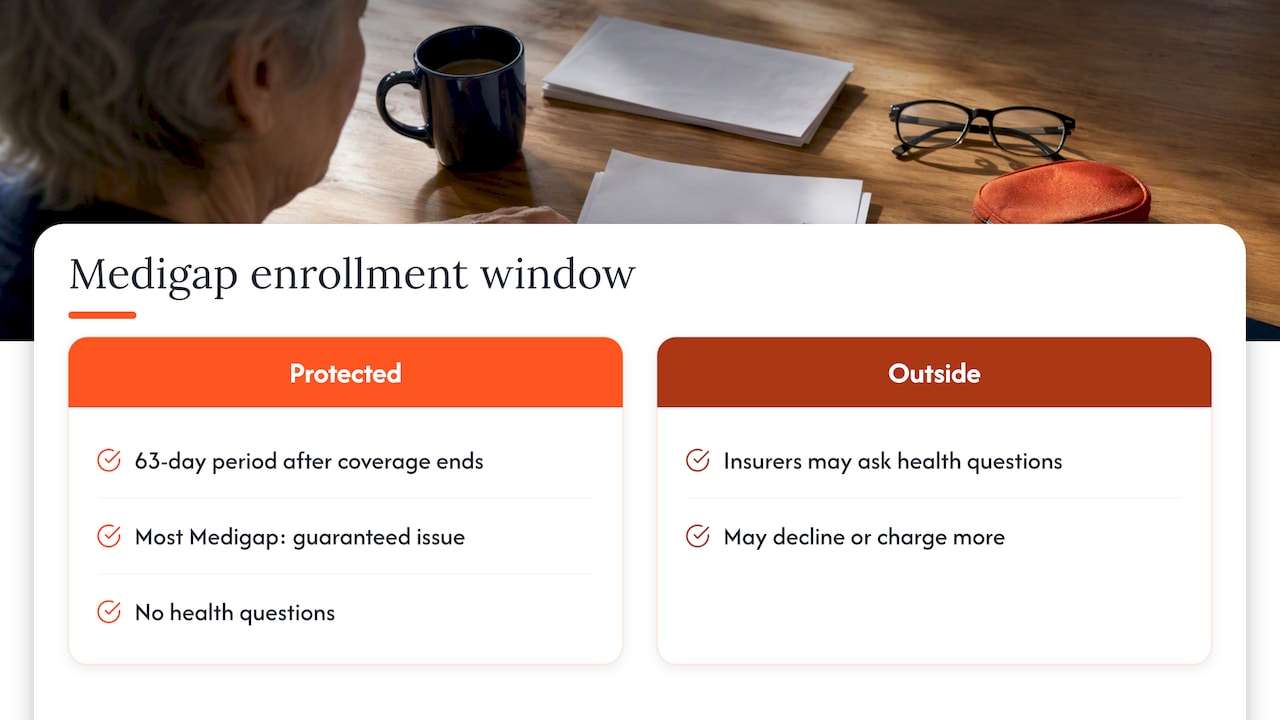
This is where timing counts. If you move out of a Medicare Advantage plan’s service area and switch to Original Medicare, you may qualify for a guaranteed-issue period of up to 63 days after your coverage ends. During that time you can buy most Medigap plans regardless of existing health problems (AARP). Outside a protected window like this, insurers in most states can ask health questions and may decline or charge more, so miss it and the option can become much harder to use.
Our walkthrough on switching from Medicare Advantage to Medigap within 63 days shows the steps, and our Medicare Supplement overview explains the plan letters.
Prescription coverage after a move
Your drug plan has its own network of pharmacies and its own list of covered drugs. Before you pick a new Part D plan, gather your current medication list with doses, then check three things for each candidate plan:
- Is each drug on the formulary, and at what tier?
- Is there a convenient preferred pharmacy near your new address?
- What are the monthly premium and deductible?
If you’re not sure how plans decide coverage, what Part D covers is a good primer. The moment you move out of your plan’s area is also a good time to compare, since a new area may offer plans you did not have before.
If you get Extra Help or help from your state
State programs differ, and so does your eligibility. A Rhode Island state resource on changes in residence advises checking the new state’s Medicare Savings Program rules when you move. If you were automatically enrolled in Extra Help through your state’s Medicaid or MSP, you may need to enroll actively after the move (Rhode Island Office of the Health Insurance Commissioner). Ask your SHIP counselor about this before the move, not months later when your pharmacy bill jumps.
Dental, vision and hearing after a move
Original Medicare does not generally cover routine dental, vision or hearing, so many people pair it with a stand-alone plan or choose a Medicare Advantage plan that bundles these benefits. Those networks are local too. After a move, you may need to find a new dentist, and it helps to read how dental insurance for seniors works, including waiting periods that could delay care on a new plan. Our own guide to dental, vision and hearing options compares the choices.
A simple timeline for your move
Two to three months before
- Call your Medicare Advantage or Part D plan and ask whether it serves your new address.
- Make a list of your doctors, drugs and pharmacies.
- If you have Extra Help or Medicaid, ask about the new state’s rules.
Moving month
- Update your address with Social Security.
- Notify your Medigap insurer and any stand-alone benefit plans.
- If your plan doesn’t reach your new address, start shopping now. The SEP opens when you move.
The two full months after
- Compare plans available in your new ZIP code and choose before the window closes.
- Confirm your new plan’s start date so you have no gap in prescription coverage.
- Reorder prescriptions through the new plan’s pharmacy network.
The next fall
- Review everything during Open Enrollment, October 15 to December 7. Plan costs and drug lists change every year.
Our enrollment timeline is a useful companion if you want the calendar in one place.
Where to get unbiased help
Around Open Enrollment you may get a flood of mail and ads. Medicare points to Medicare.gov, the Medicare & You handbook and 1-800-MEDICARE as official, unbiased sources (Medicare key dates). State Health Insurance Assistance Programs (SHIPs) offer free, personalized health insurance counseling and are not connected to an insurance company or health plan (Medicare.gov). Use them to check what you read here against your own situation. Our overview of free Medicare enrollment help lists more places to start.
Our perspective: plan the move around your coverage, not the reverse
Most of the Medicare problems we see after a move are not about the move. They come from a letter nobody opened, or a plan that quietly ended while the boxes were still packed. The deadline is short, and it is easy to lose track of it in the middle of closing on a house.
Our advice is to treat your coverage as one of the first calls you make. Find out whether your plan follows you. If it doesn’t, you have time to choose well rather than choosing in a hurry. Go through your doctors and prescriptions one by one, not just the monthly premium. A low-premium plan that excludes your cardiologist is not cheap.
We train our agents to explain options without pushing a single product, and our help doesn’t cost you extra. We also believe in annual reviews, because a plan that fit last year may not fit this year, move or no move. If you are not sure where you stand, a short conversation before the move is cheaper than a gap after it.
— Zach
Get a plan check before you move
If you’re moving to or from the Charlotte area, or just want a second set of eyes on your options, we can review your Medicare Advantage, Medigap and drug coverage and show you what is available at your new address. Start with our Medicare plans and consultation, or read about Medicare Supplement plans in Charlotte, NC if you’re leaning toward a Medigap policy.
FAQ
Does moving to another state affect my Medicare?
Original Medicare does not change when you move within the U.S., provided your new providers accept Medicare. Medicare Advantage and Part D plans can change, because they only cover specific service areas. Check with your plan before you move.
How long do I have to pick a new plan after I move?
If you move outside your plan’s service area, your special enrollment period starts when you move and runs for two full months afterward (Medicare.gov). If you do nothing during that time, you’ll be placed in Original Medicare when your old plan drops you. Choose a new plan inside the window to avoid gaps.
Do I need to buy a new Medigap policy if I move?
Usually not. You can generally keep your policy and simply give the insurer your new address. If you move out of a Medicare Advantage plan’s area and return to Original Medicare, you may have up to 63 days of guaranteed-issue rights for most Medigap plans.
Who do I tell when I move?
Start with Social Security so your address is updated for Medicare. Then tell your Medicare Advantage or Part D plan, and your Medigap insurer if you have one. Add any dental, vision or other supplemental plans to the list.
Sources
- AARP: Does Medicare Coverage Change if You Move to a New State?
- Medicare.gov: Special Enrollment Periods
- Medicare.gov: Joining a plan
- Medicare.gov: Remember Key Medicare Dates
- Rhode Island OHIC: Medicare and Changes in Residence
Recommended
Request a No Obligation Phone Call








Get Connected