

Medicare works well anywhere in the United States, but it almost never pays for care outside the country. Medicare says it usually doesn’t cover health care outside the U.S., with a few narrow exceptions. If you travel abroad, your protection comes from a Medigap plan with a foreign travel benefit, a separate travel medical policy, or both. If you travel within the U.S., your plan type decides how smooth it is: Original Medicare follows you, while Medicare Advantage depends on its network.
Below is how each piece works, where the gaps are, and what to check before you book a flight.
TL;DR
- Original Medicare covers you in all 50 states, but generally not care received outside the U.S.
- Medigap Plans C, D, F, G, M and N include foreign travel emergency coverage: 80% of billed charges after a $250 annual deductible, up to a $50,000 lifetime limit.
- Medicare Advantage plans rarely cover you abroad. Some offer an extra emergency benefit, so read your Evidence of Coverage before you go.
- Medical evacuation is not covered by Medicare and can cost well over $100,000. A travel medical policy with evacuation fills that gap.
- Snowbirds should check network rules in both states before choosing a plan type.
Table of Contents
- What “outside the U.S.” means for Medicare
- Traveling within the U.S. with Medicare
- Does Medicare cover you outside the United States?
- Medigap and foreign travel emergencies
- Medicare Advantage plans and international travel
- The gap neither covers: travel medical and evacuation insurance
- Snowbirds: two homes, one plan
- Our perspective: plan the trip around the coverage, not the reverse
- Don’t let enrollment mistakes follow you on the road
- Get a plan that fits how you travel
- A pre-trip checklist
- FAQ
- Sources
What “outside the U.S.” means for Medicare
Medicare covers care in the 50 states, the District of Columbia and the U.S. territories. Per AARP’s overview, those territories are American Samoa, Guam, the Northern Mariana Islands, Puerto Rico and the U.S. Virgin Islands. Anywhere else, including Canada, Mexico and the Caribbean, is “outside the U.S.” for coverage purposes.
Cruises add a wrinkle. Medicare’s rules turn on where the ship is and who provides care, so a ship’s doctor in international waters is generally not covered, even if you sailed from Miami.

Traveling within the U.S. with Medicare
Original Medicare
With Original Medicare you can see any doctor or hospital that accepts Medicare, anywhere in the country. Moving between North Carolina and Florida for the winter does not change that. Adding a Medigap plan keeps it simple: the supplement pays after Medicare does, so you rarely deal with network questions at all.
Medicare Advantage
Advantage plans work differently. Medicare notes that these plans often use provider networks. Emergency and urgently needed care is covered anywhere in the U.S., but routine visits out of your service area may be out of network. HMOs are the most restrictive; PPOs give more room. If you spend months in another state, Medicare.org’s guide for snowbirds points out that Advantage plans can mean higher out-of-network costs or limited access in your second home.
We lay out the trade-offs in our comparison of Medicare Advantage and Medicare Supplement plans. For a North Carolina resident, our page on Medicare and travel outside North Carolina goes deeper on domestic trips.
Does Medicare cover you outside the United States?
Generally no. Medicare’s travel page lists the exceptions, and they are specific:
- You are in the U.S. when an emergency happens and a foreign hospital is closer than the nearest U.S. hospital that can treat you.
- You are traveling through Canada by the most direct route between Alaska and another state, and an emergency occurs.
- You live in the U.S. and a foreign hospital is closer to your home than the nearest U.S. hospital that can treat your condition.
In these rare cases you pay the usual Part B deductible and coinsurance. These exceptions do not turn Medicare into a global plan. Many travelers assume they do, and that assumption is where the large bills come from.
Two practical points. Foreign hospitals do not have to accept Medicare, and the State Department warns that many overseas doctors and hospitals require full cash payment in advance. And prescriptions: AARP notes Medicare does not pay for medications or kidney dialysis abroad, so plan those before you leave. If you carry injectable medication, a guide on packing GLP-1 medication for travel covers the documentation and storage questions that come up at security and customs.
Medigap and foreign travel emergencies
This is the most useful travel feature in the Medicare system, and many people have it without knowing. According to Medicare’s Medigap comparison chart, Plans C, D, F, G, M and N include foreign travel emergency coverage. The mechanics:
| Feature | How it works |
|---|---|
| Annual deductible | $250 |
| What the plan pays | 80% of billed charges for medically necessary emergency care |
| Lifetime limit | $50,000 |
| Timing | Care must begin during the first 60 days of the trip |
| Plan N | Copayment of up to $50 for an emergency room visit that doesn’t lead to admission |
Plans C and F are not available to people who first became eligible for Medicare on or after January 1, 2020. Plan G is the one most new enrollees compare. Our guide to the $250 deductible and $50,000 cap on Medigap emergency coverage abroad walks through a sample claim.
Where the Medigap benefit falls short
- The lifetime cap is low. $50,000 is gone quickly in a major hospitalization abroad, and 20% of the bill plus anything above the limit is yours.
- It covers emergencies only. Routine care, follow-up visits and anything planned are outside it.
- It is not evacuation coverage. Medicare does not cover medical evacuation from abroad, which can exceed $250,000 depending on distance and condition, according to Medicare’s travel page.
- You file the claim yourself. Foreign providers don’t file Medicare claims for you. Ask for an itemized bill and records, and keep your receipts.
- Medicare must be the benchmark. The plan does not pay for foreign care of a type Medicare would have covered in the U.S.
Medicare Advantage plans and international travel
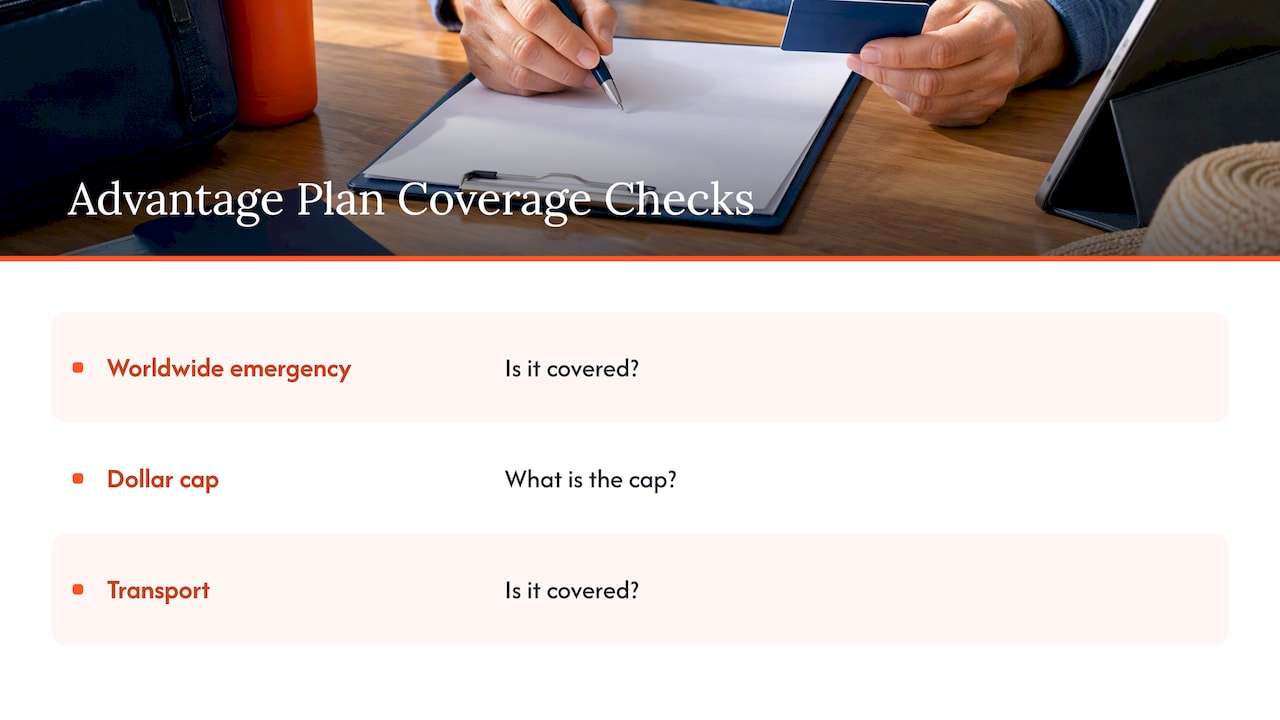
Advantage plans generally provide no medical coverage outside the U.S. Some include an optional extra benefit for emergency or urgently needed care abroad, often with a dollar cap or a set copay. Because benefits vary by plan and by year, the document that settles the question is your Evidence of Coverage, not a sales brochure. Look for the section on emergency care outside the service area, then call member services and ask three things: is worldwide emergency care covered, what is the cap, and is transport covered?
Also remember that Medigap policies cannot be used alongside a Medicare Advantage plan. If frequent international travel matters to you, that is one real argument for Original Medicare with a Medigap plan. If you prefer Advantage for its low premiums and extra benefits, plan to buy separate travel insurance. Our Medicare Advantage vs. Medigap comparison shows how the two compare on cost and flexibility.
The gap neither covers: travel medical and evacuation insurance
The CDC Yellow Book separates two products travelers often blur together. Travel health insurance pays for the doctor visit and hospital stay. Medical evacuation insurance pays to move you to a facility that meets U.S. standards, which is often the largest cost of all. The CDC says specialized travel insurance matters most for older travelers and those with pre-existing conditions, because their risk of a medical event is higher.
When you compare policies, check:
- Evacuation and repatriation limits. Make sure the policy states a figure, not just “included.”
- A 24-hour support center with physician backing. The decision to evacuate usually rests with the insurer, not you.
- Direct payment to the hospital. If it only reimburses, you may need cash up front.
- Pre-existing condition rules. Many policies require you to buy within a set window after your first trip deposit to waive exclusions. Read the wording.
- Trip length and activities. Cruises, adventure sports and long stays can change eligibility.
A warning from the State Department’s guidance: if you use a U.S. government service for evacuation, it is treated as a loan you must repay. Don’t count it as a benefit.
Snowbirds: two homes, one plan
If you split the year between Charlotte and, say, South Carolina or Florida, ask these questions before open enrollment:
- Does your plan have a network in both places, or only where you live most of the year?
- Are you allowed to be away from your plan’s service area for the months you plan to be gone? Some Advantage plans have limits on extended absences, so confirm in the Evidence of Coverage.
- Do your doctors and pharmacy work for both homes?
- If you cross into Canada or Mexico for part of the winter, do you have a Medigap travel benefit or a travel policy?
For many snowbirds, Original Medicare with a Medigap plan is the simplest fit because there is no network to leave. Others prefer a PPO Advantage plan with a national network. Either can work. The question is which trade-off suits your health, budget and travel pattern.
Our perspective: plan the trip around the coverage, not the reverse
The most common mistake we see is people learning what their plan covers after something goes wrong. Our approach is simple. We start with how you actually travel: how often, how far, for how long, and whether you need your own doctors in two states. Then we match the plan type to that pattern.
As an agency, we are paid by carriers when a client enrolls, at no extra cost to you. That is exactly why we train our agents to explain trade-offs, including the ones that argue against the plan with the better commission. If you travel abroad often, we will tell you plainly that Medigap’s foreign benefit is a useful floor, not a full answer, and that evacuation coverage is a separate purchase. If you rarely leave the Carolinas, we will say that too.
We also revisit the choice every year. Plans change their networks, benefits and premiums, and so do your travel habits. An annual review is the cheapest way to avoid a surprise at a foreign hospital.
— Zach
Don’t let enrollment mistakes follow you on the road
Travel coverage only helps if you have the right base coverage in the first place. Missing your enrollment window can add a permanent surcharge. Medicare explains that the Part B penalty is 10% of the premium for each full 12-month period you could have enrolled but didn’t, and the Part D penalty is 1% of the national base beneficiary premium ($38.99 in 2026) for each uncovered month. Both last as long as you have the coverage.
In 2026, the standard Part B premium is $202.90, so a 20% penalty for 24 missed months adds $40.58, for $243.48 a month. If you’re still working and unsure when to sign up, read our piece on the 8-month Part B deadline, then use our Part B penalty calculator or Part D penalty calculator to see your numbers. Our enrollment guide covers the Initial and Special Enrollment Periods.
Get a plan that fits how you travel
Safeguard Benefit Services is a Medicare agency in Charlotte, North Carolina. We help with Medicare Advantage, Medicare Supplement (Medigap), Part D drug plans, dental, vision and hearing coverage, and hospital indemnity insurance. We offer personalized consultations and a free Medicare roadmap that lays out your eligibility and options. If you want a plan that works for your trips, start with our Medicare Supplement plans in Charlotte, or reach us through our main site.
A pre-trip checklist
- Confirm which plan you have: Original Medicare with Medigap, or Advantage.
- For Medigap, check your plan letter for foreign travel emergency coverage, and note the $250 deductible and $50,000 limit.
- For Advantage, read the Evidence of Coverage section on emergency care outside the service area.
- Buy travel medical insurance with evacuation for international trips, and keep the 24-hour number on your phone.
- Carry your insurance cards, a medication list and enough prescriptions for the trip plus a buffer.
- Save itemized bills and records for any care abroad.
FAQ
Does Medicare cover me if I get sick on a trip to Europe?
Original Medicare generally does not. If you have a Medigap Plan C, D, F, G, M or N, the foreign travel emergency benefit can pay 80% of billed charges after a $250 deductible, up to $50,000 for life. Advantage members should check their Evidence of Coverage for an emergency benefit.
Is Medicare accepted in Canada or Mexico?
No. Foreign providers don’t have to accept Medicare, and many want payment in full at the time of care. The narrow exception covers a U.S. emergency where a foreign hospital is the closest, or a direct trip through Canada between Alaska and another state.
Can I use my Medicare in another state?
With Original Medicare, yes, at any provider who accepts Medicare. With Medicare Advantage, emergency and urgent care is covered nationwide, but routine care outside your network may cost more or not be covered, depending on your plan type.
Do I need travel insurance if I have a Medigap plan?
Usually yes for international trips. The Medigap benefit has a $50,000 lifetime cap and does not cover medical evacuation, which can cost far more. Travel insurance with evacuation covers that gap.
Sources
- Travel outside the U.S. | Medicare.gov
- Compare Medigap Plan Benefits | Medicare.gov
- Compare Original Medicare and Medicare Advantage | Medicare.gov
- Avoid late enrollment penalties | Medicare.gov
- Travel Insurance, Travel Health Insurance, and Medical Evacuation Insurance | CDC Yellow Book
- Insurance guidance | U.S. Department of State
- Will Medicare Cover Me If I Travel Outside the United States? | AARP
- Medicare for Snowbirds Living in Two States | Medicare.org
Recommended
Request a No Obligation Phone Call








Get Connected