

The best questions for a Medicare consultation are the ones that expose your real costs: Are my doctors and pharmacies in the network? Is every drug I take on the formulary? What will I pay in total over a year? Is there a deadline or penalty I could miss? Bring those four, add the specifics below, and you will leave with answers you can check in writing.
It is October 18, 2026, which means Medicare Open Enrollment runs October 15 through December 7 and any change you make takes effect January 1. If you are sitting down with an agent or counselor this month, this guide is your script.
TL;DR
- Ask about your own doctors, pharmacies and prescriptions first. A plan that looks cheap but excludes them is not cheap.
- Ask for the total annual cost: premiums, deductibles and copays together, not just the monthly premium.
- Ask what deadline or penalty applies to you: your Initial Enrollment Period, the Medigap window, and the Part D late enrollment penalty.
- Before a sales meeting, expect a Scope of Appointment form, and never hand over your Medicare, Social Security or bank details before you have decided to enroll.
- Get every answer in writing, and check it against the plan’s Evidence of Coverage.
Table of Contents
- Before you book: who you can talk to
- The five questions that matter most
- Questions about how the agent works
- Questions about timing and penalties
- Questions that separate Medicare Advantage from Medigap
- Questions about your doctors, drugs and real costs
- Questions for your current plan this fall
- A note on the yearly Wellness visit
- Our perspective: what a good consultation feels like
- Talk it through with us
- FAQ
- Sources
Before you book: who you can talk to
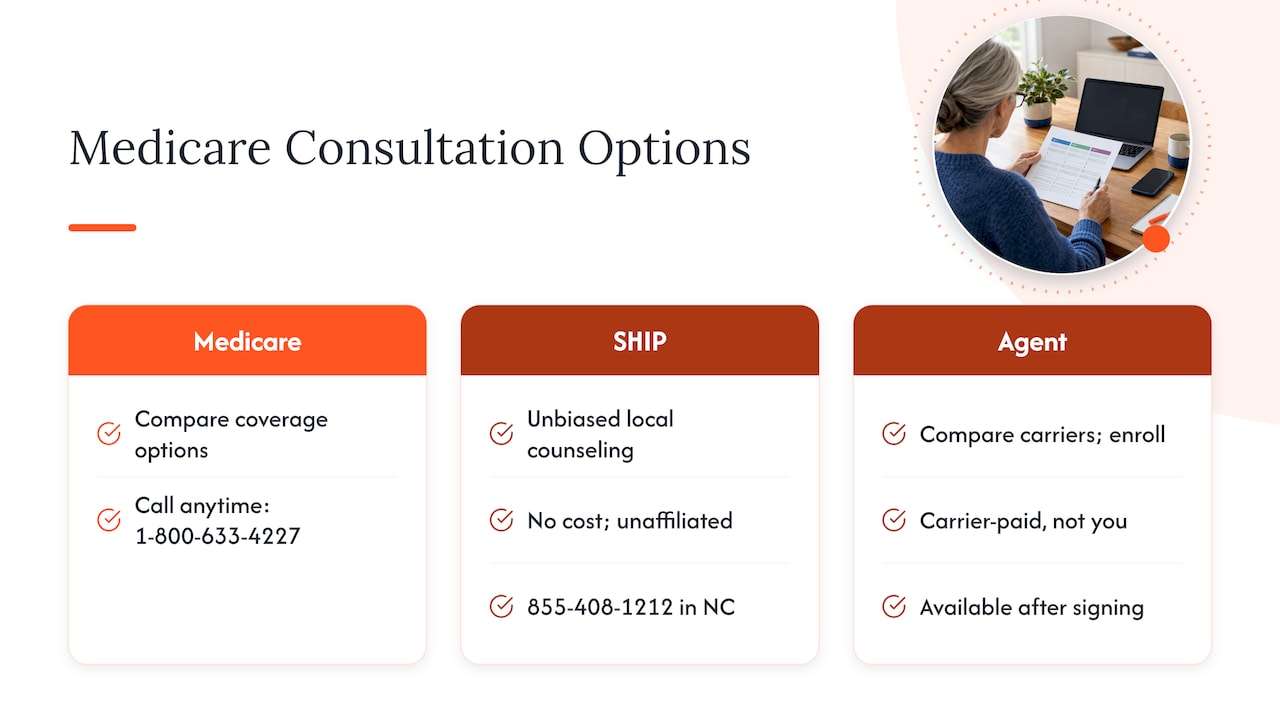
A Medicare consultation can mean three different things, and the questions change a little with each.
Medicare itself. You can call 1-800-MEDICARE (1-800-633-4227) any time to speak with a representative, and the Medicare & You handbook points readers there to explore and compare coverage options.
A State Health Insurance Assistance Program (SHIP). SHIP counselors are not affiliated with insurance companies and give local, unbiased counseling at no cost. In North Carolina the program is called SHIIP, and you can reach it at 855-408-1212. It has counselors in every county, including Mecklenburg.
A licensed insurance agent. An agent can compare plans from several carriers, enroll you, and stay available after you sign. The agent is paid by the carrier, not by you, so the questions in this article matter most here: they let you see how the person across the table works.
Many people use both a counselor and an agent. Nothing stops you from getting a second opinion before you sign.
The five questions that matter most
If you remember nothing else, take these into the room.
- Are my specific doctors, hospitals and pharmacies in this plan’s network? Name them. Do not accept a general “most doctors take it.”
- Does the formulary cover every medication I take, and at what tier? Bring the actual bottles or a printed list with doses.
- What is my total annual out-of-pocket cost? SHIP guidance tells beneficiaries to weigh premiums, deductibles and copays together.
- What happens if I need a lot of care? Ask about the maximum out-of-pocket limit, referral rules and prior authorization.
- Can I get this in writing? The same guidance says never to rely only on marketing claims and to get plan details in writing before deciding.
Questions about how the agent works
You are allowed to interview the person helping you. These questions are fair, and a good agent will welcome them.
- Which carriers do you represent in Charlotte and North Carolina, and are there any you cannot offer me? No agent sells every plan. Knowing the limits tells you how to read the recommendation.
- How are you paid, and does it change by plan? Agents in this business are paid commissions by carriers. The point is not that commissions are bad. The point is that you should hear the answer plainly and ask the agent to explain why a plan fits you rather than the agent.
- Will you be here after I enroll? Ask who answers when a claim is denied, a doctor leaves the network, or next fall’s notice arrives.
- Will you review my plan every year? Plans change annually, so a one-time sale is not enough.
- Can you show me the plan documents, not just a summary?
What a proper sales appointment looks like
For formal Medicare sales appointments, CMS requires a Scope of Appointment form at least 48 hours ahead. It lists which products will be discussed, so you are not steered into something you did not agree to hear about. If an agent skips it or tries to widen the topic on the spot, say you want to stick to what you signed.
Protect your information
SHIP guidance is clear: do not give your Medicare number, Social Security number or banking details to a representative until you have vetted them and decided to enroll. Scammers use those details to enroll people without informed consent. A genuine agent can discuss plans without them.
Questions about timing and penalties
Missing a window is the costliest mistake in Medicare, and it is often permanent. Ask the agent to put your dates on paper.
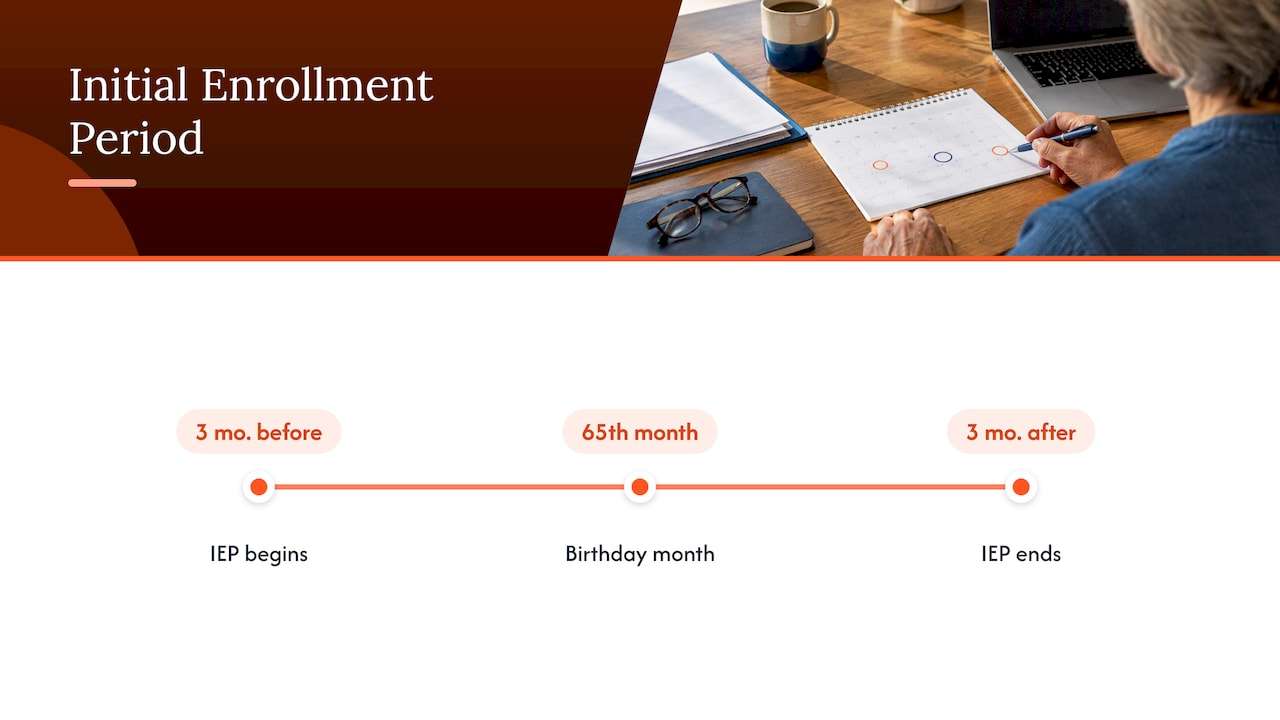
When does my Initial Enrollment Period start and end? To avoid permanent late penalties, sign up during your 7-month Initial Enrollment Period, which starts three months before the month you turn 65. If you are still working, ask whether your employer coverage counts as creditable and what happens when it ends. Our guides on when you should enroll in Medicare and how to avoid penalties walk through the common situations.
Do I have a Part D penalty risk? The Part D late enrollment penalty is 1% of the national base beneficiary premium for each month you go without creditable drug coverage (63 days or more). The 2026 base premium is $38.99, and the penalty is added to your premium for as long as you have Part D. Ask the agent how many uncovered months, if any, you have.
When is my Medigap Open Enrollment Period? It is a one-time, 6-month window that begins the first month you have Part B and are 65 or older. Inside it, insurers cannot deny you or charge more because of pre-existing conditions. Outside it, you may face medical underwriting, higher costs or denial. If you are close to that window, read our page on locking in Medigap during your six months before the meeting.
What can I change right now, and what takes effect when? Open Enrollment changes made by December 7 start January 1. Our Open Enrollment dates guide lays out the steps.
Questions that separate Medicare Advantage from Medigap
The biggest fork in the road is Original Medicare with a Medigap policy versus Medicare Advantage. Medicare describes the choice as Original Medicare, or joining a Medicare-approved private plan under Medicare Advantage (Part C). Ask the agent to explain both, not just the one that is easiest to sell.
| Question to ask | Medicare Advantage | Medigap with Original Medicare |
|---|---|---|
| Do I need a network? | Ask which doctors and hospitals are in it | Ask which providers accept Medicare |
| Will I need referrals or prior authorization? | Ask how often and for which services | Ask what the policy leaves to you |
| Is drug coverage included? | Ask whether the plan includes Part D | Ask about a separate Part D plan |
| What if my health changes later? | Ask when you can switch | Ask about underwriting outside the Medigap window |
| What can rise over time? | Ask about next year’s premium and copays | Ask about rate increases |
For a deeper side-by-side, see our Medicare Advantage vs. Medigap comparison and the primer on how Part C works.
Questions about your doctors, drugs and real costs
This is where most surprises happen, so be specific.
Doctors and hospitals
List your primary care doctor, specialists and the hospital you would go to. Ask the agent to confirm each in the plan’s directory, then confirm with the doctor’s office yourself. Ask what happens if a provider leaves the network mid-year.
Prescriptions
Give the agent every drug name, dose and pharmacy. Ask which tier each lands on, whether it needs prior authorization or step therapy, and whether your pharmacy is preferred. Also ask how generics are handled, since the cheapest option is not always the one on the plan. A practical guide to saving on generic drugs is a useful companion when you compare formulary tiers with what you pay at the counter. Our explainer on Part D prescription drug plans covers the structure.
The full-year number
Ask the agent to total, for your own usage: monthly premium times 12, the deductible, expected copays and the out-of-pocket cap. A $0 premium plan with high copays on your three medications can cost more than a plan with a premium.
Extras
If dental, vision and hearing matter to you, ask exactly what is covered, the annual dollar limit and the waiting period. Ask whether a standalone plan would serve you better than the extras bundled into an Advantage plan. We break that down in Medicare dental, vision and hearing options.
Questions for your current plan this fall
If you already have coverage, the question is not “what should I buy?” but “what changed?” Plan benefits, formularies and networks can change every year, so review the Annual Notice of Change and Evidence of Coverage you receive in the fall.
Ask your agent or counselor:
- Did my premium, deductible or copays change?
- Is each of my drugs still covered, and on the same tier?
- Are my doctors and my pharmacy still in the network?
- Did any benefit I use get cut or capped?
- Is there a better fit for next year, and what would switching cost me?
Our checklist, 5 checks before December 7, turns these into a ten-minute review.
A note on the yearly Wellness visit
People often mix up a consultation with the yearly Wellness visit. The Wellness visit is a conversation-based, preventive planning session, not a physical exam. If you have specific concerns or need an actual exam, book a separate appointment, or you may be billed for services Medicare does not cover in that visit. The visit also includes a cognitive assessment, which is a screening step and not a diagnosis. Insurance agents do not run this visit, so do not expect your plan conversation to replace it.
Our perspective: what a good consultation feels like
We are a Medicare-only agency in Charlotte, and we train our agents before they ever sit down with a client. The reason is simple: Medicare punishes guesswork. A missed enrollment window can follow someone for life, and a plan chosen from a brochure can leave a person without their doctor in January.
So we judge a consultation by what you understand afterward, not by whether you enrolled that day. You should leave knowing which options exist, which ones fit your doctors and prescriptions, and which dates apply to you. Our guidance costs you nothing extra, because carriers pay the agent, not you. We also tell clients to use SHIIP if they want a second, unaffiliated view. Good advice survives a second opinion.
We also stay after the sale. Plans change every year, so we believe in an annual review and local support when something goes wrong. If an agent cannot say who you call in March, keep looking.
— Zach
Talk it through with us
If you want to walk through these questions with someone local, Safeguard Benefit Services helps Charlotte-area clients with Medicare Advantage, Medicare Supplements, Part D prescription drug plans, dental, vision and hearing plans and hospital indemnity insurance. We offer personalized consultations and a free Medicare roadmap that lays out your options and eligibility. Bring your medication list, your doctors’ names and your Medicare card details only once you decide to enroll, and we will start from there.
FAQ
What questions should I ask a Medicare agent?
Start with your doctors, pharmacies and prescriptions, then ask for the total annual cost and the deadlines that apply to you. Ask how the agent is paid, which carriers they can offer, and who will help you after you enroll. Request everything in writing.
Who should I talk to about Medicare questions?
You have free options and paid-by-carrier options. You can call 1-800-MEDICARE or your state SHIP, and in North Carolina that is SHIIP at 855-408-1212. A licensed agent can then compare plans and enroll you.
Do I have to pay for a Medicare consultation?
SHIP counseling is free. With an agent, you do not pay a fee for the guidance, because the carrier pays the agent when you enroll. Ask any agent to confirm this before the meeting.
What should I bring to a Medicare consultation?
Bring a list of your doctors, hospitals, pharmacies, and every medication with its dose. Bring your current plan’s Annual Notice of Change if you have one. Hold back your Medicare number, Social Security number and bank details until you have decided to enroll.
Sources
- Medicare’s Open Enrollment Period, SHIP TA Center
- Avoid late enrollment penalties, Medicare.gov
- Get ready to buy a Medigap policy, Medicare.gov
- Your coverage options, Medicare.gov
- Yearly Wellness visits, Medicare.gov
- Medicare & You handbook
- Get help with Medicare enrollment, SHIP TA Center
- SHIIP, North Carolina Department of Insurance
Recommended
- Medicare Insurance: What To Expect From A Medicare Consultation Or Agent In Charlotte North Carolina: Step-by-Step
- 10 Questions To Ask Your Medicare Agent Before Enrolling
- Choosing A Medicare Plan If You Have Complex Health Needs
- How To Prepare For Your First Meeting With A Medicare Insurance Agent In Charlotte
Request a No Obligation Phone Call








Get Connected