

A Medigap household discount is a reduction in your monthly premium that some insurers offer when two people in the same home both hold a Medicare Supplement policy with the same company. It is a carrier perk, not a federal benefit, so the size, the rules and even whether it exists depend on the insurer and your state. Treat it as a tiebreaker between similar plans, not as the reason to pick one.
TL;DR
- A household discount is a percentage off the premium that an insurer may give when more than one person in a home buys Medigap from it. Medicare.gov lists discounts for married people and for multiple policies among the things that can change a premium.
- Each spouse needs their own policy. A Medigap policy covers one person only.
- Compare the same lettered plan across insurers first. Benefits are standardized, so the premium is the real difference, and the discount is one piece of that premium.
- Discount terms can change or end, for example if one of you drops the policy or moves out. Ask the insurer to put the conditions in writing.
- Medigap has no provider network, except Medicare SELECT plans, which trade a lower premium for network rules.
Table of Contents
- What a Medigap household discount is
- Who can qualify
- How much can it save, and can it change or end
- Comparing premiums when a discount is on the table
- Medigap networks and Medicare SELECT
- Your timing decides whether you can pick freely
- Our perspective on household discounts
- Get help comparing your options
- Questions to ask before you enroll
- FAQ
- Sources
What a Medigap household discount is
Medigap, also called Medicare Supplement insurance, is sold by private insurers and pays part of what Original Medicare leaves you to cover. You pay a monthly premium to the insurer for it, and insurers may offer discounts on that premium. A household discount is one of those.
In practice it works like this. The insurer takes the premium it would charge each person and reduces it by a set percentage if a second eligible person in the home also has one of its Medigap policies. The saving shows up as a lower bill, not as a separate payment or a rebate check.
Three things to keep straight:
- It is the insurer’s discount. Medicare does not set it and does not require it.
- It is not shared coverage. Medicare has no family plan. If you are unsure how two spouses fit into Medicare, our guide to how Medicare works for spouses walks through it.
- It applies to the premium only. It does not change what the plan covers.
Who can qualify
The exact conditions are set by each insurer and filed in each state, so there is no single national rule. Still, the same few conditions show up again and again.
Two people, two policies
A Medigap policy covers one person, so if you and your spouse both want Medigap, each of you has to buy your own policy. A household discount is attached to that pair of policies, not to a joint contract.
Same insurer
The discount generally requires both policies to come from the same company. If you pick one insurer for your plan and a different one for your spouse’s plan, you will normally lose the discount on both. That matters when one of you finds a cheaper rate elsewhere (more on that below).
Same address, and sometimes a relationship rule
Many carriers require both people to live at the same address. Some limit the discount to married couples, while others extend it to other people who share a home. Ask the insurer which applies to you rather than assuming. Medicare.gov names discounts for married people and for multiple policies as factors that can affect a premium, which tells you the rules differ.
Both policies in force
The discount usually lasts only while both policies stay active. If one spouse cancels, lapses or is no longer in the home, the insurer can remove the discount from the remaining policy.
How much can it save, and can it change or end
Expect a percentage of the monthly premium, not a flat dollar amount. The percentage varies by insurer and state, and some companies offer none in some states. We are not going to quote a single typical figure here, because any one number would be wrong for someone reading in the next state over. Ask each insurer for the discount percentage in your ZIP code, and for the actual dollar premium with and without it.
A quick worked example shows why the sticker discount is not the whole story. These figures are made up for illustration only:
| Insurer A | Insurer B | |
|---|---|---|
| Monthly premium, one person, same lettered plan | $150 | $130 |
| Household discount | 7% | None |
| Premium with discount | $139.50 | $130 |
Insurer A advertises a discount, yet Insurer B is still cheaper. A discount only helps if the starting premium is competitive.
When the discount can end
Ask about these before you enroll:
- One policy ends. If your spouse switches carriers, dies or cancels, your discount can disappear and your premium rises.
- You move apart. A change of address that puts you in different homes can end it.
- The insurer changes its program. Discounts are a pricing feature, and insurers can revise pricing over time.
- Premiums rise anyway. Even with a discount, your base premium can go up from year to year. Our page on Medigap rate increases explains why that happens and how to respond.
Get the discount conditions in writing, including what happens to the remaining policy if one ends.
Comparing premiums when a discount is on the table
The discount is only useful if you compare correctly. The government’s own guidance is plain: compare the same lettered plan across insurers. Benefits in each lettered plan are the same regardless of which company sells it, so for the same letter the premium is what separates one policy from another, and discounts can affect that cost. Premiums can differ substantially between insurers for identical benefits.
A clean way to do it:
- Pick the letter first. Decide which plan you want, such as Plan G or Plan N, based on coverage, not price. Our overview of Medigap plans helps with that.
- Get quotes for each person. Premiums can differ by age, tobacco use and other factors, so your spouse’s quote may not match yours.
- Ask each quote with and without the household discount. This shows how much of the saving is the discount and how much is the base rate.
- Check whether the discount applies to both of you. Some carriers apply it to both policies, some only to one.
- Look at the long game. A low price today at an insurer that raises rates steeply is not a bargain. Ask how the insurer has handled increases.
- Run the split-carrier option. Add up what you would pay if each of you took the cheapest policy at different companies, and compare it to the discounted same-carrier total. Sometimes splitting wins, sometimes not.
If one of you has health conditions, the picture changes, because insurers in most states can ask medical questions outside certain windows. See our guide to preexisting conditions and Medigap before you assume you can switch freely.
Medigap networks and Medicare SELECT
People who search for the household discount often also ask about networks, so here is the short version. Standard Medigap has no network. Original Medicare lets you use any doctor or hospital that takes Medicare, and a standard Medigap policy follows you there.
The exception is Medicare SELECT. It is a type of standardized Medigap policy that requires you to use network providers for non-emergency services to get full benefits. These plans typically offer lower premiums, but if you go out of network you will likely pay a larger share of the costs your Medigap policy would otherwise cover. Medicare still pays its own share of approved costs whichever hospital or doctor you choose. The network rule affects the part Medigap pays.
How SELECT interacts with a household discount
A SELECT plan can already carry a lower premium, and a household discount might stack on top, depending on the insurer. That makes the combined price attractive, but check three things:
- Are your regular hospitals, and your spouse’s, in the network?
- Do you travel or spend part of the year in another state? Our page on Medicare and travel covers what holds up away from home.
- What happens if you move?
State rules shape the answers. In South Carolina, for example, out-of-network care under SELECT costs more and benefits are not usually payable for non-emergency services. In Texas, if you move out of a SELECT plan’s service area, you may buy a policy with the same or fewer benefits from the same company, and if you held the SELECT policy more than six months, no medical questions are required. Medicare SELECT is available only in some states, so confirm it is sold where you live.
Do not confuse any of this with Medicare Advantage networks, which work differently. If you are weighing that option, see how to confirm Medicare Advantage networks.
Your timing decides whether you can pick freely
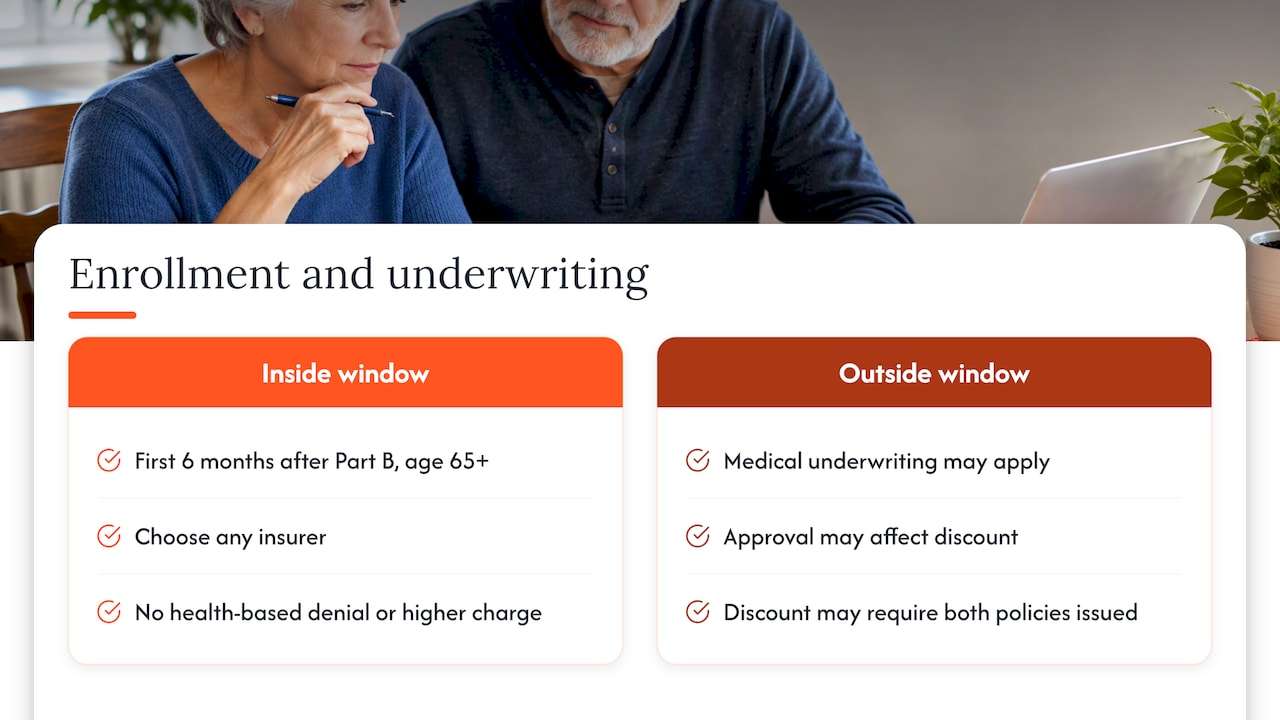
A household discount does nothing for you if you cannot get approved. Federal law gives guaranteed-issue protections, including during the first six months after first enrolling in Medicare Part B for people age 65 and older. In that window an insurer cannot turn you down or charge more because of your health. States may add broader protections: Connecticut, Massachusetts, Maine and New York have continuous or annual guaranteed-issue rules, and Delaware, Illinois, Minnesota and Rhode Island have less comprehensive expansions.
For a couple, this has a practical consequence. Spouses are rarely the same age, so one of you may be inside the open enrollment window while the other is not. The one still inside it can usually choose any insurer without medical questions. The other may face underwriting. If the discount requires both policies to be issued, the second application can decide whether the discount happens at all.
If you are coming off a Medicare Advantage plan, the clock matters too. We cover the rules in switching from Medicare Advantage to Medigap.
One more point on cost: Medigap generally pays only for care that Medicare itself covers, so a lower premium never makes an uncovered treatment covered. If you are considering something outside Medicare’s usual coverage, check first, as in this breakdown of Medicare coverage of PRP therapy.
Our perspective on household discounts
At Safeguard Benefit Services we see couples in Charlotte and across North Carolina who start with the discount and work backward. We would flip that. Start with the plan letter that fits each person’s health and budget, then find which insurers sell it, then look at the discount.
Here is how we handle it with a couple:
- We pull quotes for the same letter from several carriers for each spouse, so the comparison is fair.
- We show the totals with the discount and without it, and the split-carrier total as well.
- We ask what happens to the remaining policy if one ends, because that is the question couples forget.
- We schedule an annual review, since premiums and discount terms change over time.
Our agents go through a training program built around education, so we explain the trade-offs instead of steering you to whichever plan pays best. Our service costs you nothing extra. We are paid by the carrier when you enroll, and you pay the same premium for the same plan whether you buy through an agent or directly from the insurer.
The best outcome is not the biggest discount. It is the policy you will still be happy with in five years, at a premium you can plan around.
— Zach
Get help comparing your options
If you and your spouse are shopping for Medigap in North Carolina, we can compare same-letter plans from the carriers we work with, check discount terms for your ZIP code and show you the numbers side by side. We also offer a free Medicare roadmap that lays out your eligibility and enrollment timing. Start on our Medicare Supplement plans page or reach us through Safeguard Benefit Services.

If you are still deciding between Medigap and Medicare Advantage, our comparison of Medicare Advantage and Medicare Supplement is a good next read.
Questions to ask before you enroll
Take this list to any insurer or agent:
- What is the discount percentage in my state, and is it applied to both policies?
- Who qualifies: spouses only, or anyone in the household?
- Must both policies be issued for the discount to start?
- What happens to my premium if my spouse cancels or moves out?
- Is the plan standard Medigap or Medicare SELECT, and which hospitals are in the network?
- How has the insurer changed rates in recent years?
- Does the quote assume a different discount, such as one for paying by electronic transfer or for new enrollees?
A discount that sounds large but depends on conditions you cannot meet is not a discount for you.
FAQ
Do both spouses have to buy Medigap from the same company to get the discount?
Usually yes. Each of you needs your own policy, and the discount normally requires both to be with the same insurer and both to stay in force. Ask the carrier whether the discount applies to one policy or both.
Do Medigap plans have provider networks?
Standard Medigap plans do not. You can see any doctor or hospital that accepts Medicare. Medicare SELECT plans are the exception: they may require network hospitals, and sometimes doctors, for full benefits in non-emergency situations, in exchange for a lower premium.
Can a household discount be taken away?
Yes. It can end if one policy is cancelled, if you stop living together, or if the insurer changes its program. Get the conditions in writing and ask what happens to the remaining policy.
Is the cheapest discounted plan always the best choice?
No. Compare the same lettered plan across insurers, since benefits are identical and only the premium differs. A plan with a discount can still cost more than a competitor’s plan without one, and rate increases over time can erase an early saving.
Sources
- Get Medigap costs, Medicare.gov
- Choosing a Medigap Policy, Medicare.gov
- Medicare Supplement Shopper’s Guide, South Carolina Department of Insurance
- Medicare supplement insurance guide, Texas Department of Insurance
- Medigap Guaranteed Issue Requirements, KFF
- Is PRP Therapy Covered by Medicare or Private Insurance?
Recommended
Request a No Obligation Phone Call








Get Connected