

Medigap underwriting is the process an insurer uses to decide whether to accept your application, and at what price, based on your health. The federal rules are simple at the core: during your six-month Medigap Open Enrollment Period, or when you hold a guaranteed issue right, the insurer cannot screen you. Outside those windows, in most states, it can ask health questions, deny you, or charge you more. Knowing which side of that line you are on before you apply is the single most useful thing you can do.
TL;DR
- During your 6-month Medigap Open Enrollment Period, insurers cannot use medical underwriting to turn you down or charge more because of pre-existing conditions.
- After that window, most states let insurers deny you, price by health, or apply a pre-existing condition waiting period of up to 6 months, unless you have a guaranteed issue right.
- Applications typically ask about conditions, medications, tobacco use, height and weight, and carriers may check pharmacy and MIB records.
- A few states (Connecticut, Massachusetts, Maine, New York, and now Minnesota in a limited form) add extra protections for people 65 and older.
- If you are denied, call your State Health Insurance Assistance Program (SHIP) before you give up. In North Carolina, that is SHIIP.
Table of Contents
- What medical underwriting means for Medigap
- The two situations where underwriting is off the table
- What happens when underwriting applies
- What the health questions look like
- State rules that go further than federal law
- Perspective: why we tell people to decide early
- Underwriting, rate increases and why switching later is hard
- If you are denied or told to wait
- Do not confuse underwriting with Medicare’s other penalties
- Get help before your window closes
- FAQ
- Sources
What medical underwriting means for Medigap
Medigap, also called Medicare Supplement insurance, is sold by private insurers. The plan letters (A through N) are standardized by federal law, so a Plan G covers the same benefits no matter who sells it. What is not standardized is the price, and, outside protected windows, who gets accepted.
Medical underwriting is the insurer’s review of your health to decide three things: whether to offer you a policy, what premium to charge, and whether to attach a waiting period for existing conditions. Medicare’s own guide to choosing a Medigap policy says that outside your Medigap Open Enrollment Period or a guaranteed issue situation, an insurer may deny you a policy based on your health.
This is a very different world from Original Medicare, Medicare Advantage or Part D, where you are accepted regardless of health. Medigap is the one corner of the market where your medical history can still decide the outcome.
The two situations where underwriting is off the table
Your Medigap Open Enrollment Period
The Medigap Open Enrollment Period lasts six months. It starts when you are 65 or older and enrolled in Medicare Part B. During it, per Medicare’s guidance, an insurer cannot use medical underwriting to decide whether to accept your application or deny coverage because of pre-existing health problems.
That protection is stronger than many people realize. You can have diabetes, a heart condition, or a recent cancer diagnosis and still buy any Medigap policy the company sells in your state, at the rate it offers for your age and other permitted rating factors. We cover how to time this window in our guide to locking in Medigap during your six-month open enrollment.
Two practical points:
- The clock does not restart. Once the six months are over, the window is gone for good in most states.
- Part B timing drives everything. If you delay Part B, your Medigap window does not begin either. Your Part B Initial Enrollment Period runs from three months before the month you turn 65 through three months after, and missing it generally means a late enrollment penalty of 10% of the standard premium for each 12-month period you waited. That penalty is separate from Medigap underwriting, but the two decisions are tied together by the same birthday.
Guaranteed issue rights
A guaranteed issue right is a legal guarantee that an insurer must sell you a policy, cover your pre-existing conditions, and not charge you more because of your health. Medicare lists certain situations when you lose other health coverage as qualifying. Typical examples include losing employer retiree coverage, or a Medicare Advantage plan ending in your area.
These rights come with deadlines, usually tied to when your old coverage ends, and the deadlines are short. If you are leaving a Medicare Advantage plan after a trial period, our article on switching to Medigap within 63 days walks through the timing. Not every Medicare Advantage exit qualifies, so confirm your situation before you cancel anything.
Some life events also open other enrollment doors for Medicare plans generally, which we explain in our piece on special enrollment periods and life events. Be careful: a Medicare special enrollment period does not automatically create a Medigap guaranteed issue right. They are separate rules.
What happens when underwriting applies
Outside those two situations, the insurer has three tools.
- Deny the application. The insurer can decline you based on your health.
- Charge more. It can price your policy higher than its standard rate for your age.
- Impose a pre-existing condition waiting period. Medicare explains that an insurer may refuse to cover out-of-pocket costs for a condition you were treated for or diagnosed with in the 6 months before the policy starts, for up to 6 months after it takes effect.
That last rule has an important escape hatch. If you have at least 6 months of continuous prior creditable coverage, with no break longer than 63 days, the insurer cannot make you wait to cover a pre-existing condition. Coverage from a job or from a Medicare Advantage plan commonly counts, which is why avoiding gaps in coverage matters so much.
Our deeper walkthrough on this topic is in what insurers can and can’t do with pre-existing conditions.
What the health questions look like
People ask what the application actually contains. You do not take a physical exam or go through an in-person review for a typical Medigap application. Instead, you answer a set of health questions, often around 20, on the application form or by phone.
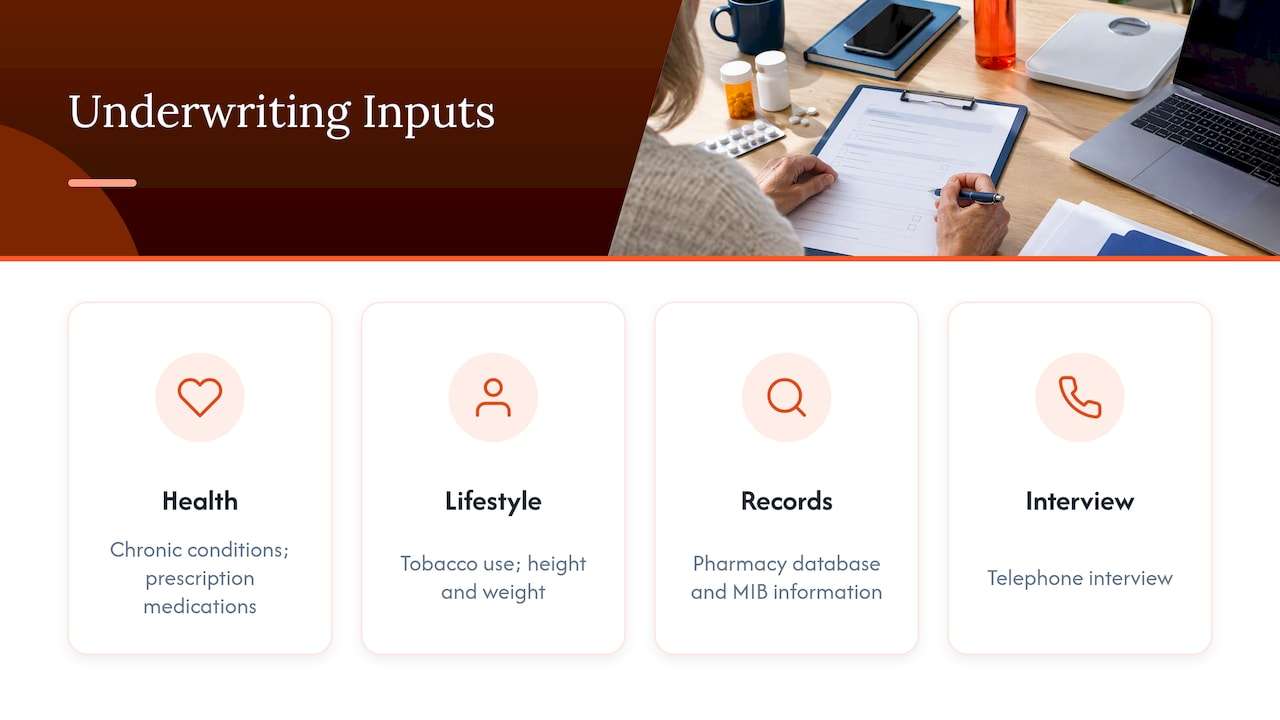
Carrier underwriting guides show what insurers may consider. One carrier’s published guide says it may ask health questions, including about chronic conditions, and look at prescription medications, tobacco use, height and weight. It may also review pharmacy database and MIB (Medical Information Bureau) information and conduct a telephone interview.
That answers a common puzzle: why would a Medigap application ask about drugs when Medigap doesn’t cover prescriptions? Because medications are a window into your health. A list of prescriptions tells the underwriter what conditions you are managing, and how stable they are.
Stability matters as much as the diagnosis
A diagnosis alone rarely decides the outcome. Carriers often look at how well-controlled a condition is. Some published agent guides, for example, describe accepting applicants with conditions such as diabetes or heart disease when they meet stability criteria, like keeping blood pressure under a stated threshold or not having had a recent medication increase. Each company sets its own standards, so one insurer may decline you while another accepts you at a standard rate.
Answer honestly and completely
Applications are signed statements. Leaving out a condition can lead to a claim being challenged or a policy being rescinded later. The safer approach is to answer every question fully, and to shop with a broker who can tell you which carriers tend to be more flexible for your condition before you apply. Our guide on choosing a Medicare plan with pre-existing conditions covers that approach.
State rules that go further than federal law
Federal law sets the floor. States can add more protection, and a handful do. According to KFF’s analysis, Connecticut, Massachusetts, Maine and New York provide continuous or annual guaranteed issue protections for people 65 and older. Other states provide protections only for qualifying events, or for people under 65 with disabilities.
Minnesota is the newest example. It enacted annual guaranteed issue protections for people ages 65 to 70, slated to take effect August 1, 2026, during the annual Medicare Open Enrollment Period (October 15 to December 7). There is a tradeoff: Minnesota law lets insurers charge 15% more than the standard community rate beginning in 2026 for people using the protection, rising by 5% a year to 35% in 2030 and later.
| State group | Protection for people 65+ | Notes |
|---|---|---|
| Connecticut, Massachusetts, Maine, New York | Continuous or annual guaranteed issue | Rules differ in how often you can switch and which plans you can pick |
| Minnesota | Annual, ages 65 to 70, during Oct 15 to Dec 7 | Premium penalty of 15% in 2026, rising to 35% by 2030 |
| Most other states, including North Carolina | Federal rules only: open enrollment and qualifying events | Medical underwriting generally applies outside those windows |
The rules are also still in motion. At its 2026 meeting, the NAIC’s senior issues task force heard a presentation calling for tighter medical underwriting rules and discussing older policyholders stuck in high-rate pools. Nothing there changes your rights today, but it shows the topic is being debated.
If you live in the Charlotte area, you fall under federal rules plus North Carolina’s. Check with SHIIP or a licensed agent about any state-specific wrinkle before you rely on a deadline.
Perspective: why we tell people to decide early
We see the same pattern again and again. Someone turns 65, keeps working, feels fine, and plans to “look at Medigap later.” Years pass. A diagnosis arrives. Then they find that the plan they wanted may now require answering health questions they can’t pass.
We train our agents to treat the open enrollment window as the main event, not a footnote. Our job is not to push a particular plan. It is to make sure you understand that the six months is the one time the insurer cannot say no, and that your choice of plan letter, carrier and price should be made while that is true. Because we are paid by carriers rather than by you, our guidance costs you nothing extra, and the same rule applies to our annual plan reviews: if a better fit exists, we would rather you know.
Underwriting is also not a verdict on you. Carriers differ a lot. A denial from one company can be an acceptance at another, and knowing which questions each carrier asks saves you from stacking up declined applications.
— Zach
Underwriting, rate increases and why switching later is hard
Many people assume they can start with a cheap Medigap policy and shop around every year. That works only if you can pass underwriting each time, or live in a state with annual guaranteed issue. Otherwise, a plan that raises premiums year after year can become a trap, because moving means answering health questions again.
That is why it helps to understand how premiums rise over time before you commit. Our article on Medicare Supplement rate increases explains the rating methods, and our piece on where to shop for Medigap costs covers how to compare quotes during your protected window.
If you are denied or told to wait
A denial letter is not always the end. Work through these steps in order:
- Check for a guaranteed issue right. Did you recently lose employer or retiree coverage, or leave a Medicare Advantage plan under qualifying circumstances? Medicare advises you to call your SHIP to check whether you qualify for a guaranteed issue right or state protections.
- Count your prior coverage. If you have at least 6 months of creditable coverage with no gap over 63 days, the insurer cannot impose a pre-existing waiting period.
- Apply with another carrier. Underwriting standards differ. A condition that is a decline for one company may be accepted at a standard rate by another.
- Consider your other options. If Medigap is out of reach, Medicare Advantage plans accept you regardless of health. They work differently, with networks and copays, so compare them honestly using our guide to Medicare Advantage versus Medigap.
- Under 65 with a disability? Protections vary a lot by state. See our guide to Medicare for people under 65 with disabilities.
Do not confuse underwriting with Medicare’s other penalties
Medigap underwriting is not a penalty. It is a screening right the insurer keeps outside protected windows. Late enrollment penalties are different: they apply to Part B and Part D, and last as long as you have the coverage. Both are driven by timing, and the same planning habit helps with each: mark your enrollment dates early. Our Medicare open enrollment dates guide covers the annual October 15 to December 7 period, which lets you change Medicare Advantage and Part D coverage but, in most states, does not give you a guaranteed way into Medigap.
Get help before your window closes
If you are turning 65 in the Charlotte area, or you are already in Medicare and wondering where you stand, we can look at your dates, your coverage history and your health picture, then show you the Medigap carriers that are likely to accept you. We compare options from multiple carriers, and there is no added cost to you for the guidance. Our Medicare Supplement plans in Charlotte page explains what we offer, and you can also read our plain-language Medigap overview first.

We also offer a free Medicare roadmap that lays out your eligibility and options, so you can see the deadlines before they matter. Contact Safeguard Benefit Services to start.
FAQ
Can a Medigap insurer deny me because of a pre-existing condition?
Yes, but only outside protected windows. During your six-month Medigap Open Enrollment Period, or with a guaranteed issue right, the insurer cannot deny you or charge more for your health. Outside those, in most states, it can deny you, charge more, or impose a waiting period of up to 6 months for pre-existing conditions.
Do I have to take a medical exam for Medigap?
Typically no. Underwriting is usually done through application questions, and sometimes a phone interview and database checks, such as prescription and MIB records. Questions often cover chronic conditions, medications, tobacco use, height and weight.
Which states have extra Medigap guaranteed issue protections?
Connecticut, Massachusetts, Maine and New York offer continuous or annual protections for people 65 and older. Minnesota added annual protections for ages 65 to 70, scheduled from August 1, 2026, with a surcharge that rises over time. Other states offer protections tied to specific events or to people under 65 with disabilities.
What if I have six months of prior coverage?
If you have at least 6 months of continuous creditable coverage with no break over 63 days, an insurer cannot make you wait to cover a pre-existing condition. It may still be able to underwrite you on acceptance and price if you are outside open enrollment and have no guaranteed issue right.
Who can I call for free, unbiased help?
Your State Health Insurance Assistance Program (SHIP) offers free counseling. In North Carolina, it is SHIIP. Medicare recommends calling your SHIP if you are denied, to check for guaranteed issue rights or state protections.
Sources
- Choosing a Medigap Policy, Medicare.gov
- Medigap May Be Elusive for Medicare Beneficiaries with Pre-Existing Conditions, KFF
- Key Facts About Medigap Enrollment and Premiums, KFF
- Part B late enrollment penalty FAQ, KFF
- Medicare Supplement underwriting guide
- NAIC Senior Issues Task Force summer meeting minutes
Recommended
Request a No Obligation Phone Call








Get Connected