

Yes, you can enroll in Medicare without collecting Social Security retirement benefits. You apply for “Medicare only” through the Social Security Administration (SSA), usually online, and you can keep delaying your monthly retirement check. The SSA says the online application takes about 10 to 30 minutes. The catch is that nothing happens automatically. If you are not already receiving benefits, you have to start the process yourself, about three months before you turn 65.
TL;DR
- You can get Medicare Part A and Part B without claiming Social Security. Apply for Medicare only on SSA.gov, by phone, or at a local office.
- Without Social Security or Railroad Retirement checks, premiums cannot be deducted, so Medicare bills you directly, every three months.
- Skipping Part B at 65 without qualifying coverage can mean a lifelong 10% surcharge for each 12-month period you went without it.
- Delaying Part B can also delay your six-month Medigap Open Enrollment Period, a one-time window.
- You need a Social Security number and must meet the citizenship or residency rules, even if you never claim benefits.
Table of Contents
- Why Medicare doesn’t start by itself when you delay Social Security
- Who is eligible if they never claim Social Security
- How to apply for Medicare only, step by step
- How you pay premiums when there is no Social Security check
- Should you take Part B at 65 at all?
- The Medigap window you can lose by delaying
- Part D and Advantage: don’t forget the other pieces
- Our perspective: treat Social Security and Medicare as two separate decisions
- Get a plan lined up while you wait on Social Security
- FAQ
- Sources
Why Medicare doesn’t start by itself when you delay Social Security
People who already receive Social Security at 65 are enrolled in Medicare Parts A and B automatically. If you are still working or deliberately waiting to claim a larger retirement benefit, you are not in that group. Delaying retirement benefits does not trigger automatic Medicare enrollment, so you must take the first step.
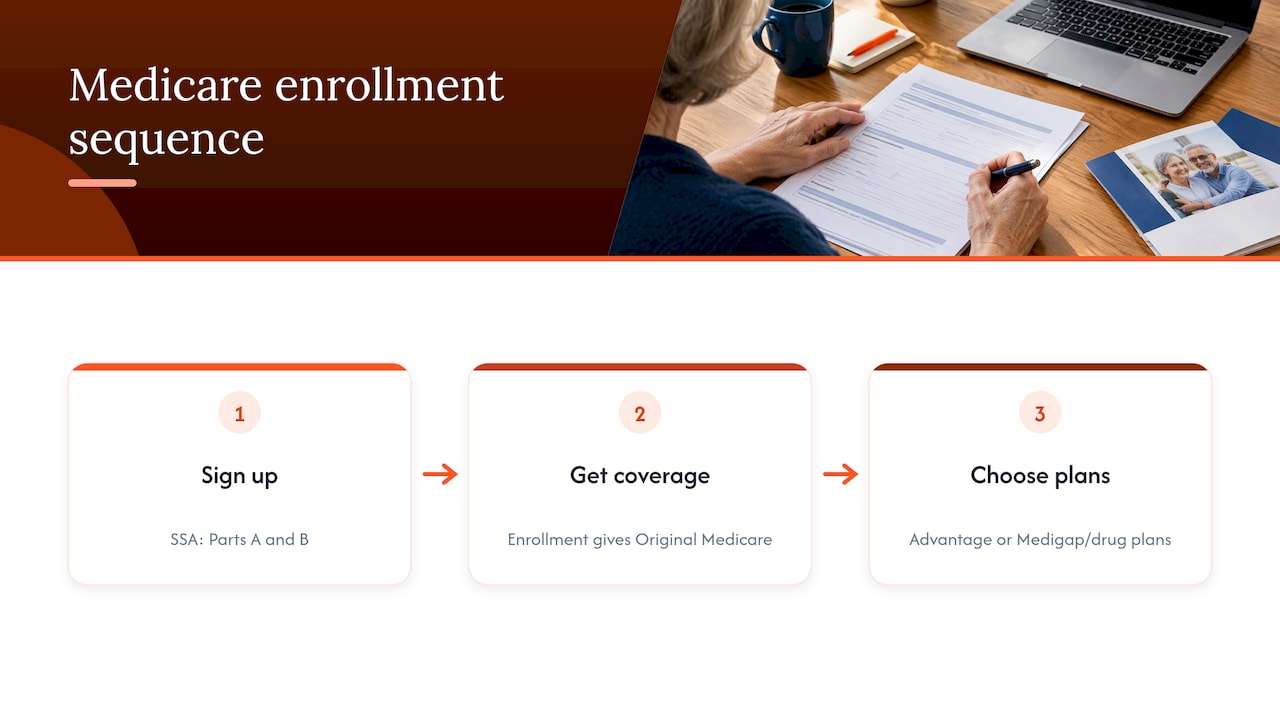
A common misunderstanding is that you should contact Medicare directly. The SSA handles it. Part A and Part B sign-up goes through Social Security, while Medicare.gov is where you later compare and choose plans. Medicare decisions happen in stages: first sign up, then pick the coverage that fits.
That sequence matters. Enrollment gets you Original Medicare. Choosing a Medicare Advantage plan, a Medigap policy or a drug plan is a separate step, handled with private carriers.
Who is eligible if they never claim Social Security
You don’t need to be drawing a check, but you do need to meet Medicare’s basic rules. According to Medicare.gov, you must be a U.S. citizen, U.S. national, lawful permanent resident, Cuban-Haitian entrant, or COFA migrant. Green card holders must have lived in the U.S. continuously for at least five years immediately before the month they apply for Part B.
Two details trip people up:
- A Social Security number is required. The application uses it to verify identity and eligibility. It is no longer printed on the Medicare card, but you still need one to apply.
- Work history affects cost, not access. If you have never worked or worked fewer than 10 years, you can usually still enroll, but Part A may not be premium-free. CMS lists a full Part A premium of $565 a month in 2026 for people with fewer than 30 quarters of coverage who qualify to buy it. A spouse’s work record can sometimes change this, so ask the SSA about your specific record.
How to apply for Medicare only, step by step
The SSA has a page just for people who want Medicare but not monthly cash benefits at this time. The usual path:
- Check your timing. The SSA advises applying online if you are within three months of turning 65, you want Medicare and have not applied before, and you live in the U.S. or a territory.
- Gather your details. Have your Social Security number, proof of age and citizenship or immigration status, and information on any employer coverage ready.
- Choose the Medicare-only application. On SSA.gov, apply for Medicare and state that you do not want retirement benefits yet.
- Report other coverage honestly. If you or a spouse is still working with an employer group health plan, that affects whether you should take Part B now.
- Watch for your card and premium notices. Then turn to plan choices.
If you prefer not to use the website, you can call the SSA at 1-800-772-1213 (TTY 1-800-325-0778) or contact your local Social Security office. If you live in Charlotte, our team can walk you through the paperwork, but the application itself is filed with the SSA.
For a broader overview of the process, see our guide on how to enroll in Medicare and our piece on when you should enroll.
How you pay premiums when there is no Social Security check
Most people have the Part B premium taken out of their Social Security payment. If you aren’t collecting benefits, there is nothing to deduct from, so Medicare bills you directly.
What to expect:
- Quarterly bills. You receive a Medicare Premium Bill (CMS-500) every three months, not monthly. Many people are surprised by the larger amount.
- Payment options. You can pay through your online Medicare account, set up Medicare Easy Pay for automatic deductions from a bank account, or mail a payment.
- The amount. The standard Part B premium for 2026 is $202.90 a month, and higher earners pay more through income-related adjustments (IRMAA).
- Deadlines. Paying late can put you in delinquent status and risk your coverage, so treat the due date seriously. Easy Pay is the simplest safeguard.
At a quarterly rate, three months of the standard premium comes to $608.70 (3 x $202.90). Put that on your calendar and in your budget, because it arrives as one bill.
Should you take Part B at 65 at all?
Not everyone must. Part B is optional if you have other qualifying coverage, most often from an active job. If you do not, skipping it is expensive.
Medicare.gov advises signing up during your Initial Enrollment Period unless you have other coverage similar in value, such as employer coverage. Otherwise you may owe a late enrollment penalty: a 10% surcharge on the Part B premium for every full 12-month period you could have had Part B but didn’t, and it lasts as long as you have Part B.
Here is a worked example. Say you wait three full years past your eligibility. Your surcharge would be 30% of the standard premium, which on $202.90 is about $60.87 a month, added for life. Our Part B late enrollment penalty calculator lets you run your own dates, and our guide to avoiding Medicare penalties at 65 explains the proof of coverage you may need.
Situations where waiting may be fine:
- You or your spouse is still working for an employer and covered by that employer’s group plan. You may qualify for a Special Enrollment Period when that coverage ends. Read our Special Enrollment Period life events guide before you decide.
- You have other coverage that Medicare.gov treats as similar in value. Confirm with your plan administrator in writing, not by assumption.
Situations where waiting is risky:
- You buy coverage on the Marketplace or individually. Medicare advises signing up when first eligible even with Marketplace or other individual coverage, to avoid a delay in coverage and possible penalties.
- You are retired and on COBRA or a retiree plan. These often do not protect you from the Part B penalty in the way active employment does, so verify before you skip Part B.
If you are keeping a health savings account while you work, check the rules for how you use it. A guide to using an HSA for telehealth visits before the deductible can help you understand how those accounts work in day-to-day care, but your HSA contribution eligibility ends once you enroll in Medicare, so confirm timing with a tax professional.
The Medigap window you can lose by delaying
This is the trap we see people overlook. The Medigap Open Enrollment Period lasts six months and begins the first month you have Part B and are 65 or older. It happens once and does not repeat. During it, carriers generally can’t turn you down or charge more because of your health history.
Miss it and you may face medical underwriting, meaning higher premiums or denial based on pre-existing conditions. So the decision about when to start Part B is also a decision about when your guaranteed access to Medigap begins.
If you are delaying Part B because of employer coverage, plan the Medigap start date for when that coverage ends and Part B begins. Our page on locking in Medigap during your six-month window covers the timeline, and Medicare Supplement (Medigap) plans explained shows what the lettered plans do.
Part D and Advantage: don’t forget the other pieces
Enrolling in Parts A and B does not give you drug coverage. Part D has its own late penalty if you go without creditable drug coverage, so check our Part D late enrollment penalty calculator and Medicare Part D explained.
You then choose between two broad paths: Original Medicare plus a Medigap policy and a drug plan, or a Medicare Advantage plan that bundles coverage. Our comparison of Medicare Advantage vs. Medicare Supplement lays out the trade-offs in premiums, provider networks and out-of-pocket costs. Mind the calendar too: the annual window that runs October 15 to December 7 is covered in our Medicare open enrollment dates guide.
Our perspective: treat Social Security and Medicare as two separate decisions
At Safeguard Benefit Services, we see the same pattern in Charlotte. Someone decides to wait on Social Security until 70, which is a sound financial choice for many people, and assumes Medicare will sort itself out. It doesn’t. The retirement decision is about income. The Medicare decision is about a deadline, and the deadline is unforgiving.
Our advice is to settle three things at least three months before your 65th birthday: whether you have coverage that truly lets you wait on Part B, how you’ll pay premiums if no check exists to deduct from, and when your Medigap window should open. Once those are clear, the plan choice becomes much easier.
We train our agents extensively so the guidance you get is educational first and never pushes a plan. Our help comes at no extra cost to you, and we review your plan every year because drug lists, networks and premiums change.
— Zach
Get a plan lined up while you wait on Social Security
If you’re in North Carolina and approaching 65, we can help you coordinate your Medicare start date with Advantage, Supplement and prescription drug options, and give you a free Medicare roadmap. Start at Safeguard Benefit Services or look at our Medicare Supplement plans in Charlotte.
FAQ
Can you enroll in Medicare but not Social Security?
Yes. You can apply for Medicare only through the SSA and keep delaying your retirement benefits. You will be billed directly for Part B since there is no benefit to deduct from.
How do I pay for Medicare if I’m not getting Social Security?
Medicare sends a premium bill every three months. You can pay through your online Medicare account, set up Medicare Easy Pay, or mail a payment. Pay by the due date to avoid delinquency.
Can I apply for Medicare without a Social Security number?
In general, no. The application uses your number to verify identity and eligibility. If you don’t have one, contact the SSA about your situation before your enrollment window closes.
Can non-U.S. citizens enroll in Medicare?
Some can. Lawful permanent residents qualify after living in the U.S. continuously for at least five years before the month they file for Part B, and certain other groups are listed on Medicare.gov. Citizenship or status documents will be part of your application.
Sources
- Sign up for Medicare | SSA
- If You Want Medicare But Not Monthly Cash Benefits At This Time | SSA
- Apply Online for Medicare, Even if You Are Not Ready To Retire | SSA
- How does Medicare work? | Medicare.gov
- How to pay Part A and Part B premiums | Medicare.gov
- Medicare Premium Bill (CMS-500) | Medicare.gov
- Avoid late enrollment penalties | Medicare.gov
- Choosing a Medigap Policy | Medicare.gov
- 2026 Medicare Parts A & B Premiums and Deductibles | CMS
Recommended
Request a No Obligation Phone Call








Get Connected