
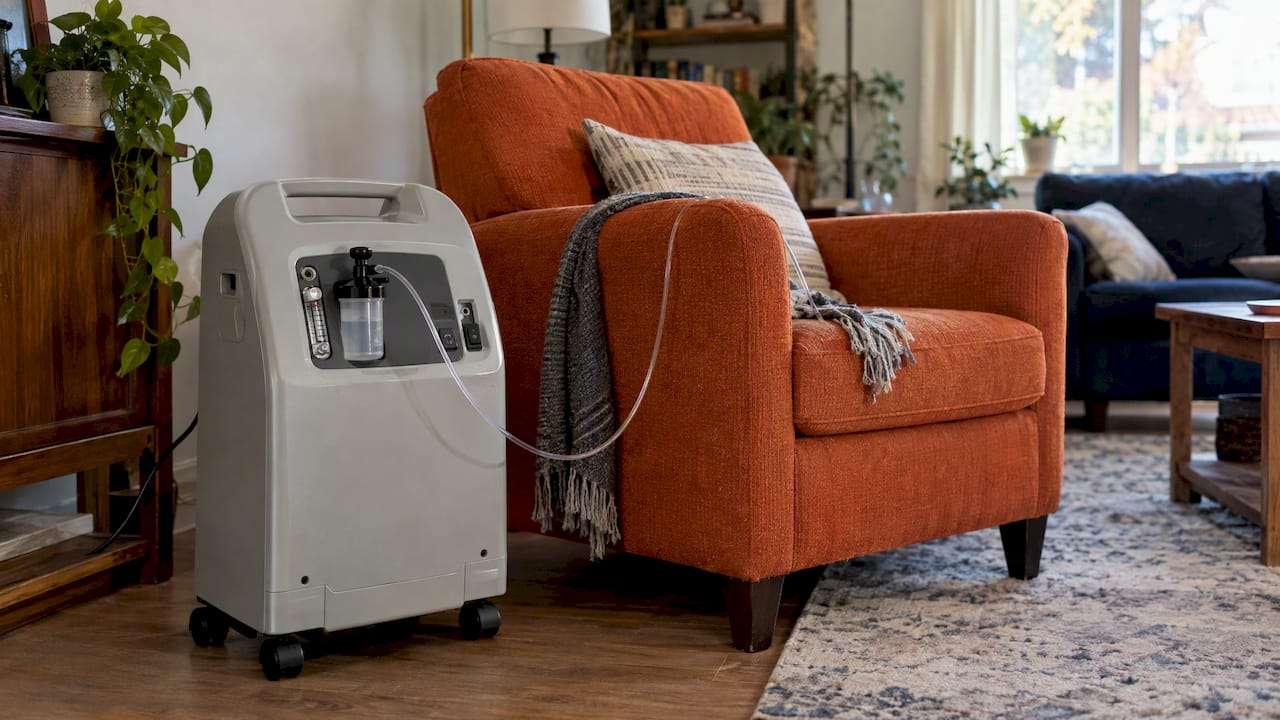
Yes, Medicare covers home oxygen therapy, but only when your doctor documents that you need it and a test shows low blood oxygen. Original Medicare pays through Part B as durable medical equipment (DME). After the Part B deductible you generally pay 20% of the Medicare-approved amount, as long as your supplier is enrolled in Medicare and accepts assignment. This guide walks through who qualifies, what the rental covers, what it costs, and what changes if you have a Medicare Advantage plan.
TL;DR
- Original Medicare Part B covers home oxygen equipment, oxygen contents, tubing, accessories, maintenance and servicing when you meet the eligibility rules.
- Qualifying generally rests on an arterial blood gas test or oxygen saturation reading, plus your doctor’s statement that oxygen should help.
- After the Part B deductible, you typically pay 20% of the Medicare-approved amount when the supplier accepts assignment.
- Medicare rents the equipment for 36 months, and the supplier must keep providing it for up to 5 years from when you started.
- Medicare Advantage plans must cover what Original Medicare covers, but supplier networks, costs and approvals can differ, so check with your plan first.
Table of Contents
- What Medicare covers for home oxygen
- How to qualify for Medicare oxygen coverage
- How to get your oxygen equipment covered
- What oxygen costs with Medicare
- The 36-month rental and what happens after
- Original Medicare vs. Medicare Advantage for oxygen
- Our perspective: plan for oxygen before you need it
- Get help comparing plans in North Carolina
- Common mistakes that delay or deny oxygen coverage
- FAQ
- Sources
What Medicare covers for home oxygen
Medicare.gov says Part B covers oxygen equipment and accessories when you meet the requirements. That includes:
- The oxygen delivery system (a concentrator, or portable tank or liquid systems)
- Containers that store oxygen
- Tubing and related supplies
- The oxygen itself (the contents)
- Necessary accessories
- Maintenance and servicing
Oxygen equipment counts as durable medical equipment. Depending on the item, Medicare may rent it, buy it, let you choose between renting and buying, or transfer ownership after required rental payments. For oxygen, the rule that matters most is the rental period, covered below.
This article is about oxygen you use at home or on the go. Hyperbaric oxygen therapy, where you sit in a pressurized chamber, is a different benefit with its own condition list. It is typically given in a hospital or outpatient setting, and you would ask the treating provider whether your condition is on Medicare’s approved list.
How to qualify for Medicare oxygen coverage
There are two parts to qualifying: the test result and the doctor’s statement.
The blood-gas evidence
CMS’s national coverage determination for home oxygen (NCD 240.2) considers oxygen reasonable and necessary for patients with significant low blood oxygen (hypoxemia) who meet its documentation, lab and health-condition requirements. The national coverage determination sorts patients into two groups:
| Group | Typical test result | Extra requirements |
|---|---|---|
| Group I | PO2 of 55 mm Hg or lower, or oxygen saturation of 88% or lower | Measured at rest, during qualifying sleep, or during exercise with documented improvement from oxygen |
| Group II | PO2 of 56 to 59 mm Hg, or saturation of 89% | Plus specified findings, such as certain heart or lung-related conditions |
These numbers are the benchmark your doctor and supplier work from. You do not need to memorize them. What you need is for the test to be done and recorded properly, because the supplier cannot bill Medicare without it.
The doctor’s statement
Medicare.gov adds that your treating doctor or clinician must say you are not getting enough oxygen and that your health may improve with oxygen therapy. Some conditions, such as cluster headaches, may qualify under separate criteria, so ask your doctor if that is your situation.
A practical checklist before your appointment
- Ask your doctor whether you need an arterial blood gas test or a pulse oximetry reading, and whether it should happen at rest, during sleep or with exertion.
- Bring a list of your diagnoses and symptoms (shortness of breath, fatigue, nighttime waking) so the record reflects them.
- Ask the doctor to confirm in writing that oxygen is expected to help your condition.
- Confirm the doctor is enrolled in Medicare.
If you also use a CPAP for sleep apnea, note that its coverage runs on separate rules; our guide to keeping sleep apnea coverage explains them.
How to get your oxygen equipment covered
Medicare’s advice is simple: use doctors and equipment suppliers who are enrolled in Medicare and accept assignment. The supplier must provide the amount of oxygen you need, and cannot switch the type of equipment you use unless your doctor orders a change.
The usual sequence looks like this:
- Qualify. Your doctor documents the test results and need.
- Write the order. The doctor prescribes oxygen, including the flow rate and when you use it.
- Choose a supplier. Pick a Medicare-enrolled supplier that accepts assignment. Ask whether it offers a portable system if you leave the house.
- Delivery and setup. The supplier delivers, sets up and teaches you to use the equipment.
- Ongoing service. The supplier handles refills, maintenance and repairs under the rental.
Our Medicare DME guide covers prior authorization and supplier checks in more detail.
What oxygen costs with Medicare
Does Medicare pay 100% for oxygen? No. Medicare.gov states that after you meet the Part B deductible, you pay 20% of the Medicare-approved amount. The Part B premium applies on top of that for anyone enrolled in Part B.
The word that protects you is assignment. According to Medicare’s durable medical equipment guidance, a supplier that accepts assignment limits your liability to the deductible and the 20% coinsurance. A supplier that does not accept assignment can charge more, and that is where surprise bills come from. For how Part B overage works, see our explainer on Part B excess charges.
A worked example
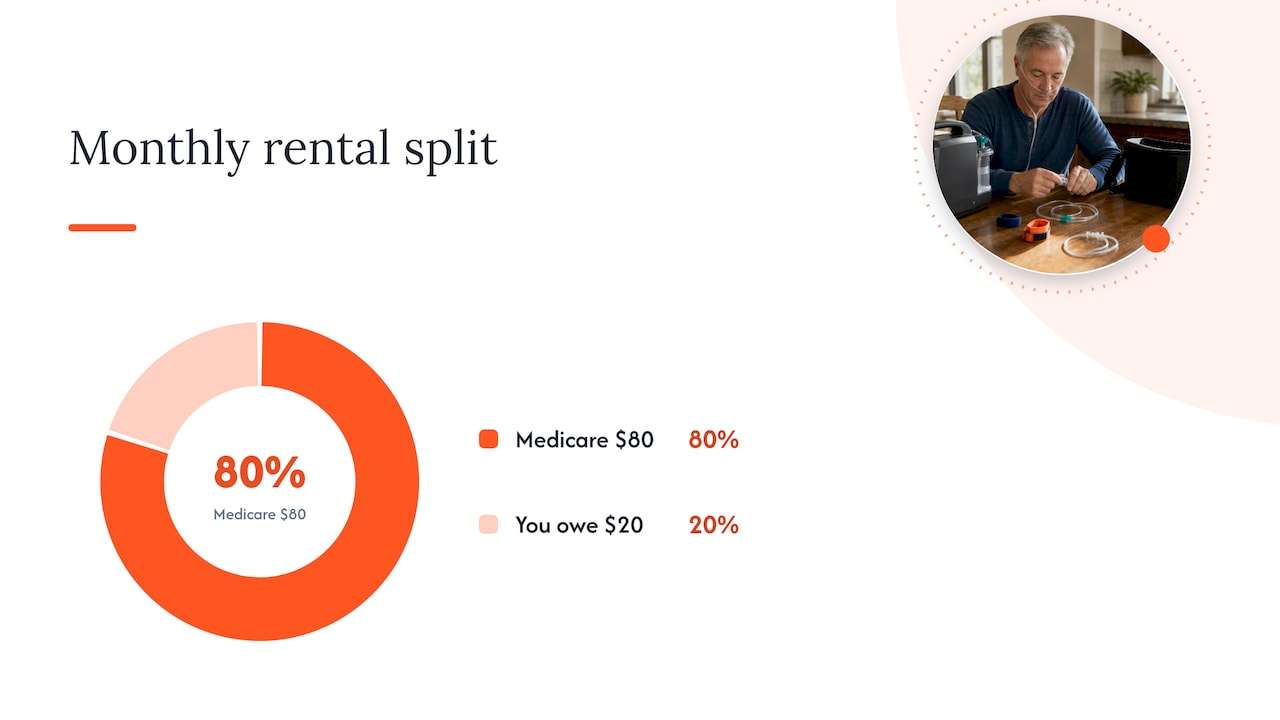
Suppose, purely as an illustration, that the Medicare-approved amount for your monthly oxygen rental is $100 and you have already met your deductible. You would owe $20 and Medicare would pay $80. If you have not met the deductible, you pay the approved amount until you do. These figures are made up to show the mechanics; your actual approved amount depends on your equipment and the Medicare fee schedule, so ask your supplier for it before you sign.
To see how deductibles, premiums and coinsurance stack up across all of Medicare, read our guide to Medicare costs in 2026 or the quick out-of-pocket estimate.
Who covers the 20%?
Many people with a Medicare Supplement (Medigap) plan have the Part B coinsurance covered, depending on the plan letter. People with Medicare Advantage pay whatever their plan sets. We explain the difference in Medicare Advantage versus Medigap.
The 36-month rental and what happens after
Medicare.gov says you rent oxygen equipment for 36 months. The rental includes the equipment, gaseous or liquid oxygen refills, tubing or mouthpieces, other necessary accessories, and maintenance and servicing.
After 36 months, Medicare stops paying for the equipment itself, but the supplier must still furnish the oxygen and equipment for as long as you need it, up to 5 years from the day you started. If you still need oxygen after 5 years, you can get new equipment, and a new 36-month payment period begins.
Two practical points follow from that:
- The supplier in month 36 stays responsible. You do not need to shop for a new supplier at the 3-year mark just because the rental payments ended.
- Keep your paperwork. Dates of first use, delivery receipts and your doctor’s orders make any later switch of supplier or equipment simpler.
Original Medicare vs. Medicare Advantage for oxygen
This is where many readers get surprised. By law, Original Medicare and Medicare Advantage must cover the same medical services, but the rules around how you get them differ. Medicare Advantage coverage varies by plan, depends on in-network versus out-of-network providers, and often involves prior authorization.
For oxygen, that usually means:
| Original Medicare | Medicare Advantage | |
|---|---|---|
| Covered equipment | Part B DME benefit | At least the same coverage as Original Medicare |
| Choosing a supplier | Any Medicare-enrolled supplier that accepts assignment | Often a plan network |
| Your cost | Part B deductible, then 20% | Set by the plan (copay or coinsurance) |
| Approvals | Doctor’s order and documentation | Plan may add prior authorization |
Before you pick a supplier under Medicare Advantage, call your plan and ask who is in network, what you will pay monthly, and whether it needs approval first. If you are weighing plan types, how networks work matters, and PPO versus HMO networks explains how that choice affects which providers you can use and what you pay.
If you are on Original Medicare and expect to need oxygen, a Medigap plan can cut the 20% you would otherwise pay. If you prefer a managed plan, our Medicare Advantage guide shows what to check. Our Medigap guide covers the other path.
Our perspective: plan for oxygen before you need it
At Safeguard Benefit Services, we see the same pattern with equipment like oxygen. People choose a plan based on premiums and the doctors they see today, then find out months later that a health change brought a supplier network, a prior authorization step or a 20% bill they did not plan for. Oxygen is a good example, because the need can arrive after a hospital stay or a lung diagnosis, and the decisions come quickly.
Our agents go through a comprehensive training program so that we can explain these trade-offs plainly rather than steer you toward one product. Our guidance costs you nothing extra. If you are on Original Medicare, we ask whether a supplement makes sense for your coinsurance. If you are on Medicare Advantage, we look at the plan’s DME network and approval rules, and we review your plan each year, since networks and costs can change.
One caution from experience: do not drop or switch coverage because you are worried about oxygen costs without comparing it with how your current plan treats DME. Call us or your plan first.
— Zach
Get help comparing plans in North Carolina
If you live in Charlotte or elsewhere in North Carolina and want to see how your current coverage would handle oxygen or other equipment, we can walk you through it. We help with Medicare Advantage plans, Medicare Supplements, Part D and more, and we can build you a free Medicare roadmap that lays out your options and eligibility. You can also start with our Medicare eligibility calculator.
If a hospital stay is a worry, our hospital indemnity insurance page explains a plan type that pays cash benefits toward costs Medicare leaves behind.
Common mistakes that delay or deny oxygen coverage
- Using a supplier that does not accept assignment. This can raise your costs beyond the 20%.
- Missing or incomplete test results. Without qualifying blood-gas evidence in the record, Medicare will not pay.
- Assuming Advantage works like Original Medicare. Networks and approvals can differ, so check first.
- Letting the supplier change equipment on its own. The supplier cannot change the equipment type unless your doctor orders it.
- Ignoring service needs after month 36. Ask what maintenance visits you can expect so you are not caught off guard by coinsurance.
FAQ
Does Medicare pay 100% for oxygen?
No. After the Part B deductible, you generally pay 20% of the Medicare-approved amount if your supplier accepts assignment. A Medicare Supplement plan may cover that 20%, depending on the plan, and Medicare Advantage plans set their own cost sharing.
How do I qualify for Medicare oxygen coverage?
You need a qualifying blood-gas result, such as a low PO2 or low oxygen saturation measured under the conditions CMS describes. Your doctor must also state that you are not getting enough oxygen and that therapy may improve your health. Your supplier and doctor must both be enrolled in Medicare.
How long will Medicare rent me oxygen equipment?
Medicare rents oxygen equipment for 36 months. After that, the supplier must keep providing the equipment and oxygen as long as you need it, up to 5 years from when you started. After 5 years, you may get new equipment and a new 36-month period.
Does Medicare Advantage cover oxygen?
Yes, Medicare Advantage plans must cover what Original Medicare covers. They can, however, require in-network suppliers, set their own copays and ask for prior authorization, so call your plan before ordering equipment.
Sources
- Oxygen equipment & accessories, Medicare.gov
- Durable Medical Equipment Coverage, Medicare.gov
- NCD: Home Use of Oxygen (240.2), CMS Medicare Coverage Database
- The Big Choice: Original Medicare vs. Medicare Advantage, AARP
Recommended
Request a No Obligation Phone Call








Get Connected