

A zero premium Medicare Advantage plan has no monthly premium of its own. You still pay your Medicare Part B premium, which is $202.90 a month in 2026, and you still pay copays, coinsurance and sometimes a deductible when you use care. “$0” describes one line of your costs. It does not describe the whole bill.
That is not a reason to avoid these plans. For many people in Charlotte and across North Carolina, they are a sensible fit. This guide explains why they exist, what they cost once you use them, where they can trip people up, and how to compare two plans that both advertise $0.
TL;DR
- A $0 premium means no separate monthly plan premium. You keep paying the Part B premium ($202.90 in 2026) to stay enrolled.
- Zero premium plans are the norm, not the exception: 67% of Medicare Advantage plans with drug coverage charge $0, and 98% of beneficiaries can reach at least one.
- Compare the out-of-pocket maximum, copays, drug formulary, network and prior authorization rules. Two $0 plans can cost very different amounts in a bad year.
- You cannot pair a Medicare Advantage plan with Medigap or a standalone drug plan.
- Review your Annual Notice of Change every fall, because a plan can keep the $0 premium and still change everything else.
Table of Contents
- What “zero premium” actually means
- Why insurers can charge $0
- How common are $0 plans in 2026?
- Where the real costs hide
- What you give up when you choose Medicare Advantage
- Who tends to do well on a $0 plan
- A worked comparison of two $0 plans
- Check it every fall
- Don’t let a Part B penalty undercut the savings
- How we think about $0 plans
- Get help comparing plans in Charlotte
- FAQ
- Sources
What “zero premium” actually means
Medicare Advantage, also called Part C, is a Medicare-approved plan from a private company that replaces Original Medicare for your health coverage. It bundles Part A (hospital) and Part B (medical), and most plans add Part D drug coverage.
A zero premium plan simply charges nothing extra each month for that bundle. Three things stay the same:
- You still owe Part B. The same document states you must keep paying your Part B premium to remain in any Medicare Advantage plan. The Social Security Administration lists the 2026 standard premium at $202.90.
- You still owe cost sharing. Copays, coinsurance and possibly a deductible apply when you see a doctor, go to the hospital or fill a prescription.
- You still follow the plan’s rules. That means a network, and often prior authorization for certain services.
If your income is above the thresholds, your Part B bill is higher regardless of plan. For 2026, the income-related adjustment applies when your 2024 modified adjusted gross income was above $109,000 (individual) or $218,000 (married filing jointly). A $0 plan does not remove that surcharge.
Want to double-check your own Part B figure? Our page on how to verify your 2026 Part B premium walks through it.
Why insurers can charge $0
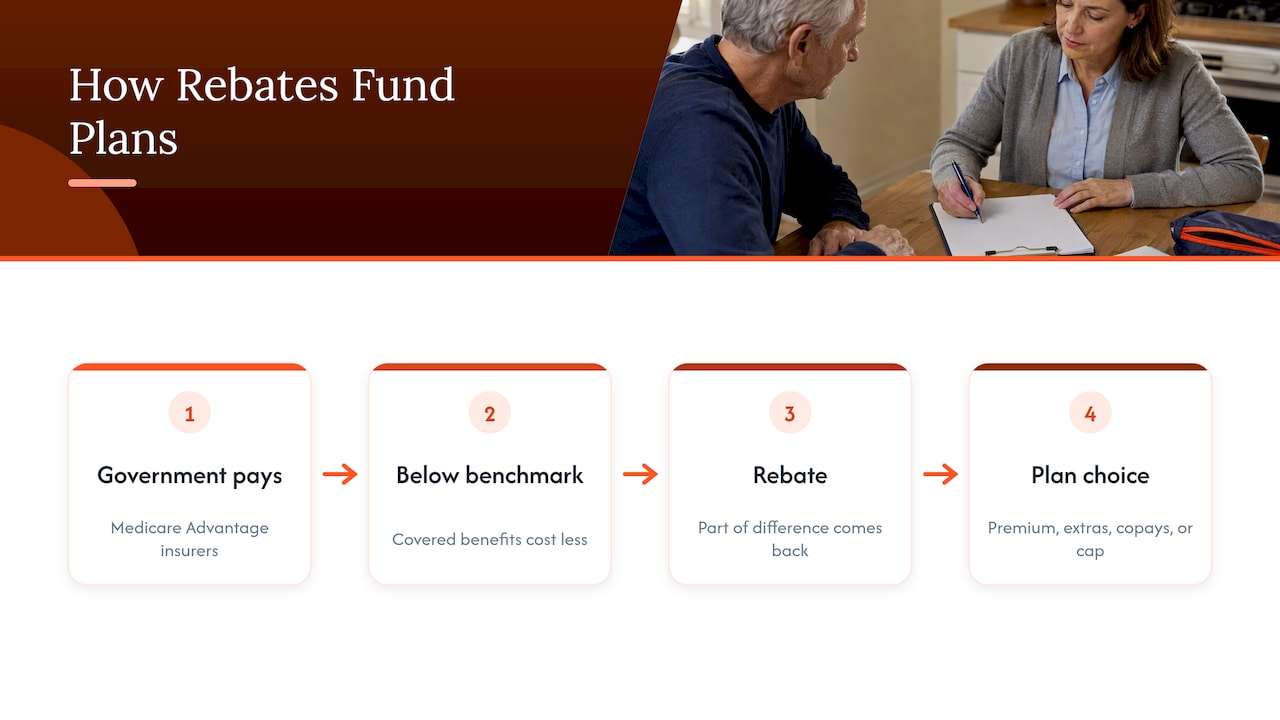
The plan isn’t giving away anything. The federal government pays Medicare Advantage insurers, and when a plan can deliver Medicare-covered benefits for less than the government’s benchmark, part of the difference comes back as a rebate. KFF explains that plans use those rebates to fund extra benefits such as dental, vision and hearing, or to lower the monthly premium.
So each plan makes a choice about where to spend its rebate dollars: a lower premium, richer extras, lower copays or a smaller out-of-pocket cap. A plan that spends heavily on the premium may have less left for something else. The same logic explains why extras like dental allowances show up in plans that cost you nothing monthly. If you’re curious how those extras differ from buying a standalone policy, see our comparison of Medicare dental, vision and hearing benefits in Advantage plans versus standalone coverage.
How common are $0 plans in 2026?
Very common. According to KFF’s 2026 analysis:
| Measure | 2026 figure |
|---|---|
| Share of MA-PD plans with a $0 monthly premium | 67% |
| Beneficiaries with access to at least one $0 MA-PD | 98% |
| Estimated average MA-PD premium | $14.00 a month |
| Standard Part B premium | $202.90 a month |
Source: KFF, Medicare Advantage 2026 Spotlight; Part B figure from SSA.
Because $0 is so common, it is a poor tiebreaker. When most of the plans in your county charge nothing, the premium stops telling you which one is better. Our deeper breakdown of what Medicare Advantage costs on average and at the maximum shows where the real differences sit.
Where the real costs hide
The premium is one piece. These are the lines that decide what you actually spend.
The out-of-pocket maximum
Every Medicare Advantage plan has a yearly cap on what you pay for covered in-network services. Plans with the same $0 premium can set very different caps. If you have a hospital stay or a cancer diagnosis, this number matters more than anything else on the plan summary. We lay out the 2026 limits in our guide to Medicare Advantage out-of-pocket maximums.
Copays and coinsurance
Look at the specialist copay, the emergency room copay, the cost of imaging, and the per-day hospital charge. A plan with a $0 premium and a $50 specialist copay is a very different product for someone who sees a cardiologist monthly than for someone who rarely goes to the doctor.
Cost sharing can also change depending on what happens during a visit. Even a routine screening can produce a coinsurance charge if it turns diagnostic, as this explainer on how Medicare colonoscopy coverage can bring a 15% charge shows. Ask how your plan treats screening versus diagnostic services before you need one.
Drug coverage
Most Medicare Advantage plans include Part D, which is why the KFF premium numbers focus on MA-PD plans. Check that your medications are on the formulary, which pharmacies are preferred, and which tier each drug sits on. You also cannot add a separate drug plan: Medicare’s guide states you cannot hold a Medicare Advantage plan and a standalone drug plan at the same time.
Networks
Most plans are built around a network of doctors and hospitals. A $0 plan is no bargain if your cardiologist or the hospital you trust is out of network. Confirm each provider yourself, with the provider’s office, not just the plan’s online directory. We outline the process in three steps to confirm your Advantage network.
Prior authorization
Many plans require approval before covering certain treatments, drugs or procedures. Medicare’s guide warns that denials are possible and plans may apply internal coverage criteria in addition to Medicare’s. The Government Accountability Office has also looked at this: a 2025 GAO report on CMS oversight of prior authorization criteria found that internal criteria can get in the way of care, with a focus on behavioral health services. If you rely on frequent specialist care, ask which services need approval.
What you give up when you choose Medicare Advantage
The $0 premium is partly possible because the plan manages your care. The trade is real, and you should make it with your eyes open.
- No Medigap. Medicare says you cannot have both a Medicare Advantage plan and a Medigap policy. Joining an Advantage plan means dropping Medigap.
- Going back can be hard. If you later return to Original Medicare, you may not be guaranteed the right to buy your old Medigap plan back, and depending on state law you might face medical underwriting, according to the same Medicare page.
- A network instead of any Medicare provider. Original Medicare with Medigap generally gives you wider provider choice, and in exchange you pay a monthly Medigap premium.
Neither path is right for everyone. If you’re weighing them, our comparison of Medicare Advantage versus Medicare Supplement goes through who tends to do better under each.
Who tends to do well on a $0 plan
A zero premium plan usually fits you best when:
- You are relatively healthy and want predictable, modest copays plus dental, vision and hearing extras.
- Your doctors and preferred hospital are in the plan’s network.
- Your medications sit on low tiers of the formulary.
- You are comfortable with a yearly out-of-pocket cap that could reach a few thousand dollars in a bad year, and you have savings that could handle it.
It may fit less well when:
- You have a complex condition and see several specialists, some outside any network you can find.
- You split time between states, so a local network won’t help you for part of the year.
- You want the most predictable cost at the point of care and are willing to pay a Medigap premium for it.
A worked comparison of two $0 plans
The numbers below are hypothetical, to show how to think about it, not real plan data.
| Plan A | Plan B | |
|---|---|---|
| Monthly plan premium | $0 | $0 |
| Primary care copay | $0 | $10 |
| Specialist copay | $45 | $30 |
| Hospital stay | Higher daily copay | Lower daily copay |
| Out-of-pocket maximum | Higher | Lower |
| Dental allowance | Larger | Smaller |
For someone who sees a specialist twice a month, Plan B could save hundreds of dollars a year, and the lower out-of-pocket cap protects against a hospital stay. For someone who rarely sees a doctor and wants better dental, Plan A may win. The premium line tells you nothing about this choice. That is why we look at the full set of costs next to your doctor list and prescription list.
Check it every fall
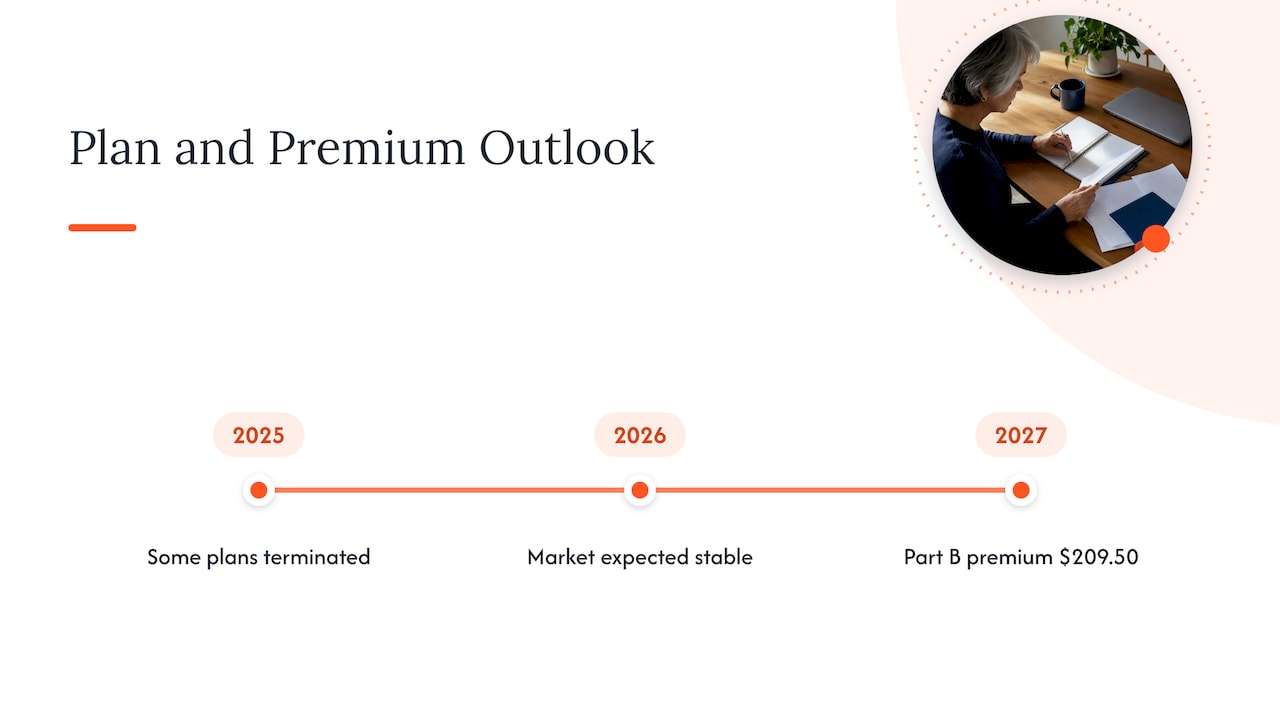
A plan that is $0 this year may not be next year, and even if the premium stays at zero, other terms can change. Insurers can adjust networks, drug formularies and cost sharing each year. The CMS says the market is expected to stay stable in 2026, and KFF notes that some plans were terminated in 2025 even though most affected people still have strong options in 2026. Plans do leave, so don’t assume yours is permanent.
Your Annual Notice of Change is the document that spells it out. Read it when it arrives in the fall, and compare it to your doctor and drug list before the annual enrollment window closes. Our page on the Annual Notice of Change tells you what to look for.
On the Part B side, the 2026 Trustees Report projects the standard premium rising to $209.50 in 2027. That is a projection, and CMS sets the actual amount. Since you pay Part B on top of any plan, it will raise your total cost even if your plan premium stays at $0.
Don’t let a Part B penalty undercut the savings
The zero premium only helps if you are enrolled in Part B in the first place. If you skip Part B when you are first eligible and have no qualifying coverage, the late enrollment penalty adds 10% to your premium for each full 12-month period you could have had it, and it lasts as long as you have Part B. If you’re still working, the deadline to delay Part B is tighter than most people think. You can estimate your exposure with our Part B late enrollment penalty calculator, or read how to avoid the Part B penalty.
How we think about $0 plans
We are a Charlotte agency, and we hear the same question every fall: “If it’s $0, why would I look at anything else?” Our answer is that the premium is the easiest number to compare and the least useful one.
We train our agents to start from the client’s situation, not from a plan list. That means asking which doctors you see, which medications you take, how often you’ve been hospitalized, and how much of a surprise bill you could absorb. A $0 plan is often the right answer, and when it is, we say so. When it isn’t, we explain why, and we’d rather you know that before you enroll than after your first claim.
Our guidance costs you nothing extra, and we stay with you after you enroll through annual plan reviews. The reviews matter because the plan you chose last year isn’t guaranteed to look the same this year.
— Zach
Get help comparing plans in Charlotte
If you’re turning 65, retiring or reviewing your current plan, we can compare the zero premium Medicare Advantage plans available to you, check your doctors and prescriptions against each, and show you the out-of-pocket maximums side by side. We also offer a free Medicare roadmap that lays out your eligibility and options. Start at Safeguard Benefit Services and tell us what you need.
FAQ
Are $0 premium Medicare Advantage plans really free?
No. You pay no separate plan premium, but you still pay your Part B premium, which is $202.90 a month in 2026. You also pay copays, coinsurance and any deductible when you use care, up to the plan’s yearly out-of-pocket maximum.
Can I have Medicare and Medicare Advantage at the same time?
You stay in the Medicare program, but the Advantage plan replaces Original Medicare for how you get your coverage. You must keep paying your Part B premium. You can’t also hold a Medigap policy or a separate drug plan while enrolled.
Does the federal government subsidize Medicare Advantage plans?
Yes. The government pays private insurers to run these plans, and plans that deliver benefits for less than the benchmark receive rebates. They use those rebates to lower premiums and fund extras like dental, vision and hearing, according to KFF.
What is the income limit to avoid higher Medicare premiums?
For 2026, the surcharge applies when your 2024 modified adjusted gross income was above $109,000 as an individual or $218,000 for married couples filing jointly, per the SSA. The surcharge is added to Part B and applies no matter which plan you pick.
Sources
- Understanding Medicare Advantage Plans, Medicare.gov
- Medicare Advantage 2026 Spotlight: A First Look at Plan Premiums and Benefits, KFF
- Most Medicare Beneficiaries Affected by Plan Terminations in 2025 Have Robust Options in 2026, KFF
- Medicare Premiums, Social Security Administration
- Learn How Medigap Works, Medicare.gov
- CMS: Medicare Advantage and Prescription Drug Programs Expected to Remain Stable in 2026
- GAO: CMS Oversight of Prior Authorization Criteria
- Medicare Part B premium projected to rise in 2027, Yahoo
- U.S. Colonoscopy Coverage: When Medicare May Charge 15%
Recommended
Request a No Obligation Phone Call








Get Connected